

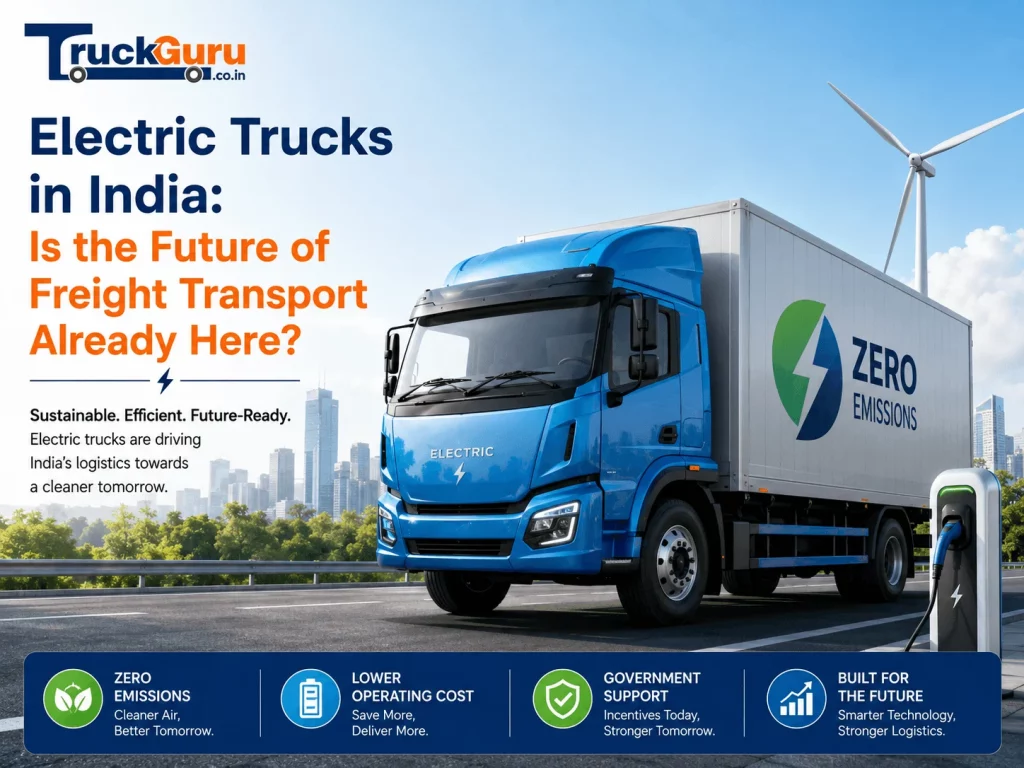
Electric Trucks in India: Is the Future of Freight Transport Already Here?
India added over 1.5 lakh electric commercial vehicles in 2023, according to Vahan data. That number is growing. The government has set ambitious EV targets, charging infrastructure is expanding, and several manufacturers have launched electric trucks designed specifically for Indian road conditions.
But for the businesses actually moving freight — manufacturers, distributors, fleet operators — the practical question is not whether EV trucks will eventually dominate. It is whether they are viable for the specific routes, loads, and operational patterns that define Indian B2B logistics today.
The honest answer, as of now, is: partially. EV trucks work well in certain freight categories and fail in others. Understanding the distinction matters more than the headline numbers.
Businesses looking to book intercity FTL freight today can check current rates on the TruckGuru freight calculator.
The State of Electric Trucks in India
India’s electric commercial vehicle (ECV) adoption is being driven primarily by last-mile and intra-city categories — three-wheelers, light commercial vehicles, and small delivery vans. These are the segments where range limitations are manageable and charging infrastructure is most accessible.
For medium and heavy commercial vehicles — the segment that handles intercity freight — the picture is more complex. Key players active in this space as of 2024 include:
- Tata Motors: Tata Ace EV (light commercial, ~154 km range declared), Tata Ultra Electric (medium category)
- Olectra Greentech: partnered with BYD for heavy electric buses; expanding into trucks
- Ashok Leyland: Circuit series electric buses; truck variants in development
- Switch Mobility: EV trucks targeted at urban logistics
- VE Commercial Vehicles (Eicher-Volvo JV): piloting electric in select corridors
Most of the commercially available EV freight vehicles in India today are focused on sub-150 km operational radii. For intercity freight — routes of 400 km to 2,000 km — dedicated electric truck options remain limited and the infrastructure to support them even more so.
Why Range Is the Central Challenge
Diesel trucks can cover 600 to 800 km on a full tank, with refuelling taking 10 to 15 minutes at any of India’s 86,000-plus fuel stations. The operating economics are well understood, and the refuelling network is dense enough that range anxiety does not factor into route planning.
Electric trucks face a different arithmetic. Current battery technology delivers practical ranges of 150 to 300 km for loaded commercial vehicles under Indian road conditions, accounting for hills, loaded weight, ambient temperature, and auxiliary power draw. Charging to 80 percent on fast DC chargers takes 60 to 90 minutes — and those chargers are not yet available along most intercity freight corridors.
This gap is not a technology failure — it reflects where the technology is in its development cycle. Battery energy density is improving at roughly 5 to 8 percent per year. Range projections for the 2027 to 2030 period suggest commercial intercity EV trucks could become viable on select high-density corridors. But for most intercity routes in India today, diesel remains the only operationally reliable option.
The Cost Argument: Upfront vs Lifetime
The most commonly cited argument for EV trucks is total cost of ownership (TCO). The logic is straightforward: electric motors have fewer moving parts than diesel engines, fuel costs are lower per km on electricity, and maintenance intervals are longer.
The calculation holds in the right context. For a truck running 150 km per day on a fixed urban delivery route — predictable charge cycles, access to depot charging, no long overnight runs — the TCO case for electric is real and strengthening. NITI Aayog and RMI India have both published analyses showing TCO parity or advantage for EVs in urban freight categories at current electricity tariffs.
For intercity freight, the calculation shifts. A diesel truck running 500 to 800 km per day earns more revenue per asset than an EV truck that needs a 90-minute charging stop mid-route. The driver time cost, the charging infrastructure cost at or near the destination, and the battery replacement cost over a 5-year ownership cycle all factor in. At current battery prices and given current infrastructure, TCO parity for intercity electric trucks is likely 4 to 6 years away on most corridors.
Government Policy and the Push for EVs
FAME-II and Beyond
The Faster Adoption and Manufacturing of Hybrid and Electric Vehicles (FAME-II) scheme provided capital subsidies for electric commercial vehicles. While FAME-II has closed, its successor, PM E-DRIVE (PM Electric Drive Revolution in Innovative Vehicle Enhancement) launched in 2024 with a Rs.10,900 crore outlay covering electric trucks and buses. This significantly improves the economics for fleet operators considering EV adoption.
National Logistics Policy and EV Integration
India’s National Logistics Policy, launched in 2022, targets reducing logistics costs from approximately 14 percent of GDP to below 8 percent. Electrification of short-haul and urban freight is identified as one lever. The DPIIT-NCAER MSME logistics cost data from September 2025 confirms that last-mile and urban freight costs remain disproportionately high — the segment where EV trucks offer the clearest benefit.
State-Level Initiatives
Several states have introduced EV-specific incentives for commercial vehicles, including Maharashtra, Gujarat, and Karnataka. Gujarat’s EV policy, for instance, offers additional subsidies on top of central incentives and has prioritised charging infrastructure along select industrial corridors.
Where EV Trucks Make Sense in Indian Freight Today
Setting aside the long-term trajectory, there are freight categories where electric trucks are already a rational operational choice:
- Urban and last-mile distribution: Fixed routes under 150 km, depot-based charging, predictable load cycles. FMCG distributors in metro cities, e-commerce last-mile operators, and dairy and cold chain operators running overnight return cycles.
- Industrial intra-plant logistics: Plant-to-warehouse or warehouse-to-warehouse runs within an industrial estate or between adjacent facilities. Range is not a constraint and the savings on fuel and maintenance are immediate.
- Port-to-warehouse corridors: Short, high-frequency runs between ports and nearby warehouses or container freight stations. Kandla-Gandhidham, JNPT-Bhiwandi, and similar corridors are candidates.
- Dedicated contractual lanes under 200 km: Shippers with fixed daily lanes and predictable return loads can plan EV charging into the schedule without operational disruption.
For intercity FTL freight — routes of 400 km and above — diesel trucks remain the standard. The infrastructure, range, and total cost economics do not yet support consistent EV operation on most intercity corridors in India.
Charging Infrastructure: The Missing Piece
India had approximately 12,000 public EV charging stations as of early 2024, according to the Ministry of Power. This is growing rapidly, but the distribution is uneven. Most charging stations are concentrated in metro cities and along select highways such as the Delhi-Mumbai Expressway. Tier-2 and Tier-3 cities, where a significant proportion of Indian industrial freight originates, have sparse coverage.
For electric trucks to become viable on intercity freight corridors, the charging network needs to be dense enough that a truck can top up within a 200 km radius at any point on its route. Industry estimates suggest this requires 50,000 to 80,000 truck-capable DC fast chargers across the national highway network — a deployment that is 5 to 7 years away at current installation rates.
The Transition Timeline: A Realistic Assessment
Electric trucks in India are not a distant possibility — they are a present reality for specific freight categories. The question is which categories and over what timeline.
- 2024 to 2026: EV trucks viable for urban, last-mile, and intra-city freight under 150 km. Limited intercity viability.
- 2027 to 2029: Battery costs declining, range improving, charging density on priority corridors increasing. Select intercity lanes become EV-viable for high-frequency operators.
- 2030 and beyond: Policy mandates likely to accelerate adoption. TCO parity expected across most freight categories. Intercity EV freight becomes operationally mainstream on high-density corridors.
For fleet operators and shippers planning capital allocation over the next 3 to 5 years, the decision is not binary. Mixed fleets — diesel for long-haul intercity routes, electric for urban and short-haul — represent the most practical near-term strategy for businesses moving freight at scale.
Key Takeaways
- India’s EV truck adoption is real and accelerating, but concentrated in urban and last-mile categories
- Intercity freight over 400 km remains diesel-dominated due to range limits and charging infrastructure gaps
- TCO advantage for electric trucks is established in urban freight; intercity parity is 4 to 6 years away on most corridors
- Government policy (PM E-DRIVE, state incentives) is significantly improving the economics of EV adoption for fleet operators
- Charging infrastructure deployment on intercity corridors is the critical bottleneck — not the trucks themselves
- Mixed fleets are the most rational near-term strategy for businesses moving freight across both urban and intercity routes
For businesses booking intercity FTL freight today, TruckGuru’s freight calculator gives a confirmed per-km rate across 110+ cities.
FAQ
Are electric trucks available in India?
Yes. Tata Motors, Olectra, Switch Mobility, and Ashok Leyland all offer electric commercial vehicles in India. Most commercially available models are suited to urban and short-haul freight under 200 km. Intercity electric trucks for routes above 400 km are limited as of 2024.
What is the range of electric trucks in India?
Practical loaded range for electric commercial vehicles in India is approximately 150 to 300 km depending on battery size, load weight, road conditions, and temperature. Tata Ace EV has a declared range of around 154 km under standard conditions.
Are electric trucks cheaper than diesel trucks in India?
For urban and last-mile freight under 150 km per day, total cost of ownership for electric trucks is competitive with diesel at current electricity tariffs. For intercity freight, TCO parity with diesel is estimated to be 4 to 6 years away on most corridors.
What government subsidies exist for electric trucks in India?
The PM E-DRIVE scheme launched in 2024 with Rs.10,900 crore for electric commercial vehicles. Several states including Maharashtra, Gujarat, and Karnataka offer additional EV subsidies. These significantly improve the upfront cost economics for fleet operators.
How long does it take to charge an electric truck in India?
DC fast charging to 80 percent takes approximately 60 to 90 minutes for current battery packs used in electric commercial vehicles. AC slow charging at depots takes 6 to 8 hours and is used for overnight charging cycles.
Is charging infrastructure for electric trucks available across India?
As of early 2024, approximately 12,000 public charging stations exist in India, concentrated in metros and select highways. Coverage along Tier-2 and Tier-3 industrial freight corridors is limited. Intercity EV freight viability depends on this infrastructure expanding significantly.
When will electric trucks be used for long-distance freight in India?
Industry and policy projections suggest select intercity corridors could become EV-viable between 2027 and 2029 as battery costs fall and charging infrastructure improves. Broad intercity adoption is most commonly projected for 2030 and beyond.
Should I switch my freight fleet to electric trucks now?
For urban and short-haul routes under 150 km, electric trucks offer real cost and operational advantages today. For intercity freight, a mixed fleet approach — diesel for long-haul, electric for urban routes — is the most practical near-term strategy for most businesses.