

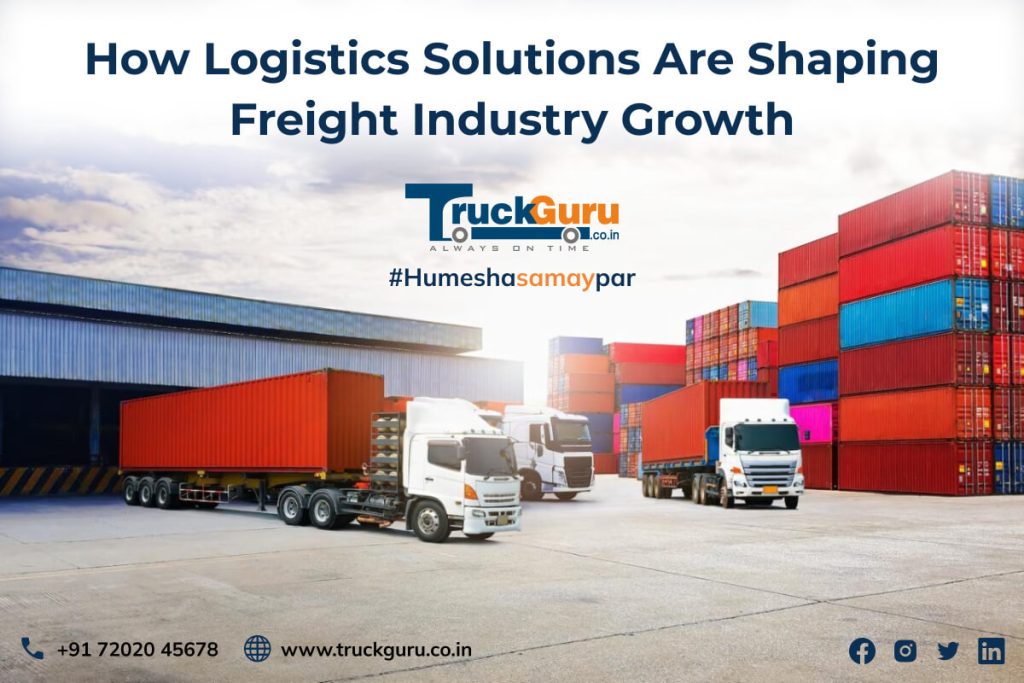
Freight Industry Growth in India: What Is Actually Changing
India’s logistics costs sit at roughly 14% of GDP, against a global norm closer to 8-9%. That gap is the headline number behind most “freight industry growth” coverage, and it is the reason digital booking, better route planning, and infrastructure investment have become a genuine business story rather than a back-office detail. The market is growing — estimates from different research firms vary on the exact figures, so treat any single precise number with some caution — but the more useful question for a business that actually ships goods is not the market size.
Logistics Solutions: Quick Summary
Discover how digital logistics solutions in India drive freight growth with automation, 3PL, AI & smart supply chains. Partner with TruckGuru for success!
It is what specifically has changed about booking and moving freight, and what is still more hype than reality.
What Has Genuinely Changed
Road transport carries roughly two-thirds of India’s freight by most estimates, which is why digital booking platforms for trucking specifically — not logistics in the abstract — have had an outsized effect. The shift from phone-call-and-broker booking to an online platform with a confirmed rate before dispatch is the single biggest practical change for a business that ships regularly. It replaces a process that used to involve calling multiple contacts and negotiating with one, where the price is known before the truck moves.
GPS tracking on most FTL bookings now is also a genuine shift, not a hype claim — a shipper can see where a truck actually is rather than calling the driver to ask. Digital Lorry Receipts and GST-compliant invoicing generated automatically at booking and delivery have similarly replaced paper documentation that used to be a common source of disputes.
Where the Industry Talk Gets Ahead of What Most Businesses Actually Use
A lot of “logistics solutions in India” content bundles together blockchain record-keeping, IoT cargo sensors, AI-driven predictive routing, robotic warehouse automation, and full 4PL supply chain management as if every business adopting “digital logistics” gets all of it at once. In practice, most of these remain pilot programs or apply mainly to large enterprise shippers with the volume and budget to justify them — a mid-sized manufacturer booking FTL transport a few times a week is using a confirmed-rate booking platform and GPS tracking, not blockchain-verified IoT-monitored AI-routed freight.
Third-party logistics (3PL) — outsourcing transport and storage to a specialist — and fourth-party logistics (4PL) — outsourcing entire supply chain management — are real categories, but they describe a different scope of service than booking individual FTL trips. A business deciding between handling its own logistics and outsourcing to a 3PL is making a much bigger decision than choosing which platform to book a truck on.
What a Confirmed-Rate Booking Model Actually Looks Like
Rather than a marketplace connecting a business to a pool of individual truck owners to negotiate with — which is how a lot of “on-demand truck rental” content describes this space — a platform like TruckGuru works on a fixed-rate structure: the price shown for a route and truck size is the price on the invoice after delivery. There is no bidding process and no separate negotiation step. This matters because the marketplace-and-negotiate model, while genuinely useful for matching supply and demand, introduces exactly the price uncertainty that a confirmed-rate model is built to remove.
What Digital Booking Changes in Practice
Illustrative scenario, not a specific client account.
Consider a manufacturer that previously booked trucks by calling two or three known contacts, waiting for callbacks, and confirming a price only once a truck was already en route. Moving to a digital platform with upfront confirmed pricing and GPS tracking removes the callback wait entirely — the rate is known at the moment of booking, not negotiated after the fact.
Delivery timing becomes more predictable because the shipper can see the truck’s actual position rather than relying on a driver’s phone update. None of this requires AI route prediction or IoT sensors to deliver real value — a confirmed rate and live tracking solve the two most common complaints in manual truck booking by themselves.
Where Infrastructure Investment Fits In
Government infrastructure programs are a real and significant part of why freight transit times are improving. Bharatmala is building tens of thousands of kilometres of highway, and Gati Shakti is meant to integrate road, rail, and port planning rather than developing each separately. Officials have publicly set a goal of bringing India’s logistics costs down toward the global norm over the coming years — the exact target and timeline vary by source. They should be verified against a primary government release before being quoted with a specific date.
What This Means for a Business Booking Freight Today
The practical takeaway is narrower than most “future of logistics” content suggests. A business shipping FTL freight today benefits most from three concrete things: a confirmed rate it can budget around, GPS tracking it can show customers, and digital documentation that removes paper-based disputes. Blockchain ledgers and AI-predictive routing are real technologies appearing in parts of the industry, but they are not what is driving the day-to-day improvement most shippers are actually seeing.
Check a confirmed rate for your next shipment on the freight calculator.
Frequently Asked Questions
Why are India’s logistics costs higher than the global average?
India’s logistics costs run close to 14% of GDP against a global norm of roughly 8-9%. Fragmented documentation, historically inconsistent infrastructure quality across regions, and a large unorganised transport sector have all contributed, though this gap has been narrowing as digital booking and infrastructure investment expand.
Does digital truck booking actually save money compared to traditional booking?
The main saving is in price certainty rather than a guaranteed discount — a confirmed rate at booking removes the negotiation and price uncertainty common in phone-based booking. Whether the number itself is lower depends on the route and the operator, not the platform alone.
What is the difference between 3PL and simply booking FTL transport?
3PL means outsourcing transport and storage operations to a specialist provider, managing them on your behalf. Booking individual FTL trips is a narrower transaction — you are booking a single truck for a single shipment, not outsourcing your broader logistics operation.
Are AI and IoT actually used in Indian freight transport today?
In parts of the industry, yes — mainly among larger enterprise shippers with the volume to justify the investment. For most mid-sized businesses booking FTL transport, the more immediate and widely available improvements are confirmed-rate booking and GPS tracking, not AI-driven systems.
Call 72020 45678 or book online at truckguru.co.in for a confirmed FTL rate on your next shipment.
Related Reading
- Reduce Manufacturing Freight Costs: India Intercity Guide
- Reduce B2B Freight Costs in India: 25 Proven Strategies
- Ship-To GSTIN Mandate August 2026 — What Shippers Must Do
For current rules and official notifications, see the Ministry of Road Transport & Highways.