

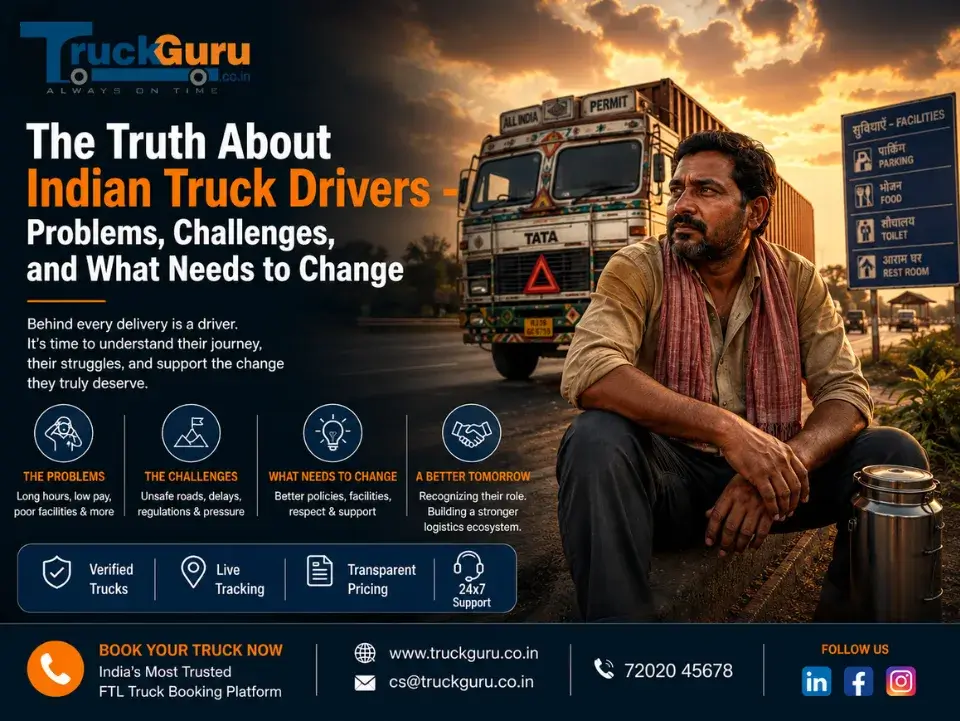
The Truth About Indian Truck Drivers – Problems, Challenges, and What Needs to Change
India’s road transport network moves roughly 65% of the country’s freight. It connects cities, towns, and villages that no railway or airline can reach. Behind every delivery — every factory consignment, every hospital supply, every shelf in a distant town — is a driver who has spent days on the road away from home.
The Truth About a Driver's Life: Quick Summary
The Truth About a Driver's Life: Indian truck drivers keep the economy moving, yet face severe challenges – long hours, poor pay, health risks, and road.
Yet the people who keep this system running are also among the most overlooked in the Indian workforce. The trucking industry is facing a serious and growing driver shortage. A 2019 report by the Indian Foundation of Transport Research and Training (IFTRT) estimated a shortfall of over 2.2 million drivers in India. The gap widens each year as fewer young people enter the profession.
The shortage is not accidental. It is the direct result of working conditions that push experienced drivers out and discourage new ones from joining. This article examines the eight most significant problems Indian truck drivers face — and why fixing them is inseparable from solving the capacity problem.
Why India Has a Truck Driver Shortage
The trucking industry in India is largely unorganised. Most trucks are owned by small operators running one to five vehicles. Drivers work under informal arrangements — no written contract, no defined hours, no standard pay, and no guaranteed benefits.
When the work is demanding, the pay is uncertain, and the personal cost is high, experienced drivers leave. Young people looking at the profession from the outside see those conditions and choose other careers. The result is a structural shortage that affects every shipper, transporter, and supply chain in the country.
8 Real Problems Faced by Indian Truck Drivers
1. Work Pressure and Extreme Hours
Truck drivers are under constant pressure to meet delivery deadlines. A shipment booked for next-morning delivery at a destination 600 km away means driving through the night with limited rest. Most intercity trips involve continuous driving for 10 to 15 hours a day, with minimal scheduled breaks.
The pressure is compounded by the fact that delays have direct financial consequences. Owners may dock pay for late deliveries. Shippers may refuse the load. Drivers absorb pressure from both ends. The only available response is to drive longer and rest less.
2. Low and Irregular Pay
Driver salaries in India vary significantly by operator, vehicle type, and route. Entry-level and short-route drivers often earn Rs.12,000 — Rs.18,000 per month. Experienced intercity drivers can earn Rs.25,000 — Rs.35,000, though this is far from universal. The larger problem is irregularity: many drivers report being paid late, or not being paid the full agreed amount.
Irregular pay makes household planning difficult. School fees, rent, and any fixed obligation become harder to manage. It also makes the profession unattractive to younger workers who have more options and less tolerance for income instability.
3. Sleep Deprivation and Fatigue
Sleep deprivation is one of the most serious and most ignored risks in Indian trucking. Drivers on long-distance routes regularly drive for 12 to 16 hours with inadequate rest stops. With poor rest infrastructure on highways, fatigue is the norm rather than the exception for long-distance drivers.
This has direct consequences on road safety. A fatigued driver’s reaction time, judgement, and alertness all deteriorate in ways that no experience can compensate for. Many accidents attributed to driver error on Indian highways have sleep deprivation as a contributing factor.
4. Poor Food and Rest Facilities on Highways
Most drivers eat at roadside dhabas — the cheapest option available at a highway stop. The food is often high in oil and carbohydrates, low in nutritional variety, and prepared under uncertain hygiene conditions. Drivers rarely have access to a kitchen. Carrying and storing food across a multi-day trip is impractical.
Proper truck rest stops exist on some National Highways. Large stretches of state roads and secondary routes have no facilities at all. Where rest areas do exist, facilities are often inadequate: no clean water, no sanitation, no secure parking.
5. Highway Conditions and Infrastructure Gaps
India has over 6.3 million km of roads according to Ministry of Road Transport and Highways data — one of the largest road networks in the world. But the quality of that network is highly uneven. National Highways have improved significantly over the past decade. State highways and district roads remain poorly maintained in many regions. Trucks use these for the first and last mile of most trips.
Potholes, unmarked diversions, narrow bridges, and unlit stretches increase fatigue, vehicle wear, and accident risk — simultaneously. The driver bears the physical and mechanical cost of every bad road kilometre.
6. Health Consequences of the Job
Long hours seated in a truck cab, combined with poor diet and limited physical activity, create predictable health outcomes. Musculoskeletal problems — back pain, joint issues, and spinal strain from constant vibration — are extremely common among long-distance drivers. Respiratory issues from diesel exhaust exposure are also well-documented.
The bigger problem is access to healthcare. Drivers who fall ill mid-route are far from home and often far from any medical facility. Many ignore symptoms and continue driving because stopping means losing income. By the time a condition is treated, it is often more serious than it needed to be.
7. Road Accidents and Blame
Trucks are involved in a high share of fatal highway accidents. This reflects the kilometres they cover, often at night on the most dangerous stretches — not necessarily driver recklessness. When accidents do occur, drivers frequently face immediate blame regardless of the circumstances.
Mob violence against drivers at accident scenes is a documented and recurring problem in India. Drivers are sometimes beaten before any investigation takes place, even when the other party is clearly at fault. The fear of being stranded, attacked, or arrested without support nearby adds significant psychological stress to an already demanding job.
8. Family Separation and Relationship Strain
A driver on a long-distance intercity route may be away from home for 10 to 20 days at a stretch. For married drivers with children, this means missing school events, medical emergencies, and the daily routines that relationships depend on. Communication through a mobile phone fills only some of that gap.
Drivers often cite family strain as a primary reason for leaving the profession. Partners who struggle with the arrangement, children who grow up without a parent present, and constant social isolation make the personal cost of the job very high. Many drivers would accept lower pay for a route that brought them home more frequently.
What Needs to Change for Indian Truck Drivers
Several of these problems require policy-level responses — from the government, transport authorities, and industry associations. Others can be addressed by the operators and platforms that organise freight in India.
Policy and Regulatory Changes
- Regulated driving hours: mandatory rest requirements — similar to those in the European Union — have been proposed but not systematically enforced in India. No more than 9 driving hours per day is the standard elsewhere.
- Driver welfare infrastructure: more properly equipped truck rest stops on national and state highways — with clean water, sanitation, secure parking, and basic medical access.
- Formalisation of employment: written contracts, defined pay, and access to social security (EPFO, ESIC) for drivers under organised operators.
- Faster accident resolution: clearer legal processes to protect drivers from mob violence at accident scenes, and faster access to legal aid.
What Technology and Better Platforms Can Do
Not all of these changes require legislation. Some come from how freight is organised at the platform level.
- Transparent freight pricing: when shippers pay fair, verified rates, more of that margin can flow through to driver compensation. Platforms that show rates before booking and eliminate broker layers reduce leakage that keeps driver pay low.
- GPS tracking and safety: real-time GPS gives drivers a documented route record. In accident disputes, this provides an independent record of location and speed.
- Digital documentation: e-way bills, digital LRs, and app-based confirmations reduce time spent at checkposts.
- Verified bookings: drivers on platforms that verify shipper and cargo details face fewer surprises at pickup — wrong loads, unpaid wait time, or disputed terms.
TruckGuru is a pan-India FTL intercity truck booking platform working with verified truck owners and their drivers across 110+ cities. The platform provides transparent freight pricing, GPS tracking on all shipments, and digital booking confirmation — reducing the uncertainty and administrative friction that affects drivers and owner-operators on every trip.
Key Takeaways
- India faces a shortfall of over 2.2 million truck drivers, a gap that will widen unless working conditions improve.
- The eight core problems are interconnected. Extreme hours, irregular pay, sleep deprivation, poor facilities, bad roads, health consequences, accident blame, and family separation each make the others worse. Fixing one without addressing the others does not resolve the driver shortage.
- Policy changes on driving hours, driver welfare infrastructure, and employment formalisation are essential but slow to implement.
- Technology platforms can move faster than policy. Transparent pricing, GPS records, digital documentation, and verified bookings each reduce friction points that make a driver’s job harder than necessary.
- The driver shortage is ultimately a business problem for every company that ships goods in India. The sector cannot grow its capacity without making the profession more attractive to the people who have to do it.
Frequently Asked Questions
How many truck drivers are there in India?
India has approximately 7 to 8 million truck drivers. Against this, the IFTRT estimated a shortfall of over 2.2 million drivers in 2019, with the gap continuing to grow as demand for freight capacity increases faster than new drivers enter the profession.
What is the average salary of a truck driver in India?
Salaries vary significantly by route, operator, and experience. Entry-level and short-distance drivers typically earn Rs.12,000 — Rs.18,000 per month. Experienced intercity drivers can earn Rs.25,000 — Rs.35,000 per month. Pay irregularity — delayed or partial payments — is a widespread problem across the sector.
Why is there a truck driver shortage in India?
The shortage is driven by working conditions that push experienced drivers out and discourage younger workers from entering. Extreme hours, low and irregular pay, poor health outcomes, family separation, and safety risks on highways all contribute. The informal structure of most driver employment adds further instability.
Are truck drivers responsible for most highway accidents in India?
Trucks cover more kilometres than most other vehicles — often at night on poorly maintained roads. This explains their high proportion of highway accidents. Responsibility for any specific accident depends on the circumstances. Drivers are frequently blamed without investigation. Mob violence at accident scenes is documented and the legal system has been slow to address it.
What is the daily life of a truck driver in India like?
A typical intercity trip means 12 to 16 hours of driving, eating at highway dhabas, and sleeping in or near the truck cab. Weeks pass without seeing family. Long-distance drivers may be away from home for 10 to 20 days per trip. Health risks, road risks, and financial uncertainty are constants throughout.
What can be done to improve truck driver welfare in India?
Regulatory changes are the most impactful levers: mandatory rest hours, highway rest infrastructure, formalised contracts, social security access. All require government action. At the platform level, transparent pricing, GPS documentation, and digital bookings reduce uncertainty and friction for drivers and owner-operators.
Related Reading
- How to Estimate Goods Transport Rates: A Beginner’s Guide
- How Are Truck Transportation Charges Calculated in India?
- 6 Truck Booking Platforms Compared for FTL Freight in India: FR8, WheelsEye, Trukky, BlackBuck, Vahak & TruckGuru
For current rules and official notifications, see the Ministry of Road Transport & Highways.