

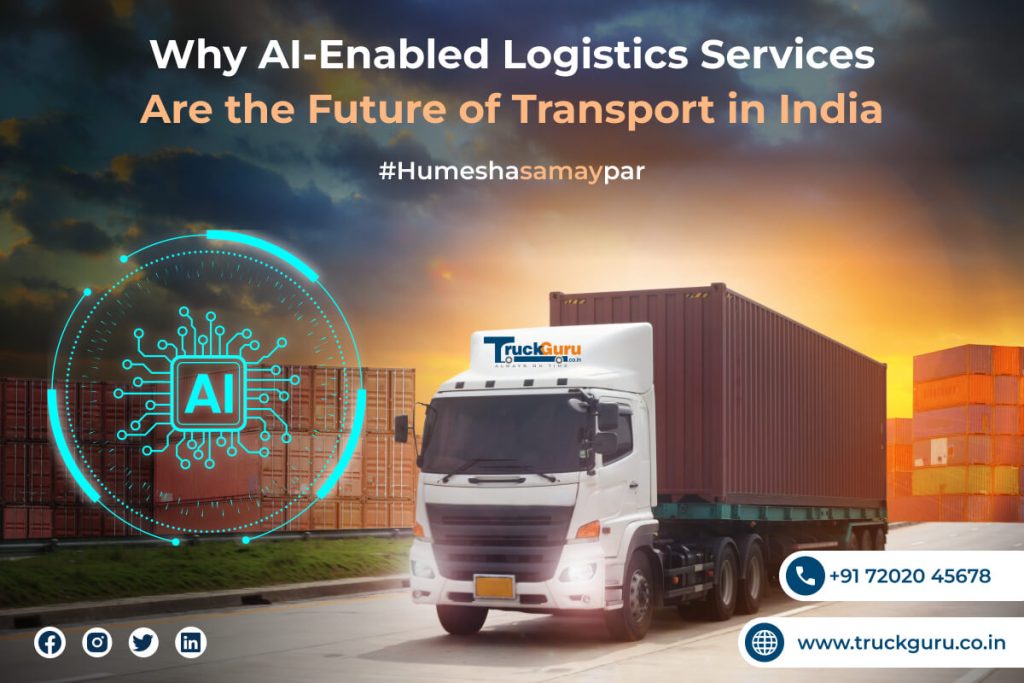
AI in Logistics in India: What It Actually Does
Every logistics company in India has, at some point, had a morning like this: a dispatcher spends two hours building the day’s routes from memory and yesterday’s notes, a customer reschedules at 10 AM, and by evening, three trucks came back half-empty while one made a trip nobody planned for. This is the exact problem AI in logistics in India is supposed to fix, and in a fair number of cases, it genuinely does — but not in the sweeping, every-problem-solved way most of the marketing around it suggests.
Logistics Services: Quick Summary
Discover why AI-enabled logistics services are transforming transport in India—cut costs, boost fleet efficiency and deliver faster with TruckGuru’s smart solutions.
This piece looks at what AI in logistics in India is actually being used for right now, where it helps in ways you can measure, and where the claims outrun what the technology reliably does.
What People Mean When They Say “AI in Logistics”
In practice, it usually means one of three things: a system that predicts something (when a truck will need servicing, how much demand is coming next month), a system that optimises something (which route, which load combination, which truck for which job), or a system that tracks something in real time and flags when conditions change. None of these require the system to “think” the way the word AI implies — most of what gets called AI in logistics is closer to well-built statistical forecasting and route math than anything resembling general intelligence.
That distinction matters because it sets expectations correctly. A system that is good at predicting fuel consumption on a known route is solving a narrow, well-defined problem. A system that promises to handle “all your logistics complexity” without more detail is making a much bigger claim than the underlying technology usually supports.
Where AI Genuinely Helps in Indian Logistics Today
A handful of applications have moved past the pilot stage and into regular use across the industry:
Route planning that adjusts mid-day
Static route plans built each morning break the moment traffic, weather, or a rescheduled delivery changes the picture. Systems that pull live traffic and road data can recalculate a route in the time it takes a dispatcher to notice something went wrong. This is one of the more mature applications — the data inputs (traffic, road closures, weather) are widely available and well-structured, which is exactly the kind of problem this technology handles well.
Predictive vehicle maintenance
Fleets that fit sensors to engines, tyres, and brakes can catch early signs of failure — a slow oil pressure drop, unusual vibration patterns — before they become a breakdown on NH-44 at 2 AM. This genuinely reduces unplanned downtime, though it requires sensor hardware on every vehicle, which is a real cost that smaller fleets often can’t justify yet.
Demand forecasting tied to seasonal patterns
A company that ships festival-season inventory knows November and December look nothing like July. Forecasting models that learn from a few years of order history can flag the ramp-up early enough to arrange extra trucks and drivers in advance, rather than scrambling when the order volume has already hit.
Load and capacity planning
Fitting different package sizes into the fewest possible vehicles is a genuinely hard combinatorial problem once you have more than a handful of items — the kind of thing software solves better than a person eyeballing a loading dock. The payoff is fewer half-empty trucks and fewer return trips.
Where the Marketing Gets Ahead of the Technology
A lot of “AI logistics platform” pitches bundle all of the above into one dashboard and imply it works out of the box for any fleet, any cargo type, any route. In reality, each of these systems needs reasonably clean historical data to learn from, and Indian freight data — spread across paper LRs, WhatsApp confirmations, and half-digitised admin systems — often isn’t there yet for a lot of smaller and mid-sized operators. A system promising accurate demand forecasting on six months of patchy order data is making a promise the data can’t support.
The specific cost-saving numbers thrown around — “save 15-25%,” “cut empty runs by 40%” — are real outcomes some companies have achieved, but they depend heavily on the starting point. A fleet that already runs efficiently has much less room to improve than one running on guesswork. Treat any number quoted without context as a starting point for questions, not a guarantee.
AI in Indian Logistics: Beyond the Truck
The same underlying ideas apply to warehousing and inventory, not just trucks on the road:
- Inventory levels that track actual buying patterns instead of fixed reorder points
- Demand-supply matching that reduces both overproduction and stock-outs
- Shipment visibility that lets a manager see where goods are at any point in the journey, not just at pickup and delivery
These tend to mature faster than the trucking-side applications because warehouse data is usually more structured to begin with — inventory systems already track SKU-level data that route planning systems have to assemble from scratch.
Where TruckGuru Actually Stands on This
TruckGuru doesn’t market itself as an AI logistics platform, and it’s worth being direct about why: a booking platform’s job is to give a shipper a confirmed rate and a truck that shows up on time, not to sell a dashboard most FTL customers don’t need.
What TruckGuru does use internally is Hermes, an operations tool built on a local language model trained on TruckGuru’s own rate card, route data, and booking patterns. It helps the operations team answer routine questions faster and keep rate quotes consistent across corridors — it’s a working internal tool, not a customer-facing AI suite, and we’re not going to claim otherwise.
On the booking side, what a shipper actually gets is a rate that’s calculated the same way every time for the same route and truck size — no negotiation, no quote that changes depending on who you talk to. That consistency comes from a fixed-rate engine, not machine learning, and it solves a real problem in Indian FTL booking: most shippers have dealt with brokers who quote differently depending on the day. A predictable number, even from simple math, beats an unpredictable one from a black box.
Check a rate for your route on the freight calculator.
What This Means If You’re Evaluating an AI Logistics Vendor
Ask what data the system actually needs to work well, and whether your business has it. Ask for a specific number tied to a specific starting condition, not a range pulled from someone else’s case study. And ask what happens when the system is wrong — a route recalculation that’s wrong costs you twenty minutes; a demand forecast that’s wrong costs you a warehouse full of unsold festival stock. The applications that have earned their place in Indian logistics — route planning, predictive maintenance, load optimisation — got there by solving narrow problems well, not by promising to solve everything at once.
Frequently Asked Questions
What does AI actually do in Indian logistics right now?
The mature applications are route planning that adjusts to live traffic, predictive vehicle maintenance using sensor data, demand forecasting based on order history, and load optimisation for fitting cargo into fewer vehicles. These are narrower than “AI manages your whole supply chain,” but they’re genuinely useful where they apply.
Can AI actually cut logistics costs in India?
Yes, but the savings depend on how inefficient the starting point was. A fleet running on rough guesswork has more room to improve than one already running reasonably well. Treat any specific percentage you see quoted as conditional on the starting baseline, not a guaranteed outcome.
Does TruckGuru use AI for logistics?
TruckGuru uses an internal tool called Hermes to help its operations team work faster and maintain consistent rate quotes. TruckGuru does not market a customer-facing AI logistics dashboard — the platform’s value is a confirmed, consistent rate at booking and a truck that shows up, not an AI suite.
What data does an AI logistics system need to work well?
Reasonably clean historical data on routes, demand, and vehicle performance. Companies with paper-based or fragmented records (split across WhatsApp, paper LRs, and partial digital systems) often find that the data isn’t ready for the forecasting tools yet, regardless of how good the software is.
Call 72020 45678 or book online at truckguru.co.in for a confirmed FTL rate on your route.
Related Reading
- Reduce Manufacturing Freight Costs: India Intercity Guide
- Reduce B2B Freight Costs in India: 25 Proven Strategies
- Ship-To GSTIN Mandate August 2026 — What Shippers Must Do
For current rules and official notifications, see the Ministry of Road Transport & Highways.