

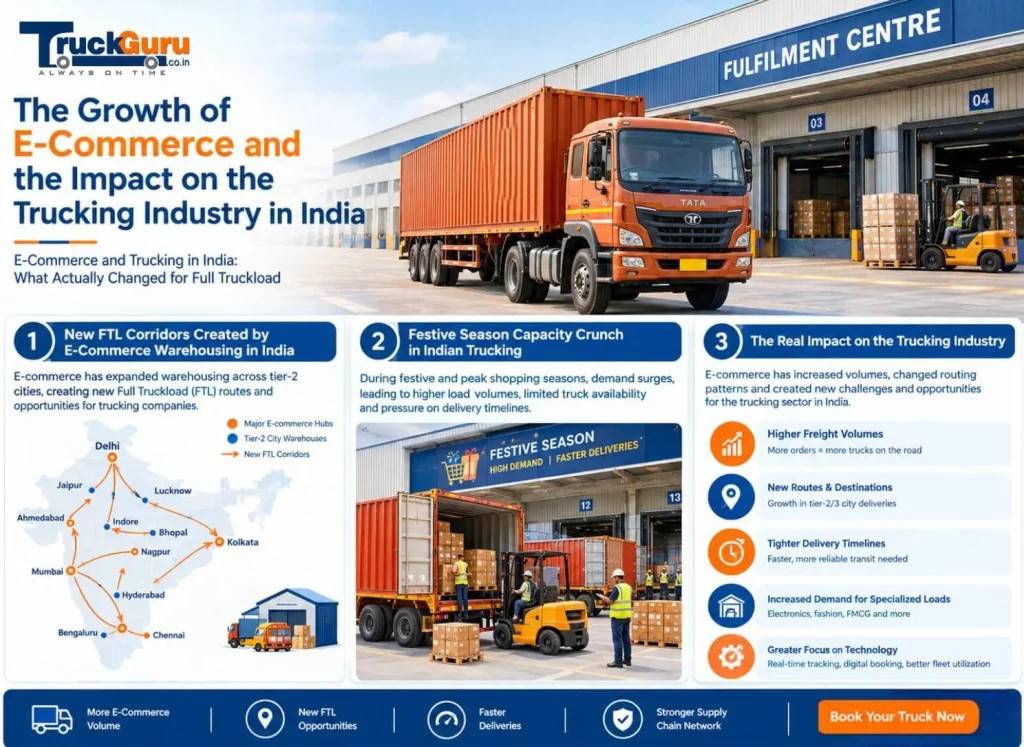
E-Commerce and Trucking in India: What Actually Changed for Full Truckload
Ask most people how e-commerce changed Indian trucking and you get an answer about vans delivering parcels to doorsteps. That part is real, and it is also the part that has nothing to do with full-truckload freight.
E-Commerce Impact on Trucking: Quick Summary
The e-commerce impact on trucking in India runs upstream, not the last mile. New corridors, festive capacity crunches, and why your rates move even if you do not sell online.
The e-commerce impact on trucking that matters to a manufacturer in Ankleshwar or a ceramics unit in Morbi occurs further up the chain and shows up in their rates, whether or not they sell a single item online.
The E-Commerce Impact on Trucking Starts Long Before the Last Mile
A product ordered online has usually travelled several full truckloads before anyone puts it in a van.
It moves from the factory to a central warehouse. From there to a regional fulfilment centre. From that fulfilment centre to a smaller sortation facility closer to the customer. Only the final leg is the delivery van everyone pictures.
Those upstream movements are ordinary intercity FTL freight, in the same 20ft and 32ft containers everyone else books, competing for the same vehicles on the same corridors.
New corridors that did not carry much freight before
The clearest structural change. As fulfilment networks pushed into tier-2 and tier-3 cities, freight started running to places that previously received goods through longer, less direct distribution chains.
For a shipper, that cuts both ways. Thin corridors, where you paid more because a vehicle came back empty, may now have return freight available. Rates on those routes are better than they were. Meanwhile corridors around major fulfilment clusters carry more competing demand than they used to.
Worth asking your transporter directly whether return loads exist on your route now. On several corridors the answer has changed in the last few years, and rates follow return availability more closely than they follow distance.
The festive crunch, and why it costs you money
This is the item that affects shippers who have nothing to do with e-commerce.
Large online sale events concentrate enormous freight volume into short windows. Fulfilment centres stock up in the weeks before, which pulls vehicles onto those corridors and out of general availability. Then the same period collides with the festive season, when driver availability drops because people travel home.
The result for an unrelated business is that placement takes longer, and spot rates rise in September and October, for reasons that have nothing to do with their own cargo. A ceramics consignment from Morbi to Delhi competes for the same 32ft container as a fulfilment centre restock.
The practical response is to plan around it. Move what you can outside the window, book earlier for what you cannot, and expect placement to take days rather than hours in that period.
What e-commerce demanded, and what it changed for everyone
- Documentation expectations rose. Large e-commerce operators required digital proof of delivery, booking records and status visibility as a condition of doing business. Operators built that capability for those customers and now offer it generally. Smaller shippers benefited without asking.
- Tighter delivery windows became normal. Fulfilment operations run to appointment slots rather than approximate days. That expectation has spread, which is good for planning and unforgiving when a vehicle is late.
- Formalisation accelerated. Large operators will not work with transporters who cannot invoice properly or produce documentation. Combined with GST and e-way bill requirements, that pushed a meaningful share of freight into the organised sector.
What the E-Commerce Impact on Trucking Did Not Change
- E-commerce has not made intercity FTL faster. Transit time still follows distance, road conditions and gate hours.
- It has not reduced the importance of the consignment note or proof of delivery. If anything, it raised it.
- It has not solved driver availability, which remains the binding constraint during the exact weeks demand peaks.
- It has not lowered rates generally. It redistributed them by corridor and by season.
Where TruckGuru Fits
TruckGuru provides full truckload intercity transportation across 110+ cities in India, with upfront freight pricing and the vehicle type, route and rate stated before loading. Toll is included in the quoted fare. Dispatched bookings carry live GPS tracking, and digital documentation includes the LR and delivery records, with GST invoicing and e-way bill support applied where relevant. Check a corridor rate on the freight calculator or book a truck online.
It is full truckload intercity only. Last-mile delivery, parcel and courier movements, and warehousing are outside what TruckGuru does. If you need the final leg to a customer’s doorstep, that is a different kind of operator.
For planning around capacity crunches, see supply chain disruption planning. For the levers that actually move your freight bill, see logistics costs in India.
Key Takeaways
- The e-commerce impact on trucking that matters to FTL shippers is upstream, not last mile.
- Goods move through several full truckloads between factory and fulfilment centre before any van is involved.
- Fulfilment networks in tier-2 cities created corridors that now carry return freight, which improves rates on routes that used to run empty one way.
- Festive and sale-event stocking tightens vehicle availability nationally. Your September and October rates move for reasons unrelated to your cargo.
- Documentation and delivery-window expectations rose across the market because large operators demanded them.
- None of it made transit faster or solved driver availability.
Frequently Asked Questions
What is the e-commerce impact on trucking in India?
Mainly upstream of the delivery van. Fulfilment networks generate substantial full truckload freight between factories, central warehouses and regional centres, which created new corridors and concentrated demand into seasonal peaks.
Does e-commerce use full truckload freight?
Yes, extensively. Stock moves by full truckload from factories to warehouses and between fulfilment centres. Parcel-level movement only begins on the final leg to the customer.
Why do freight rates rise before the festive season?
Two things happen at once. Fulfilment centres stock up ahead of major sale events, pulling vehicles onto those corridors, and driver availability drops as people travel home for festivals. Placement takes longer, and spot rates rise, regardless of what you ship.
How should I plan freight around the festive period?
Move what you can outside the window, book earlier for what you cannot, and expect vehicle placement to take days rather than hours. Treat September and October as a known constraint rather than a surprise.
Has e-commerce made freight cheaper?
Not generally. It redistributed cost by corridor and by season. Routes that gained return freight improved, routes around fulfilment clusters became more contested, and seasonal peaks became sharper.
Do I need a last-mile operator or an FTL transporter?
If you are moving a full vehicle between two business locations in different cities, you need FTL. If you are delivering individual orders to customer addresses, that is last-mile parcel work and a different kind of operator entirely.
The Short Version
E-commerce did not change what a truck does. It changed which corridors carry freight and when capacity gets scarce. If your rates move in October and you sell nothing online, that is why.
Related Reading
- How to Estimate Goods Transport Rates: A Beginner’s Guide
- How Are Truck Transportation Charges Calculated in India?
- 6 Truck Booking Platforms Compared for FTL Freight in India: FR8, WheelsEye, Trukky, BlackBuck, Vahak & TruckGuru
For current rules and official notifications, see the Ministry of Road Transport & Highways.