

A truck earns on the days it is loaded. Everything else in a transport business is arithmetic around that one fact, which is why finding loads is not an administrative task. It is the business.
There are five channels Indian truck owners use to find truck loads, and most successful operators run several at once rather than committing to one. Here is what each does, what it costs and where it fails.
1. Commission agents and brokers
Still the backbone of Indian road freight. An agent holds relationships with shippers, books your vehicle against a load, and takes a cut.
- What works: volume and speed. A well-connected agent on your corridor can keep a vehicle moving with almost no effort from you, and the relationship compounds over years.
- What it costs: the commission, and more importantly, your access to the customer. You never learn who the shipper is, so you cannot go direct later. That is the trade.
- Where it fails: unfamiliar destinations. Your agent in Ludhiana cannot find you a return load out of Bengaluru, because their network does not reach there.
2. Transport nagar and physical markets
The freight markets in every major city, Bhiwandi outside Mumbai, the transport nagars in Delhi, Ahmedabad, Jaipur and elsewhere, still move enormous volume through face-to-face booking.
For a driver sitting at a destination with an empty vehicle, this is often the fastest option available on the day. It is also where rates are most exposed, because you are negotiating from an obviously weak position: everyone can see your truck is empty and going nowhere.
Practical use: treat it as a fallback rather than a plan. A load found this way is usually better than another day parked, and usually worse than a load arranged before you arrived.
3. Online platforms: how to find truck loads outside your network
The channel that changed operator economics most, because it solved the specific problem the other channels could not: finding freight in a city where you know nobody.
An owner in Ludhiana can see what is moving out of Bengaluru without a contact there. That directly attacks empty running, which is the highest cost in a small transport business.
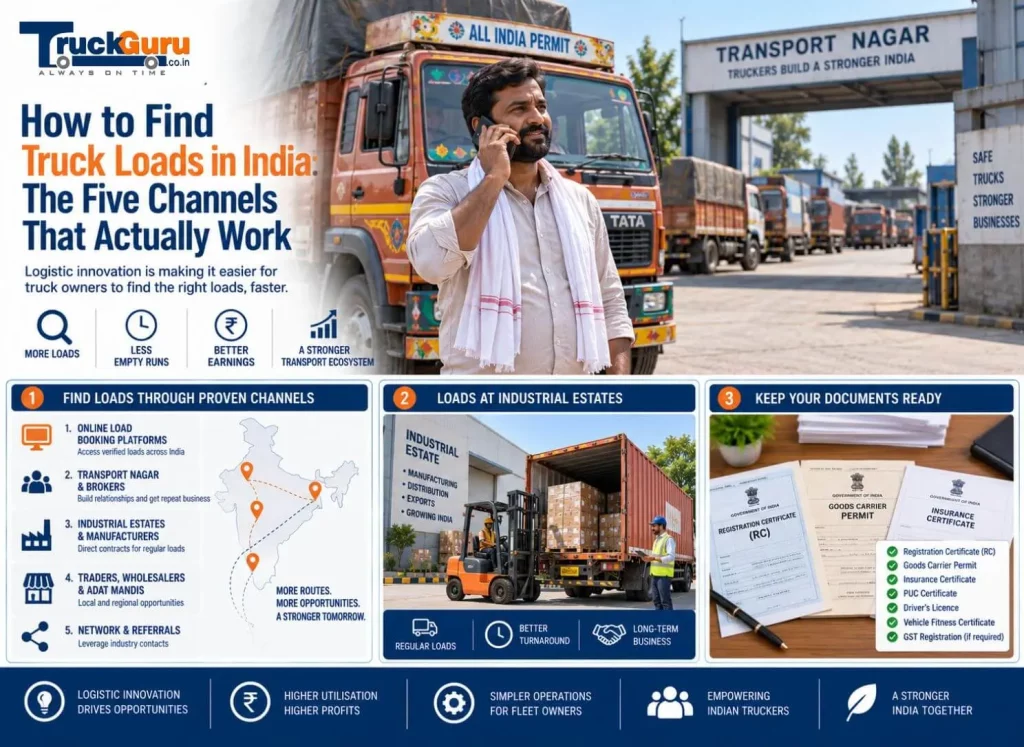
To register on most platforms, you will need vehicle and business documents ready: RC, permit covering your routes, current insurance, fitness certificate, driver licence and GSTIN. Operators who keep these current get onboarded quickly. Those who do not lose days to it.
4. Direct shipper relationships
The highest-value channel and the slowest to build. A manufacturer in Sanand or a chemicals unit in Ankleshwar who books you directly pays no commission to anyone, which means the rate is better for both of you.
How it actually happens: you deliver reliably for a shipper through an agent or platform, they notice, and over time the relationship forms. It is rarely won by cold approach. Industrial estates are the place to concentrate, because units cluster and one good relationship leads to the neighbouring gate.
The catch is concentration risk. An operator with two direct customers carrying most of their volume is one contract loss from a serious problem.
5. Subcontracting from larger fleets
Larger operators frequently hold more freight than their own vehicles can carry, particularly at quarter end and during festive peaks. Running loads for them is steady work with no customer acquisition effort.
The rate is lower because they are taking a margin. What you get in exchange is predictability, and for an operator with an EMI due, that trade often makes sense. Agree the rate split, damage responsibility and payment days in writing before the first load.
The Number That Decides Your Month
Not the outbound rate. The return leg.
A good rate from Ahmedabad to Delhi with an empty return is frequently worse than a modest rate with freight both ways. Work out your earnings per round trip rather than per load, and judge channels on whether they solve the return, not on the headline number they quote outbound.
That is the honest reason platforms mattered. Not the app itself, but that it gave a small operator visibility of freight in a city where their network ended.
For permit, fitness and vehicle category requirements, check with your RTO and the Ministry of Road Transport and Highways, since rules vary by state and are amended.
Where TruckGuru Fits
TruckGuru runs full truckload intercity freight across 110+ cities in India, connecting shippers with independent transport vendors. Bookings carry the vehicle type, route and rate stated before loading, toll included in the quoted fare, and staged payment across confirmation, loading and delivery. If you run vehicles and want load access outside your own corridors, see the transporter page.
For working with other operators rather than through a platform, see strategic alliances in logistics. For software beyond load finding, see mobile apps for logistics.
Key Takeaways
- Use several channels to find truckloads. Operators who depend on one lose days whenever it goes quiet.
- Agents give you volume and cost you customer access. That is the trade, not a flaw.
- Transport Nagar is a fallback, not a plan. An empty truck negotiates badly.
- Platforms solved the specific problem of finding freight where you have no contacts.
- Direct shipper relationships pay best and take longest. Watch concentration risk.
- Judge every channel on earnings per round trip, not on the outbound rate.
Frequently Asked Questions
How do owners find truckloads in India?
Through commission agents, transport nagar markets, online load booking platforms, direct shipper relationships and subcontracting from larger fleets. Most working operators use several rather than relying on one.
What is the fastest way to find a return load?
An online platform if you plan, since it shows freight in cities where you have no contacts. Transport Nagar if the vehicle is already sitting empty at the destination, though you will negotiate from a weak position.
What documents do I need to register on a load platform?
Typically the RC, a permit covering your routes, current insurance, fitness certificate, driver licence and GSTIN. Keeping these current speeds up onboarding considerably.
Is it better to work with an agent or find loads directly?
Both, in practice. Agents give you volume without effort but keep the customer relationship. Direct shippers pay better but take years to build and carry concentration risk. Most stable operators run a mix.
Why does the return leg matter so much?
Because a truck running empty one way earns on half its kilometres while costing on all of them. Empty running is the largest cost in a small transport business, so a modest rate with freight both ways often beats a good rate one way.
Should I subcontract for a larger fleet?
It is worth it when you need predictable work more than you need margin, which for an operator with vehicle finance is often. Agree the rate split, damage responsibility and payment days in writing before the first load.
The Short Version
Loads come from five places, and no operator should depend on one. Keep your documents current so you can take work from any of them at short notice, and judge every offer on the round trip rather than the outbound leg.