

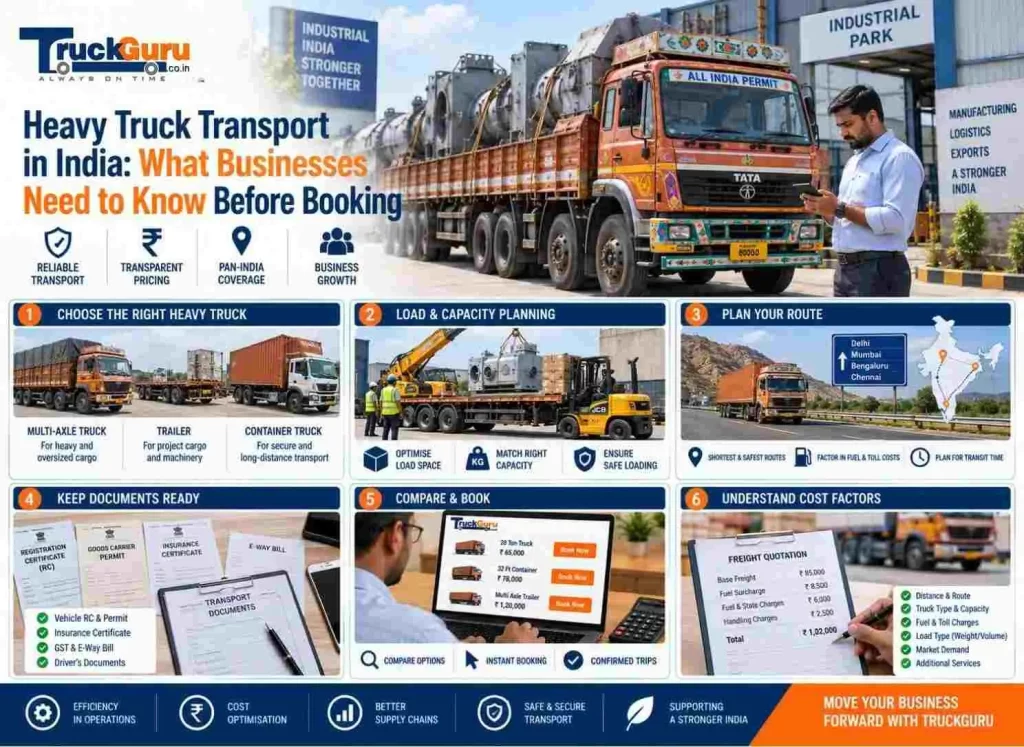
Heavy Truck Transport in India: What Businesses Need to Know Before Booking
A machine tool maker in Rajkot books a large vehicle for a consignment that measures fine on paper. The truck arrives, the crew starts loading, and the item will not sit inside the body within the height the vehicle can legally carry on that route. The booking is wasted, and the dispatch slips by two days.
Heavy or oversized cargo cannot be treated as an ordinary FTL shipment. Cargo dimensions, weight, loading method, road restrictions and the permissions required all affect whether a movement is possible, and none of that appears in a tonnage figure.
What Counts as Heavy or Oversized Cargo
In Indian practice, cargo becomes oversized when it exceeds what a goods vehicle can carry within the dimensional and weight limits applying to that vehicle and route. The usual term is over-dimensional cargo, shortened to ODC.
It is a relative definition rather than a fixed one. A consignment that is routine on one vehicle class becomes oversized on a smaller one, and a movement that is straightforward on a national highway may not be permitted through an older city approach road. Requirements can vary depending on the cargo, vehicle, route and the authorities involved, so classification is settled case by case rather than by a single national number.
Typical Indian examples include transformers, boiler sections, pre-cast concrete elements, large fabricated structures, and plant components that cannot be dismantled for transit.
Heavy Cargo and Oversized Cargo Are Different Problems
This distinction saves more wasted bookings than anything else in this article.
Heavy means dense. Castings, tiles, drummed chemicals, bagged material. The consignment reaches the vehicle load capacity with the body part empty. That is an ordinary FTL booking, and it is solved by choosing the right vehicle size.
Oversized means dimensionally abnormal. The item will not fit within a standard body, or its height or width needs route clearance and permissions. That is a different exercise involving purpose-built trailers, a route survey for bridges, overhead lines and turns, permissions from the relevant authorities, and sometimes escort vehicles or restricted movement hours.
A standard FTL booking is a next-day decision. An ODC movement is a project with lead time. Treating the second as the first is where things go wrong.
Where TruckGuru Specialises
TruckGuru books full trucks from the Tata Ace to the 32 ft container. Most bookings sit at the smaller end of FTL: Tata Ace and mini truck, Bada Dost, and Eicher trucks in 14 ft, 17 ft and 19 ft bodies.
That focus is deliberate, and it suits a specific kind of consignment. Small and mid-sized loads that do not justify a large vehicle. Pickups from older industrial estates and market areas where approach roads will not take anything long. Businesses dispatching frequently in modest quantities rather than occasionally in bulk. A components unit sending 900 kg to Hosur twice a week is better served by an operator who runs that class of vehicle constantly than by one who treats it as a small job.
Container vehicles in 20 ft and 32 ft (SXL and MXL) book the same way for larger consignments.
When You Need a Specialist ODC Operator
If your cargo cannot be accommodated within a standard vehicle body, or if its dimensions require route clearance and permissions, you need a specialist operator rather than a standard FTL booking.
Indicators that you are in that territory: the item cannot be dismantled into transportable sections, it needs a crane at both ends rather than a forklift, its height or width would exceed what a normal vehicle can carry on the route, or a previous mover told you the route needed surveying.
Those movements are outside TruckGuru service scope. Saying so is more useful than accepting the enquiry and disappointing you at the loading bay.
What to Check Before Booking
Five minutes with a measuring tape prevents most of the problems in this article.
- Weight of the packed consignment, including crating and pallets
- Length, width and height of the item as it will sit on the vehicle
- Whether it can be stacked or must travel as a single unit
- Loading and unloading method, and whether that equipment exists at both ends
- Approach road and gate width at pickup and delivery
- Route restrictions, particularly height clearances and city entry timings
- Any documentation the cargo type or route specifically requires
The approach road is the item most often skipped, and it is the one that decides your maximum vehicle size more often than the cargo does. A truck that cannot reach your gate is a failed placement regardless of how well the load fits inside it.
TruckGuru Service Scope
TruckGuru provides FTL transportation with a specialism in light commercial vehicles, and container vehicles up to 32 ft available for larger consignments. Specialist ODC and heavy transport trailer movements are outside that scope.
Frequently Asked Questions
What counts as over-dimensional cargo in India?
Cargo exceeding the dimensional or weight limits applying to the vehicle and route being used. It is assessed case by case, since requirements can vary depending on the cargo, vehicle, route and authorities involved, rather than by a single national threshold.
Is heavy cargo the same as oversized cargo?
No. Heavy means dense, which is a load capacity question and books as ordinary FTL. Oversized means dimensionally abnormal, which is a clearance and permissions question. A consignment can be one without being the other.
Does TruckGuru provide ODC or specialist heavy transport?
No. TruckGuru specialises in light commercial vehicle FTL, with container vehicles up to 32 ft available for larger loads. Specialist ODC movements needing purpose-built trailers, route surveys and permissions fall outside that scope.
My consignment is small but very heavy. Can you carry it?
Usually yes. Dense cargo in modest volume is exactly what the light commercial range handles well. Give the packed weight and dimensions at enquiry, and the vehicle follows from those two figures.
How do I know which truck size I need?
Measure the packed consignment for weight and for length, width and height, then match against vehicle body dimensions and load capacity. Dense cargo reaches the weight limit early; bulky cargo fills the body first, so check both.
What if my cargo is borderline?
Give exact dimensions and weight at enquiry rather than an estimate, and say what loading equipment exists at each end. Ten minutes of checking beats discovering the problem when the vehicle arrives.
Booking Standard FTL
If your consignment fits a standard vehicle, check a corridor rate on the freight calculator and book a truck online. For body lengths and load capacities by vehicle class, see the guide to truck sizes in India. Have weight and dimensions ready, because those two figures settle the vehicle in most cases.
Related Reading
- How to Estimate Goods Transport Rates: A Beginner’s Guide
- How Are Truck Transportation Charges Calculated in India?
- 6 Truck Booking Platforms Compared for FTL Freight in India: FR8, WheelsEye, Trukky, BlackBuck, Vahak & TruckGuru
For current rules and official notifications, see the Ministry of Road Transport & Highways.