

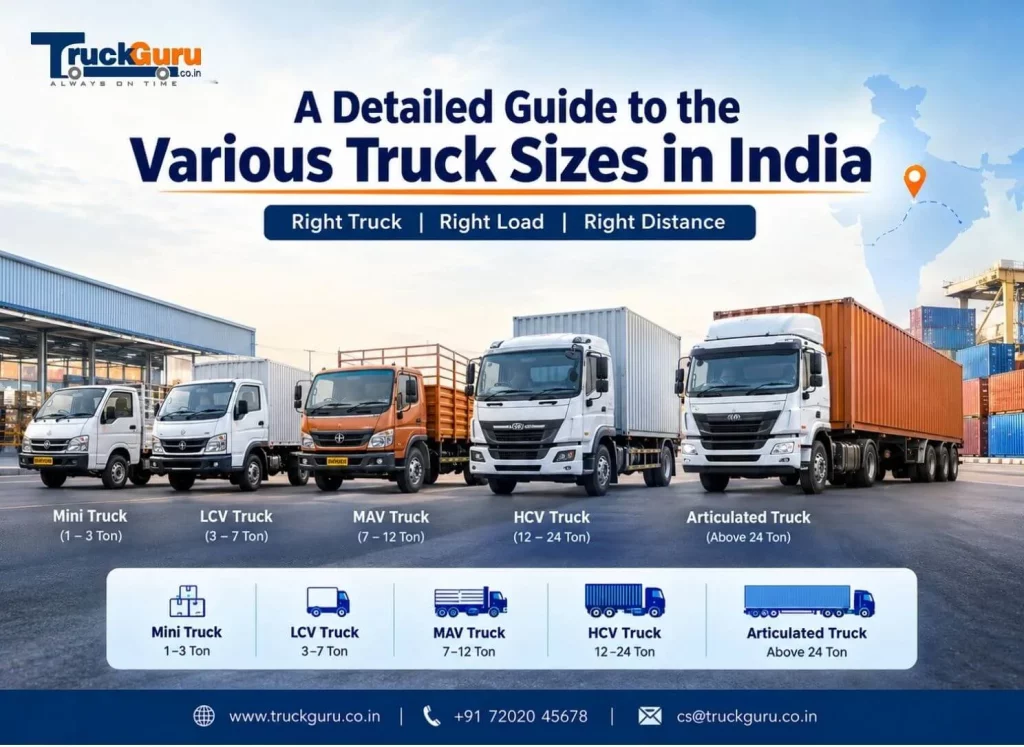
A Detailed Guide to the Various Truck Sizes in India
A ceramics unit in Morbi loads 12 tonnes of tiles into a 32ft container, and the vehicle is sent back at the weighbridge. The consignment was fine on paper. The problem was the container: it was a single axle, and the booking assumed multi-axle numbers. Two words on the vehicle specification, one wasted day.
Truck Sizes in India: Quick Summary
A practical guide to truck sizes in India, with load capacity by vehicle class, single axle vs multi axle, and how to match truck size to your cargo and route.
Truck sizing in India goes wrong far more often on this kind of detail than on anything dramatic. Deck length gets quoted, load capacity gets assumed, and the axle configuration nobody asked about turns out to be the number that mattered. This guide covers the sizes actually in circulation for freight, what each one carries, and where the specification traps sit.
Truck or lorry: settling a common confusion
You will see a lot of Indian logistics content claiming a lorry is a larger vehicle and a truck is a smaller one. That is not correct, and it is worth clearing up before you read any size chart.
Truck and lorry are the same thing. The difference is regional English, not vehicle class. Lorry is standard British usage, carried into Indian English through the same route as bonnet, boot and petrol. Truck is the American term, which is what most trade documentation and vehicle manufacturers now use. A 32ft container is a truck in Ahmedabad and a lorry in Chennai, and it is one vehicle either way.
Where the confusion does real damage is in booking conversations. If a vendor uses “lorry” to imply something bigger and prices accordingly, ask for the body length in feet and the registered load capacity in tonnes. Those two numbers are the only ones that mean anything.
Truck sizes in India by load capacity
Here is the working range for full truck load freight, smallest first. Figures are load capacity, not gross vehicle weight.
Light commercial vehicles
- Tata Ace: 750 kg to 1,100 kg. The smallest vehicle in regular circulation. Its real advantage is access, not capacity, so it earns its place on pickups from older market areas and narrow industrial lanes where nothing larger can turn.
- Tata Intra: 1,000 kg to 1.5 tonnes. Longer deck than the Ace in the same access class.
- Bada Dost: up to 1.7 tonnes in the open body and up to 1.5 tonnes in the closed container. Common for spares, samples and urgent part consignments between manufacturing clusters.
- Mahindra Pickup: the same broad bracket, with good availability across most origin cities.
- Tata 407: still common on Indian roads between the pickup class and a 14ft truck. For loads in this range, TruckGuru books the 14ft Eicher.
Medium trucks
- 14ft Eicher: 3 to 3.5 tonnes. This is the most-booked size in Indian freight and the default for a mid-sized SME consignment.
- 17ft Eicher: a longer deck for cargo that has outgrown the 14ft on volume rather than weight.
- 19ft Eicher: the last step before you move into container class.
Containers
- 20ft container: 5 to 7 tonnes. Enclosed body. Standard for weather-sensitive and sealed movements.
- 32ft container: 15 to 18 tonnes, depending on axle configuration. The default vehicle for consolidated long-distance freight.
Two corrections worth making, because both errors are repeated across most Indian truck-size listicles. There is no standard 24ft container in regular FTL circulation, so treat any 24ft quote as something to verify before you confirm. And the vehicle is called a Bada Dost, not an Ashok Leyland Dost.
Single axle and multi axle: the number most bookings miss
A 32ft container is not one specification. The axle configuration changes what it can legally carry, and the deck length is identical either way, so you cannot tell by looking at it.
A multi-axle 32ft sits at the upper end of the 15 to 18 tonne band. A single axle sits lower. If your consignment is close to the top of that range, the axle configuration stops being a technicality and becomes the difference between the load moving and the load being turned back at a weighbridge.
So when you book anything in container class, confirm three things in writing: body length in feet, axle configuration, and registered load capacity. A quote that gives you only the first one is incomplete.
Road and route constraints that cap your size
Vehicle dimensions in India are governed by the Central Motor Vehicles Rules, which set maximum width, height and length for goods vehicles. Rather than repeat figures that circulate incorrectly online, check the current CMVR limits directly if you are moving anything near the edge of a category, because the numbers differ by vehicle class and get amended.
What matters more day to day is the route itself, and here the rule is simple: your last 500 metres sets your maximum vehicle size, not your cargo.
- Planned industrial estates: Sanand, Chakan, Manesar, Hosur, Sri City and similar take 32ft containers without difficulty. Wide internal roads, proper turning radius, usually a dock.
- Older manufacturing pockets and city markets: parts of Bhiwandi, the interior lanes of Ludhiana, older Ahmedabad and Surat commercial areas. A 32ft may not physically reach the gate even when the highway leg is fine.
- Height clearances: railway underbridges and older flyovers on some state highway stretches constrain container movements. Flag over-height cargo at the enquiry stage so the route gets planned around it rather than discovered mid-transit.
- Entry timing: several metros restrict goods vehicle movement during daytime hours. That does not change your truck size, but it changes when a large vehicle can actually deliver.
Matching truck size to your industry
Cargo density does more to decide truck size than industry does, but some patterns hold consistently.
- Ceramics, tiles and sanitaryware: dense cargo that hits the weight limit well before the deck fills. Morbi consignments routinely leave container space unused, and that is correct rather than wasteful.
- Textiles and garments: the opposite. Bales fill a 19ft or 20ft body at a fraction of its load capacity. Size by volume, not weight.
- Chemicals and pharmaceuticals: drums and carboys are dense but stack poorly, which is why 14ft and 20ft bookings from Ankleshwar and Vapi often need a size up from what the tonnage suggests.
- Engineering goods and machinery components: dense and irregular. Weight-driven sizing, with open body used where the item exceeds container internal height.
- Agricultural produce and bagged goods: predictable stacking, weight-driven. Usually 20ft and 32ft on long-distance corridors.
- FMCG and packaged goods: bulky cartons, volume-driven, container body for weather protection.
How to size a booking in practice
- Weigh and measure the packed consignment, including pallets and crating. Packaging adds 8 to 15 percent to both figures.
- Work out cubic feet as well as kilograms, then book against whichever limit you hit first.
- Confirm axle configuration on anything in container class.
- Check the destination approach road and gate timings before you finalise the size.
- Ask what the vehicle will be loaded to, not just what it is rated for.
If you want the decision process rather than the specifications, the companion piece on choosing the correct truck type walks through the weight-versus-volume calculation in more detail. For the full vehicle range with booking, see truck types.
TruckGuru runs full truck load freight across 110-plus cities in India, with toll included in the quoted fare rather than added at delivery. Booking runs through the Android or iOS app or the website, and you can see the current transportation services range or book a vehicle from a specific origin such as Ahmedabad. Payment is structured as a Booking Amount at confirmation, 90 percent once the truck reaches your pickup location, and the balance at delivery before unloading begins. NEFT, IMPS, UPI and major debit and credit cards are accepted.
Key takeaways
- Truck and lorry are the same vehicle. The difference is British versus American English, not size.
- Intercity FTL sizes run from the Tata Ace at 750 kg through to the 32ft container at 15 to 18 tonnes.
- Axle configuration changes what a 32ft container can carry, and the deck looks identical either way. Always confirm it.
- There is no standard 24ft container in regular circulation, whatever the size charts say.
- Dense cargo like tiles and chemicals hits the weight ceiling early. Bulky cargo like textiles hits the deck limit early.
- The destination approach road caps your vehicle size more often than the cargo does.
Frequently asked questions
What is the difference between a truck and a lorry in India?
Nothing. They are two words for the same vehicle. Lorry comes from British English and truck from American English, and both are used interchangeably across India. Any claim that a lorry is structurally larger than a truck is incorrect.
How many tonnes can a 32ft truck carry?
Between 15 and 18 tonnes, depending on whether it is a single axle or multi axle variant. Confirm which one you are getting before booking, because the gap matters if your consignment sits near the top of that range.
What truck size do I need for 5 tonnes?
A 20ft container at 6.5 to 7 tonnes covers it comfortably for dense cargo. If those 5 tonnes are bulky, such as textiles or packaging material, check your cubic feet first, because you may run out of deck space before you reach the weight limit.
What is the smallest truck available for freight?
The Tata Ace, at 750 kg to 1,100 kg. It is booked less for its capacity than for its access, since it reaches pickup points that larger vehicles cannot.
Is a 24ft container available in India?
Not as a standard specification in regular FTL circulation. If a quote lists one, ask for the actual body length and registered load capacity before you confirm the booking.
What are LCV, MCV and HCV?
They are regulatory categories based on gross vehicle weight: light, medium and heavy commercial vehicles. They are useful for compliance paperwork but not for booking freight, because two vehicles in the same category can have very different deck lengths. Book on body length and load capacity instead.
Does truck size affect my freight rate proportionally?
No. Rates do not scale in a straight line with capacity, which is why the sizing decision moves your per-consignment cost more than most shippers expect. Consolidating into one larger vehicle usually beats two smaller ones on long-distance routes.
Getting the size right the first time
Have your weight, cubic feet and destination approach details ready before you request a quote. Those three inputs settle the truck size in most cases, and they make competing quotes actually comparable. You can check current rates and vehicle options on the TruckGuru freight calculator.
Related Reading
- How to Estimate Goods Transport Rates: A Beginner’s Guide
- How Are Truck Transportation Charges Calculated in India?
- 6 Truck Booking Platforms Compared for FTL Freight in India: FR8, WheelsEye, Trukky, BlackBuck, Vahak & TruckGuru
For current rules and official notifications, see the Ministry of Road Transport & Highways.