

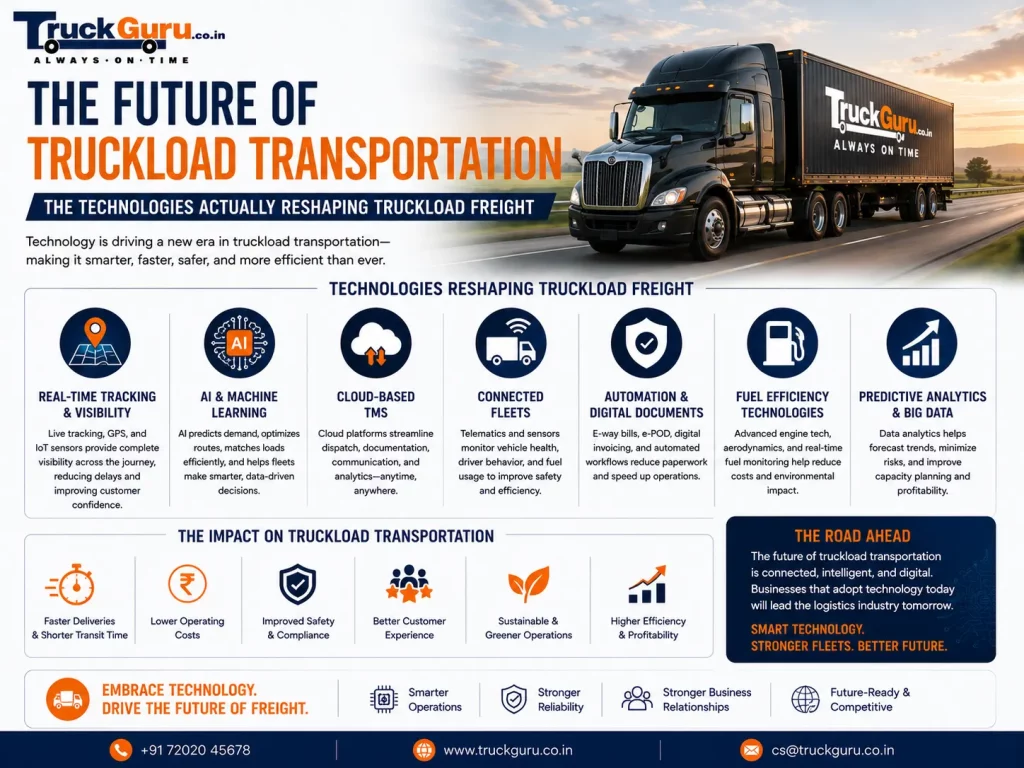
The Technologies Actually Reshaping Truckload Freight
Truckload transportation underpins a large share of supply chains in manufacturing, retail, and agriculture — moving raw materials and finished goods between the points where they are produced and where they are actually needed. In India specifically, that means domestic road freight between cities, since road carries the large majority of the country’s freight by tonnage. Most of the global commentary on “the future of trucking” is written from a US or European vantage point, where some of the technology below is genuinely closer to deployment than it is here.
Future of Truckload Transportation: Quick Summary
Curious about the future of truckload transportation? Discover upcoming trends and innovations shaping the logistics industry for smarter, faster deliveries.
Worth separating what is already practical in an Indian context from what remains further out, rather than treating every global trend as equally near-term everywhere.
This demand shows up directly across logistics services booked between Indian cities every day.
Capacity Concerns
Truckload capacity fluctuates with demand in genuinely hard ways to plan around — seasonal peaks, economic shifts, and regional demand swings all affect how easily a truck is available on a given route at a given time. Transport companies increasingly use data analytics and demand forecasting to plan capacity ahead of these swings rather than reacting to them after the fact, though no amount of forecasting fully eliminates the unpredictability of demand shifting faster than fleets can adjust.
Checking a freight calculator rate ahead of a booking at least removes price uncertainty from the planning equation, even when availability itself is harder to predict.
Rising Fuel Costs
Fuel price volatility affects operating margins directly in an industry where fuel is one of the highest line-item costs. Alternatives like biodiesel, hydrogen fuel cells, and electric trucks are genuine areas of research and limited deployment globally, but it is worth being honest about where India specifically stands: diesel remains the dominant fuel for commercial trucking on Indian roads today, and large-scale alternative-fuel adoption is still in early stages rather than mainstream.
Truck size and category still matter more than fuel type for controlling cost today — see the truck type guide for current options.
Digitalization
This is the trend with the most practical relevance right now, and the one already genuinely deployed rather than speculative. Digital freight tracking, route data, and automated documentation reduce manual errors and the overhead that comes with paper-based processes — a shipment with GPS tracking and a digitally-generated LR and invoice needs less manual reconciliation than one tracked entirely on phone calls and paper receipts. For a business booking freight regularly, this also means fewer disputes over delivery timing, since the tracking record settles the question rather than relying on someone’s memory of when a truck actually arrived.
TruckGuru’s online truck booking and mobile app are concrete, currently available examples of this trend rather than a future promise.
Autonomous Vehicles
Self-driving trucks using sensors and AI to handle highway driving, and in some pilots, more complex traffic conditions, are a real and active area of research globally — the stated goals are fewer accidents linked to driver fatigue, lower operating costs, and some relief for the driver shortage many markets face. It is worth being direct that this remains a pilot and testing-stage technology globally, with no commercial deployment on Indian roads today and no clear regulatory framework yet for how it would work here. This is a trend worth tracking, not something currently relevant to booking a truck in India.
Platooning Technology
Platooning links trucks digitally so they can travel close together in a coordinated line, which can reduce fuel consumption through reduced aerodynamic drag and allows for faster coordinated braking response. Like autonomous driving, this remains in testing and limited pilot deployment globally rather than widespread commercial use, and is not currently part of how trucks operate on Indian highways.
Increasing Transparency and Visibility
Real-time tracking and digitised documentation are genuinely improving visibility across logistics networks, and some companies globally are experimenting with blockchain-based record-keeping for tamper-resistant transaction logs. TruckGuru’s own current visibility tooling is more conventional — GPS tracking on booked shipments and digitally-generated documentation, rather than blockchain infrastructure. Both approaches solve a similar underlying problem: knowing where a shipment actually is and having a reliable paper trail, without relying on someone manually updating a spreadsheet.
Confirm a partner truck and driver through the transporter network before a shipment leaves.
B2B Multi-Modal Platforms
A separate category of logistics technology company operates multi-modal platforms — centralised hubs coordinating road, rail, air, and sea movement for shippers who need more than one transport mode in a single supply chain. This is a genuinely useful model for businesses with that kind of complexity, but it describes a different category of service than a single-mode, domestic road booking platform. Worth knowing the distinction exists, even if it is not directly relevant to most FTL bookings within India.
For straightforward domestic road freight, transportation services booked directly tend to be simpler than routing through a multi-modal hub built for more complex shipments.
Where TruckGuru Fits Today
Set against the broader trends above, TruckGuru’s actual current capability is more modest and concrete: confirmed-rate FTL truck booking between Indian cities, GPS tracking on the shipment itself, and digital LR and GST invoice generation after delivery. No autonomous trucks, no platooning, no blockchain infrastructure — the practical, already-deployed end of the digitalisation trend rather than the speculative end.
Check a confirmed rate on the freight calculator or review available truck sizes for your shipment.
Closing Thoughts
Some of what shapes the future of truckload transportation is already practical and worth adopting now — digital tracking and documentation chief among them. Some of it, like autonomous driving and platooning, is genuinely promising but still years from being relevant to a booking made in India today. Knowing which category a given trend falls into is more useful than treating all of them as equally close to changing how freight actually moves.
Frequently Asked Questions
What is the future of truckload transportation?
A mix of near-term and long-term shifts: digital tracking and documentation are already practical today, while autonomous trucks, platooning, and alternative fuels remain in research and pilot stages globally, with limited to no presence on Indian roads currently.
Are autonomous trucks currently used in India?
No. Autonomous trucking remains in pilot and testing stages globally, with no commercial deployment or clear regulatory framework for Indian roads at this time.
Does TruckGuru use blockchain for tracking?
No. TruckGuru uses GPS tracking on booked shipments and digitally-generated LR and GST invoice documentation. Blockchain-based tracking is a trend some logistics companies are experimenting with globally, not something currently part of TruckGuru’s tooling.
Is TruckGuru a multi-modal logistics platform?
No. TruckGuru books single-mode domestic road FTL transport between Indian cities. Multi-modal platforms coordinating road, rail, air, and sea are a different category of logistics service.
Call 72020 45678 or book online at truckguru.co.in for a confirmed rate on your next shipment.
Related Reading
- Reduce Manufacturing Freight Costs: India Intercity Guide
- Reduce B2B Freight Costs in India: 25 Proven Strategies
- Ship-To GSTIN Mandate August 2026 — What Shippers Must Do
For current rules and official notifications, see the Ministry of Road Transport & Highways.