

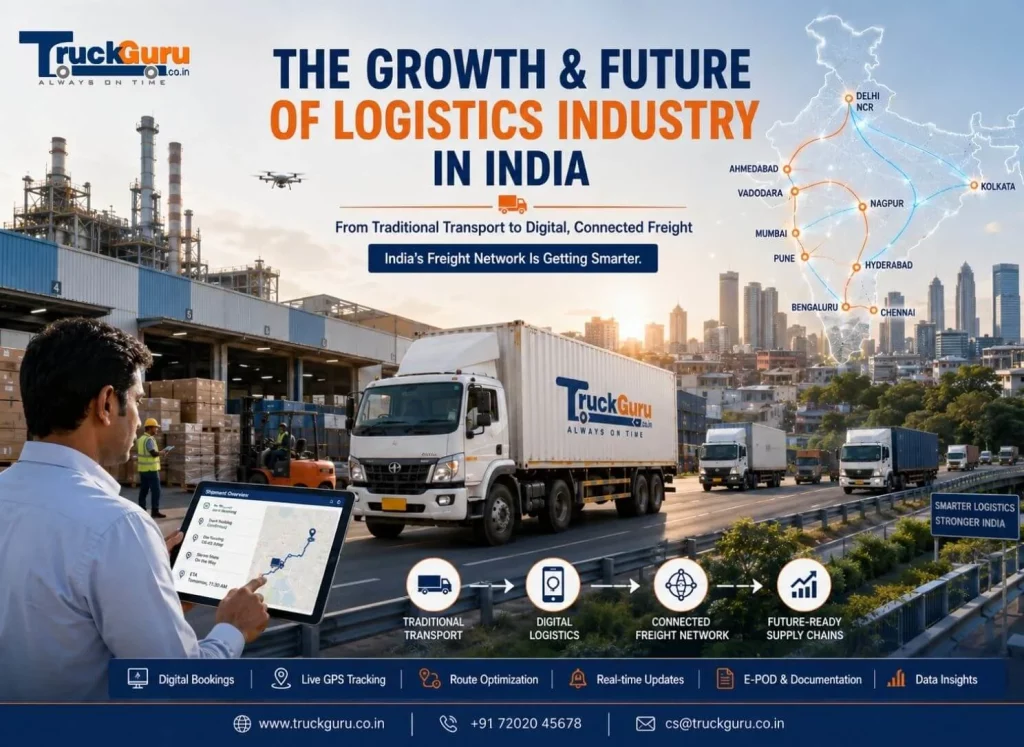
The Growth and Future of India’s Logistics Industry
Ask a freight manager at any mid-size manufacturer how truck booking has changed since 2019 and you will hear roughly the same three things. Trucks are easier to find. Rates hold instead of shifting at the loading dock. Paperwork that used to eat half a day now takes ten minutes on a phone.
Growth and Future of Logistics Industry: Quick Summary
Growth and Future of Logistics Industry: Discover the growth and future of logistics in India. Explore digital solutions, 3PL services &.
There are numbers behind that, and they are worth stating carefully because the widely quoted ones have changed. India’s logistics cost was measured at 7.97 per cent of GDP for FY 2023-24 in an NCAER assessment prepared for DPIIT and launched in September 2025. That figure replaces the 13 to 14 per cent number that circulated for years, which came from adapted international models rather than India-specific measurement.
The market size question gets messier. LogiMAT India put the freight and logistics market at USD 317.26 billion in 2024, heading to USD 484.43 billion by 2029. Other research houses land well below that. Treat any single market-size figure as one estimate among several rather than a settled fact.
What follows is less about the headline numbers and more about which specific things changed on the ground for people who book trucks.
Road still moves most of India’s goods, and rail was never going to change that
Rail and road get framed as competing modes in most industry commentary. On the ground, that framing does not survive contact with reality.
Rail works for bulk commodities. Coal, iron ore, cement, fertiliser, moving in volume between fixed terminals, where a two-day variance in arrival changes nothing. It does not run from a factory gate in Sriperumbudur to a distributor’s dock in Nagpur, and no amount of infrastructure investment will make it do that.
Estimates of road’s share vary by measurement basis, from around 60 per cent in World Bank and KPMG analyses to over 70 per cent in industry reports. Either way the practical conclusion for a shipper stays the same. If you are a pharma company in Genome Valley shipping to a hospital distributor in Chandigarh, or an auto component unit in Bhiwandi filling orders across four states, road FTL is not one option among several. It is how the goods move.
What the freight corridors actually changed
Both dedicated freight corridors are now complete. That is new, and it happened recently enough that a lot of published material has not caught up.
Eastern DFC
The Eastern DFC runs 1,337 km from Ludhiana to Sonnagar and has been fully operational since October 2023, covering Punjab, Haryana, Uttar Pradesh, Jharkhand and Bihar. A 538 km extension from Sonnagar into West Bengal was originally part of the project before being pulled out and handed to the Ministry of Railways separately, which is why older coverage still lists Dankuni as the terminus.
Western DFC
The Western DFC covers 1,506 km from Dadri to JNPT. DFCCIL confirmed completion on 31 March 2026 after the final 102 km JNPT to New Saphale section passed trial runs in both directions. About 1,404 km had already been commissioned by December 2025, so this was the last link rather than a sudden opening.
The Delhi-Mumbai freight belt now has a dedicated rail spine running parallel to it. DFCCIL expects roughly four hours off transit times for trains using the full route.
What that means if you book road freight
It does not mean less demand for FTL trucking. Coal and cement shifting to rail does not affect a manufacturer shipping finished goods between two specific docks. Different cargo, different origin-destination logic, different job entirely.
What it does mean is fewer heavy commercial vehicles on parallel highway stretches. If your loads run on NH 44 or NH 48, that translates to steadier transit windows. Not dramatic. Still real.
A third corridor from Dankuni to Surat, roughly 2,100 km through West Bengal, Jharkhand, Odisha, Maharashtra and Gujarat, was announced in the Union Budget 2026-27 with pre-construction work directed to be fast-tracked. No completion date is public. Treat it as directional rather than something to plan around.
The digital changes that actually reached the shipper
Most logistics technology coverage is written for people who run warehouses, not people who book trucks. Robotics pilots and blockchain proofs of concept do not affect a manufacturer arranging a Coimbatore to Delhi shipment next Tuesday.
Three things did change how that booking works.
Rates that hold. Booking platforms quote a price before you commit and honour it at loading. The complaint shippers have had about informal broker arrangements for decades finally has a structural answer.
E-way bills that verify electronically. GST-linked bills generate and clear at checkposts without paper. On a six-state run from Tamil Nadu to Punjab that matters more than it sounds, because a documentation gap used to mean a call, a wait, and sometimes a penalty.
Rate visibility before the negotiation. Freight calculators let a shipper benchmark corridor rates before talking to anyone. That information previously sat entirely with the broker, which is precisely why rates moved at the loading dock.
The practical version: you can check freight rates on any Indian corridor in under two minutes without picking up the phone. The TruckGuru freight calculator does this by route and truck type, toll included.
What e-commerce did to B2B freight patterns
Amazon, Flipkart and Meesho concentrated freight demand around specific zones. Bhiwandi, Kundli, Manesar, and the fulfilment belt outside Hyderabad. For manufacturers supplying those platforms the distribution pattern inverted.
A Tirupur garment unit used to send smaller consignments to dozens of retail outlets across several states. Now it sends full truckloads to three or four fulfilment centres. Fewer bookings per week, larger loads each time, destinations that stay the same month to month.
The freight mode did not change. The routing got simpler, which made planning easier.
Who is actually running this freight?
The sector is commonly cited as employing more than 22 million people across drivers, warehouse staff, brokers, fleet managers and technology teams. A large share of that sits in small-fleet road freight: owner-operators running one to five trucks who carry a substantial portion of India’s intercity capacity while receiving almost none of the industry coverage.
Digital booking platforms affect this group directly. Small operators get access to steadier demand without depending on a broker relationship. Shippers get a layer of accountability that informal chains rarely provide. The shift is slow, uneven across regions, and nowhere near complete, but it is moving in one direction.
Three problems infrastructure spending has not fixed
City entry restrictions. Heavy vehicle bans during peak hours in Chennai, Hyderabad, Pune and Delhi hit last-mile scheduling directly. A truck arriving outside the window waits. This is a departure-timing problem rather than a distance problem, and shippers who plan only on transit distance get caught by it repeatedly.
Checkpost variability. GST standardised the e-way bill but did not standardise how fast individual checkposts process one. On a seven-state corridor the variation compounds. Experienced freight planners build buffer into transit estimates for exactly this reason, particularly on long north-south routes.
Seasonal rate pressure. October to December and January to March both tighten capacity on high-density corridors, which pushes spot rates up. The exact percentage varies by corridor and year, but the pattern is predictable enough that booking a few days ahead of these windows consistently costs less than booking same-week.
The bottom line
India’s freight infrastructure is genuinely better than it was five years ago. Both DFCs are running end to end, e-way bill compliance is tighter and faster, and corridor rates are visible before you negotiate rather than after.
None of that replaces operational judgment. Knowing which corridors run thin on return loads, which checkpost stretches quietly add an hour, which weeks to avoid in festival season, all of that still matters.
But the baseline improved. You can check a rate on the freight calculator, match your cargo to the right vehicle on the truck size guide, and book an FTL truck at a price that holds. In 2019, that took a lot more phone calls.
FAQ: market, corridors, and policy
What is India’s logistics cost as a percentage of GDP?
An NCAER assessment prepared for DPIIT and launched in September 2025 measured it at 7.97 per cent of GDP for FY 2023-24, or about Rs.24.01 lakh crore. This supersedes the widely quoted 13 to 14 per cent figure, which was based on adapted international models rather than India-specific measurement. An earlier NCAER estimate put FY22 in the 7.8 to 8.9 per cent range.
How large is India’s logistics market?
Estimates vary considerably by methodology. A LogiMAT India 2024 report put the freight and logistics market at USD 317.26 billion in 2024, projected to reach USD 484.43 billion by 2029 at 8.8 per cent CAGR. Other research firms place the 2024 figure closer to USD 230 billion. Use these as directional rather than precise.
Which Dedicated Freight Corridors are operational in India?
Both. The Eastern DFC from Ludhiana to Sonnagar, 1,337 km, has been fully operational since October 2023. The Western DFC from Dadri to JNPT, 1,506 km, was completed on 31 March 2026 after DFCCIL ran trials on the final 102 km JNPT to New Saphale section. A third corridor from Dankuni to Surat was announced in Budget 2026-27 and is in pre-construction.
Do freight corridors reduce demand for road trucking?
No. DFCs move bulk commodities between fixed terminals. FTL road freight moves finished goods between specific factory gates and buyer docks. What corridors change is highway congestion, which means fewer heavy vehicles on parallel stretches and steadier transit windows for road freight.
What is PM Gati Shakti and does it affect my shipments?
It is a planning framework that puts road, rail, port and digital logistics data on one platform across government ministries. It does not affect an individual booking. Its effect shows up over a three to five year horizon as better roads and faster corridor completion.
FAQ: booking, documentation, and cost
How has e-commerce changed B2B freight in India?
It concentrated destinations. Manufacturers supplying e-commerce platforms now typically send full truckloads to three or four large fulfilment centres instead of smaller consignments to many retail outlets. Fewer bookings, larger loads, more predictable routing.
What are the biggest practical challenges for road freight right now?
City-level heavy vehicle entry restrictions that affect last-mile scheduling, checkpost processing variability that adds unpredictable time on multi-state corridors, and seasonal capacity tightening from October through March that pushes spot rates up on high-density routes.
How does FTL trucking fit into all this?
FTL is the primary mode for B2B manufactured goods moving between specific factory and warehouse pairs. As manufacturing clusters in Sriperumbudur, Patancheru, Bhiwandi and Sitapura expand, FTL demand from those clusters grows with them. TruckGuru connects manufacturers directly to verified truck operators at confirmed intercity rates across 110+ cities.
What documentation do I need for intercity truck transport?
An e-way bill for any consignment above Rs.50,000 crossing state borders, generated by the consignor or consignee before dispatch rather than by the transporter. A GST-compliant tax invoice and a Lorry Receipt at dispatch complete the set.
Should I book ahead or wait for a better spot rate?
The corridors where waiting costs most are the ones with weak return-load demand, since the operator prices an empty return leg into your rate either way.
Check a rate for your corridor on the TruckGuru freight calculator or call 72020 45678.
Related Reading
- How to Estimate Goods Transport Rates: A Beginner’s Guide
- How Are Truck Transportation Charges Calculated in India?
- 6 Truck Booking Platforms Compared for FTL Freight in India: FR8, WheelsEye, Trukky, BlackBuck, Vahak & TruckGuru
For current rules and official notifications, see the Ministry of Road Transport & Highways.