

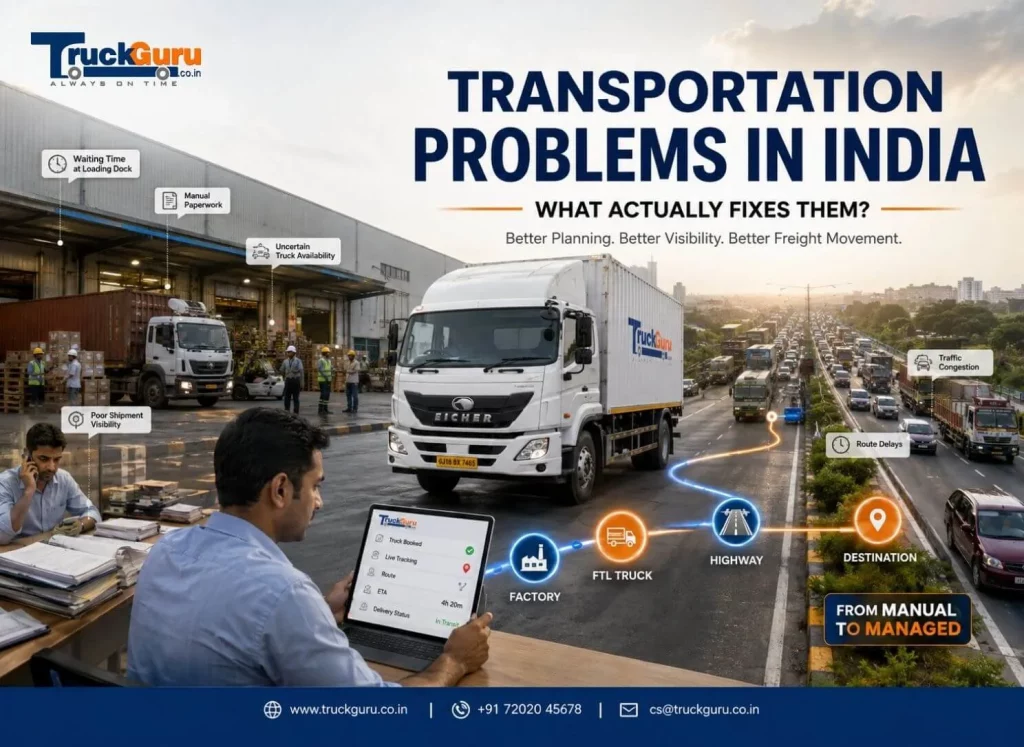
Transportation Problems in India and What Actually Fixes Them
The biggest problem in Indian road freight right now is not fuel prices or bad roads. It is that there are not enough people willing to drive the trucks.
For every 100 trucks on Indian roads there are roughly 55 drivers, down from 75 a few years ago, according to TeamLease Services. That works out to about 60 lakh trucks and 36 lakh drivers, which means somewhere around 20 lakh trucks sit parked on any given day. Not because there is no freight. Because there is nobody to drive them.
Union Minister Nitin Gadkari put the gap at 22 lakh drivers in the Lok Sabha, citing a World Bank report. That is the largest driver shortage of any country in the world.
Everything else on the usual list of transport problems is real. But most of it is manageable with planning. The driver shortage is structural, and it is what a shipper feels first when capacity tightens in October.
Why nobody wants to drive a truck
The pay does not justify the job. Most long-haul drivers earn Rs.20,000 to Rs.25,000 a month. A cab driver in Bengaluru or Pune earns comparable money, sleeps at home, and does not spend 20 to 25 days a month away from family.
Then there is the health cost. A Kantar IMRB study conducted with Castrol India, covering over 1,000 truckers, found that more than half develop chronic conditions by age 40 to 42. Back pain and cervical problems mostly, from sitting in a cab with no suspension worth the name for twelve hours a day.
Ask any fleet owner in Gujarat or Punjab and they will tell you the same thing: drivers do not want their children in the profession. That is the part that makes this structural rather than cyclical.
What is being done
MoRTH issued a notification in December 2023 requiring air-conditioned cabins in all N2 and N3 category vehicles manufactured on or after 1 October 2025. N2 covers goods vehicles between 3.5 and 12 tonnes GVW, N3 covers everything above 12 tonnes. Testing follows IS 14618:2022. It applies to new manufacture only, so the existing fleet is unaffected.
On training, Gadkari has said MoRTH is putting Rs.4,500 crore toward 1,600 driver training centres. Whether that closes a 22 lakh gap is another question, but it is the first commitment at that scale.
Highways are a small share of the network and a large share of the deaths
MoRTH data for 2023 shows highways making up roughly 5 per cent of India’s road network while accounting for more than 53 per cent of accidents and 59 per cent of fatalities. Overspeeding was behind 68 per cent of road deaths.
The 2024 report recorded 4,87,707 accidents and 1,77,175 fatalities nationally. Rural areas carried 62.4 per cent of accidents but 70.8 per cent of deaths, which tells you something about emergency response times outside cities.
For a fleet operator this is not abstract. Higher accident rates on the corridors you run mean higher insurance premiums, more vehicle downtime, and driver attrition after a bad incident. Defensive driving training is one of the few interventions a private operator can actually make without waiting for infrastructure.
Fuel is the cost line everyone watches and few manage well
Diesel is the single largest variable in a freight operator’s cost structure, and there is no lever that makes it cheaper. What there are, are levers that make you burn less of it.
CNG and LNG work on fixed corridors where refuelling infrastructure exists. That is a real qualifier. The Delhi-Jaipur and Mumbai-Pune stretches have reasonable CNG coverage. Much of central India does not, which is why operators running Nagpur or Raipur lanes stay on diesel regardless of the economics.
Electric makes sense under about 150 km on fixed routes with depot charging. Beyond that, range and charging density on Indian highways do not support it yet.
The unglamorous option is driver training. Fuel-efficient driving habits, correct tyre pressure, and route selection that avoids known congestion deliver savings without capital expenditure. Less exciting than switching fleets, considerably faster to implement.
The delays that cost most are the ones nobody plans for
Two kinds of delay hit Indian freight, and shippers consistently underestimate the second one.
The first is city congestion, which everybody knows about. Outer Ring Road, Tumkur Road and Hosur Road in Bengaluru at peak hours. The Bhiwandi approach in Mumbai. These are predictable and can be planned around by shifting departure times.
The second is checkpost variability. GST standardised the e-way bill, but it did not standardise how quickly individual checkposts process one. On a Coimbatore to Ludhiana run crossing six states, the variance compounds, and there is no way to know in advance which crossing will take twenty minutes and which will take three hours.
Experienced freight planners build buffer into transit estimates specifically for this. Shippers who plan purely on distance get caught repeatedly, then blame the transporter.
What helps
- FASTag on every vehicle, which is now near-universal and has cut toll plaza queuing significantly
- E-way bill generated and verified before dispatch rather than at the gate
- Departure timing that accounts for city entry restrictions at the destination, not just the origin
- Night running on corridors where it is safe, which avoids both congestion and daytime heat
Paperwork is better than it was, and still not simple
The e-way bill removed a lot of the old friction. Before GST, a truck running Tamil Nadu to Punjab needed separate state paperwork at each border. That is largely gone.
What remains is permit complexity. National permits cover interstate movement, but operators running mostly within one state and occasionally taking a longer job get caught without the right coverage. It is one of the more common reasons a truck gets held.
The practical answer is boring: keep documents digital, verify the e-way bill covers the full route before the truck leaves, and confirm permit coverage for every state on the corridor. Most documentation delays are avoidable at the planning stage rather than the checkpost.
What this means if you book freight rather than run trucks
Most of the above is an operator problem, not a shipper problem. But it reaches you through capacity and price.
When drivers are short, capacity tightens on high-density corridors first, particularly October through March. Spot rates rise in those windows and the trucks that are available go to shippers who booked ahead. That is the practical consequence of a 55:100 driver ratio for a manufacturer in Hosur trying to get a load to Delhi in November.
Booking a few days ahead of those windows consistently costs less than booking same-week. You can check what a corridor is running at on the TruckGuru freight calculator before committing to anything.
How TruckGuru handles these
Verified vehicles and drivers. Licence class checked against vehicle type, RC, fitness certificate, insurance and permits confirmed before a truck is listed. That removes the permit and documentation category of delay before it happens.
Confirmed rates. The figure quoted at booking is the figure on the invoice, toll included. It does not move at the loading dock.
GPS tracking from dispatch through delivery, so a delay is visible when it happens rather than when the truck fails to arrive. Support runs Mon-Sat 9:30 AM to 6:30 PM and Sunday 9:30 AM to 2:30 PM. Match cargo to the right vehicle on the truck size guide.
FAQ
What is the biggest transportation problem in India?
The driver shortage. India has roughly 55 drivers for every 100 trucks, down from 75 a few years ago, per TeamLease Services. Nitin Gadkari has put the gap at 22 lakh drivers, citing a World Bank report. Around 20 lakh trucks sit idle as a result.
Why is there a truck driver shortage in India?
Pay of Rs.20,000 to Rs.25,000 a month that does not compensate for 20 to 25 days away from home monthly, health conditions affecting more than half of drivers by age 40 to 42 per a Kantar IMRB and Castrol India study, and a generational shift away from the profession.
Are AC cabins mandatory in Indian trucks?
For new manufacture, yes. A MoRTH notification dated 8 December 2023 requires air-conditioned cabins in N2 and N3 category vehicles manufactured on or after 1 October 2025. N2 covers 3.5 to 12 tonnes GVW, N3 above 12 tonnes. Existing vehicles are not affected.
How dangerous are Indian highways for freight?
MoRTH 2023 data shows highways at about 5 per cent of the road network accounting for over 53 per cent of accidents and 59 per cent of fatalities. Overspeeding caused 68 per cent of deaths. The 2024 report recorded 1,77,175 fatalities nationally.
How can transport businesses reduce fuel costs?
CNG or LNG on corridors with refuelling coverage, electric for fixed routes under about 150 km with depot charging, and driver training on fuel-efficient habits. The last one requires no capital and delivers results fastest.
What causes delays at state borders?
Processing variability rather than the paperwork itself. The e-way bill is standardised nationally but checkpost throughput is not. On a six-state corridor the variance compounds unpredictably, which is why experienced planners build buffer into transit estimates.
Do freight rates go up at certain times of year?
Yes. October to December and January to March both tighten capacity on high-density corridors, which pushes spot rates up. Booking ahead of those windows consistently costs less than booking same-week.
How does a shipper avoid documentation delays?
Generate the e-way bill before dispatch rather than at the gate, confirm it covers the full route, and check permit coverage for every state on the corridor. Most documentation delays are avoidable at the planning stage.
Check a corridor rate on the TruckGuru freight calculator or call 72020 45678.
Related Reading
- How to Estimate Goods Transport Rates: A Beginner’s Guide
- How Are Truck Transportation Charges Calculated in India?
- 6 Truck Booking Platforms Compared for FTL Freight in India: FR8, WheelsEye, Trukky, BlackBuck, Vahak & TruckGuru
For current rules and official notifications, see the Ministry of Road Transport & Highways.