

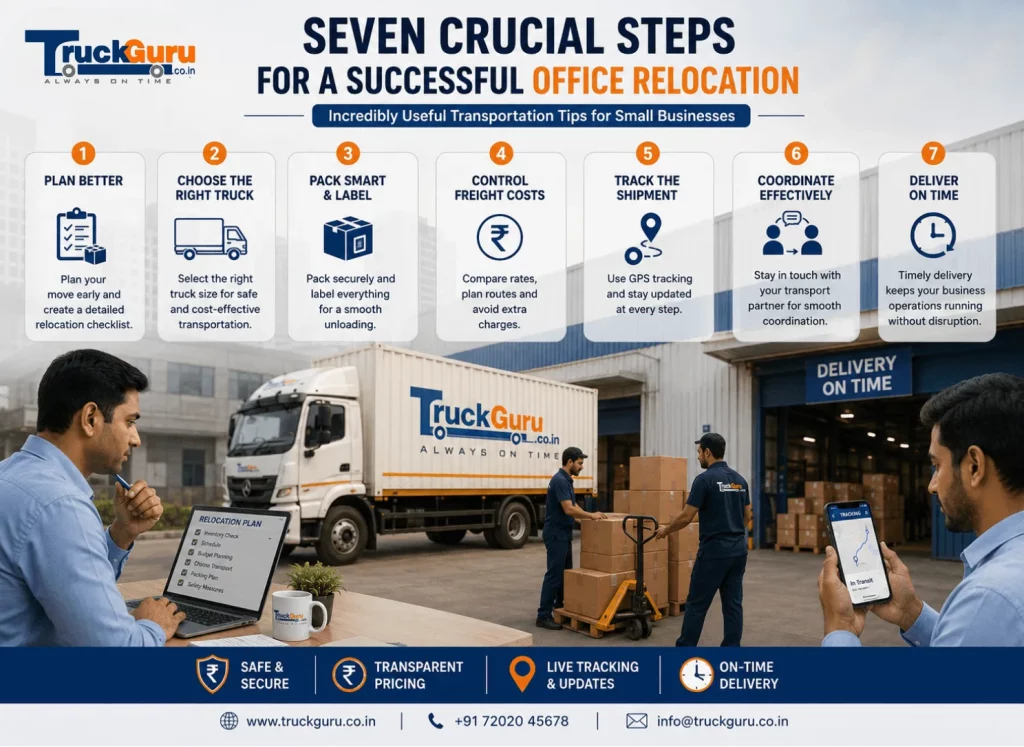
Following the right office relocation steps is what separates a smooth move from a week of chaos. Most office moves go wrong before moving day arrives — the truck shows up, and half the team is still packing. The internet at the new office isn’t set up. A key server wasn’t properly shut down. These aren’t bad luck. They happen when planning starts two weeks too late.
Office Relocation Steps: Quick Summary
Office relocation steps: Planning an office move? Follow these seven practical steps to relocate your office smoothly, on schedule, and without disrupting.
Relocating an office is genuinely complex. You’re not moving chairs and monitors. You’re moving an operational system that 20, 50, or 200 people depend on every day. The companies that come out the other side without disruption aren’t doing anything heroic. They’re just more organised.
Here’s how to actually do it.
1. The Timeline You Think You Need Is Too Short
Be honest with yourself about lead time. A small office — say 15 to 40 people — genuinely needs three to five months of runway, even if it doesn’t feel like it. Anything above 80 people, or any move that crosses state lines, needs at least a year. Often more.
Here’s why that sounds excessive until it isn’t: commercial lease exit clauses alone can take 30 to 90 days to action. Then you have IT decommissioning, vendor notifications, building access approvals at both ends, regulatory filings if your registered address is changing, and interior fit-out at the new place. The fit-out rarely finishes on time.
Start a project doc the same week you decide to move. Nothing elaborate — just a list of everything that needs to happen, in order, with names and dates next to each item. That document will save you from the thing that sinks most office moves: discovering a critical task in week eight that should have started in week two.
If you need intercity freight as part of the move, look at intercity freight services early. Availability on popular routes — especially end-of-month — fills up faster than most people expect.
2. One Person Has to Own This
Committees don’t move offices. People do.
Pick one person to be accountable for the entire relocation. Not the CEO — they don’t have the bandwidth, and they’re the wrong profile for this anyway. You want someone senior enough to make calls without constant approval, but operational enough to know how the building works, where things are stored, and which department will cause problems if you don’t loop them in early.
That person needs real authority: sign off on vendor quotes up to a defined limit, make space allocation decisions, pull people from regular work when the move needs attention. A coordinator with no authority is just someone to blame when things go wrong.
One practical thing: get their manager’s explicit commitment to reduce their regular workload in the final six to eight weeks before the move. Otherwise you end up with someone who runs a major logistics operation between back-to-back meetings.
3. You Need a Move Team, Not Just a Move Manager
The coordinator can’t manage every workstream alone. Each department holds information only they know — which equipment is critical, what can go into storage, where the unusual power requirements are, which team needs to walk in first on day one.
Set up a small working group: someone from IT to own server migration and network setup at the new location; someone from admin or facilities to deal directly with the freight vendor and manage access logistics; a person from HR or comms to keep employees informed so nobody finds out about the move from the rumour mill; department heads to confirm space requirements for their teams.
This group meets weekly in the two months before the move. Not for status updates — for catching blockers before they turn into crises. The question every meeting should answer: what will go wrong if we don’t deal with it this week?
Write down every decision. Who decided what to move versus dispose of. Which floor goes first. Where the server room sits in the new building. Verbal agreements made under time pressure have a way of turning into arguments when you’re standing in an empty office at 9pm wondering where the network switch ended up.
4. Your First Budget Estimate Is Wrong. Add 15 Percent.
Almost everyone underestimates the cost of an office move. Not because they’re careless — the non-obvious costs are genuinely hard to anticipate until you’ve done it once.
The obvious line items: freight, packing materials your team sources themselves, and a local labour contractor if you need loading help. The costs that catch people: professional dismantling of modular workstations (most office furniture doesn’t survive moving in assembled form), server rack deinstallation and reinstallation, IT setup at the new office including cabling and ISP provisioning, disposal or resale of equipment you don’t plan to take, and temporary storage if your exit and entry dates don’t line up.
That last one catches more people than you’d expect. You hand back the old office on the 31st, the fit-out at the new place finishes on the 7th. A week of commercial storage for a 60-person office’s worth of furniture adds up fast.
For the freight portion — the actual truck movement between cities — check the TruckGuru freight calculator before you finalise the budget. You get a real number for your route and volume, which beats estimating blind.
One thing to state clearly: TruckGuru provides truck and driver. Your team handles packing and loading at your end. If you need labour for that, source a local contractor separately.
5. Not Every Freight Company Can Handle an Office Move
A company that moves household goods and a company that can handle a 60-workstation office with servers, modular furniture, and a firm delivery window are not the same thing.
When you evaluate freight vendors, ask specifically: did they handle commercial office relocations before — not just general freight? What’s the largest office move on their record, and can they provide a reference? Do they offer a dedicated truck, or do they co-load your goods with other shipments and make multiple stops?
Co-loading costs less. It also means your goods sit in a depot overnight, get handled three times, and arrive two days late. For an office move — where your team stands by waiting to set up — that trade-off rarely makes sense.
Before you compare quotes, work out how much space you actually need. Use the truck type guide to understand which vehicle class fits your volume, then check the truck size guide for load capacity. TruckGuru’s FTL network runs dedicated trucks on intercity routes across India — the fleet goes from Tata Ace at 750kg up to 32ft containers at 15 tonnes plus. Fixed trip rate at booking, no per-km billing, no intermediate stops. Check your route on the TruckGuru freight calculator before you commit.
Get two or three quotes regardless. Compare what each includes and how each structures its pricing — not just the headline number.
6. Your Moving Date Should Come From Your Lease, Not Your Preference
The date you want to move and the date you can actually move often differ by weeks.
Pull out your current lease and read the exit clause before you put any dates on the calendar. Most commercial leases require 30 to 90 days’ written notice. Some carry make-good clauses — you have to restore the space to original condition, remove cabling, patch walls, sometimes repaint — before you hand back the keys. Missing these clauses tends to cost more than the freight bill.
At the new location, get the fit-out completion date from the builder in writing, then add two weeks as buffer. Fit-outs run late. If you move into a managed or coworking space, check upfront whether you have dedicated freight lift access during your move window. Some buildings have strict move-in hours — if your truck arrives at 4 pm on a Friday and the loading bay closes at 5 pm, you have a real problem.
Once you lock in dates, tell the freight vendor that day. End-of-month slots fill fast — most commercial leases expire on the last day of the month, so everyone moves at the same time. Good operators book out weeks ahead.
7. Tell People Before the Move, Not After
Every person, company, or government body that sends you something physical or digital needs your new address before you move — not when their delivery bounces or their email goes unanswered.
Clients need a formal written notice at least 30 days before the effective date. Include the new address, when it takes effect, and who to contact with questions. A website banner alone won’t cut it.
Suppliers and vendors who deliver goods need updated records before your move date — your stationery supplier, equipment vendors, anyone who sends physical contracts. A courier arriving at your old address on moving day is a solvable problem, but it’s one more thing to handle when you already have enough going on.
On the compliance side: if your registered office address changes, file with the Ministry of Corporate Affairs. Form INC-22 covers changes within the same state; Form MGT-14 may apply for other scenarios — check with your company secretary. Update GST registration through the portal too. People procrastinate on this one. An incorrect address on GST filings creates invoicing and ITC problems that compound over months.
Update Your Digital Presence After the Move
Once you sort the legal side, work through your digital footprint: website footer, Google Business Profile, LinkedIn company page, Justdial, Indiamart, and any directory listing where your address appears. Set a reminder to check all of these one week after the move — some updates take time to propagate.
What the First Week Actually Looks Like
Even a well-planned office move produces a chaotic first week. Accept that now so it doesn’t catch you off guard.
Run a proper audit at 48 hours: every workstation powered on, internet and phones confirmed live across all desks, damaged or missing items logged immediately. Don’t let minor damage sit — photograph it and raise it with the freight provider while the evidence is fresh. Get the claims process from your freight vendor in writing before moving day, not after.
The other thing worth doing in week one: write down what you’d do differently. Not in a blame-audit way — just practical notes on what the timeline got wrong, what cost more than expected, what decision you made at 11pm that could have happened three weeks earlier. The next time your business relocates, that document is worth more than any guide.
Frequently Asked Questions About Office Relocation Steps
How far in advance should we start planning an office relocation?
For offices under 30 people, three to four months works if you act immediately and make decisions fast. Above 30 people, six months is more realistic. Large offices or intercity moves — especially state-to-state — need nine to eighteen months. Lease negotiations, fit-out delays, and IT migration eat the timeline before logistics even begin.
How do we work out how many trucks we need?
Start with an inventory: workstations, chairs, server racks, cabinets, packed boxes. A 32ft container takes around 15 tonnes — roughly the contents of a fully furnished 50 to 60 person office. A 14ft truck takes 3 to 3.5 tonnes, suitable for a team of 8 to 12 people. Use TruckGuru’s truck size guide as a starting point, then get your freight vendor to do an on-site survey before you confirm. Estimates from memory are guesses.
What’s the practical difference between FTL and a shared truck?
FTL means the truck carries your goods only, direct from pickup to destination. With a shared truck, your goods enter a consolidated load, go to a depot, transfer, then arrive via multiple stops. Shared costs less and introduces more risk — slower, harder on fragile items, unpredictable on timing. For a household move where a day’s delay doesn’t matter, shared can work. For an office where 50 people need to work on Monday morning, it’s a gamble.
Do we need to update our GST registration when we move offices?
Yes — do it before the move, not after. Moving within the same state means updating your existing registration with the new address through the GST portal. Crossing state lines means you need a new GST registration in the destination state. Sitting on this means invoices go out with an incorrect address, which creates ITC disputes that compound quietly over time.
How should we handle servers and IT equipment during an office move?
IT packs last and sets up first. Servers need a full shutdown and backup before they go near a truck. Use anti-static packaging throughout. If your IT team doesn’t have experience decommissioning and recommissioning server hardware — including checking for vibration damage after transport — bring in a specialist. This is not work for a general moving crew.
Does TruckGuru provide packing or loading labour for office moves?
No. TruckGuru provides truck and driver for intercity FTL freight. Your team packs and loads at the pickup point. If you need loading labour, arrange it through a local contractor. You can book a truck online directly once your dates and route are confirmed.
Related Reading
- How to Estimate Goods Transport Rates: A Beginner’s Guide
- How Are Truck Transportation Charges Calculated in India?
- 6 Truck Booking Platforms Compared for FTL Freight in India: FR8, WheelsEye, Trukky, BlackBuck, Vahak & TruckGuru
For current rules and official notifications, see the Ministry of Road Transport & Highways.