

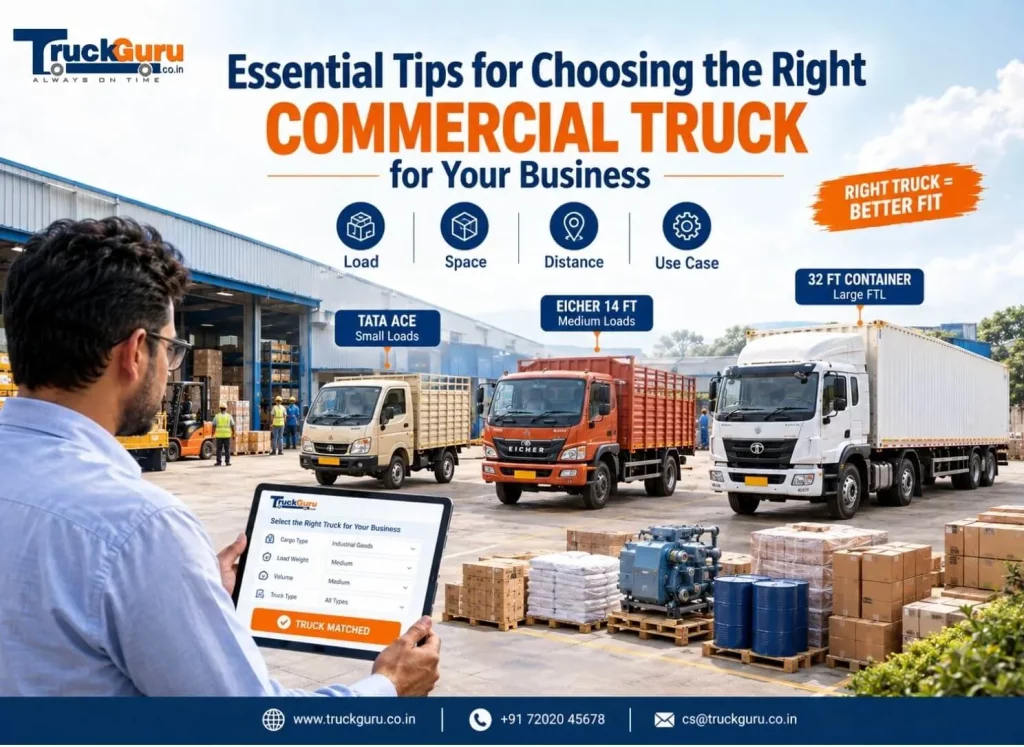
Essential Tips for Choosing the Right Commercial Truck for Your Business
A furniture manufacturer in Jodhpur buys a commercial truck to stop paying freight bills. Eighteen months later, the 14ft vehicle sits idle three weeks a month, the driver has left twice, and the fitness renewal is due. The size was right. The purchase was still the wrong call, because the business never had enough consistent volume to keep the truck moving.
Commercial Truck for Business: Quick Summary
Commercial truck for business: Truck sizes in India explained: compare load capacity, axle types, and truck classes to choose the right vehicle for your.
Buying a commercial truck in India is less about the vehicle than most buying guides admit. The specification decisions are the easy part. What decides whether the purchase works is utilisation, running cost and whether you can keep a driver. This guide covers all three, plus the specification checks that actually matter in Indian conditions.
Start with the question most buyers skip
Before comparing models, work out how many days a month the truck will actually be loaded and moving.
This number decides everything. A commercial vehicle costs you money on the days it does not move as well as the days it does, because EMI, insurance, permit, parking and driver salary do not pause. Owning becomes sensible when your utilisation is high and predictable. It stops being sensible when your volume is seasonal or lumpy.
Do the calculation honestly. Take your last twelve months of freight spend, then count the number of trips behind it and the routes they ran. Two things usually emerge:
- Dead running: the return leg. If you send goods from Jodhpur to Delhi and have nothing coming back, you own a truck that earns on half its kilometres. Return loads are the single biggest variable in owner-operator economics, and most first-time buyers plan for them optimistically.
- Seasonality: agricultural, textile and construction supply chains have pronounced peaks. A truck sized for your peak month is idle in your quiet months. A truck sized for your average month cannot handle your peak.
If your volume runs steady on fixed routes with return loads available, owning tends to work. If it is seasonal, or spread across many destinations, or under roughly half the month, the numbers usually favour booking freight as you need it. Plenty of businesses land on a mixed approach: own one vehicle for the routes that run constantly, book the rest.
Match the commercial truck class to your load, not your ambition
Oversizing is the more expensive mistake when buying a commercial truck, because you pay for the capacity on every trip whether you use it or not, and larger vehicles cost more on fuel, tyres, permits and insurance.
The market segments break down roughly as follows.
Light commercial vehicles
Tata Ace, Tata Intra, Ashok Leyland Bada Dost, Mahindra Bolero Pik-Up and similar. Load capacity from around 750 kg upward. These suit businesses moving small consignments frequently, and they reach pickup and delivery points that larger vehicles physically cannot. Service networks are dense across India, which matters more than it sounds when you break down at 2am on a state highway.
Medium commercial vehicles
Tata 407, Eicher Pro series, Mahindra Furio and comparable models. This is the working segment for most SME distribution and manufacturing supply. The 14ft body class in particular carries a large share of Indian intercity freight, so parts, drivers and resale demand are all easy to find.
Heavy commercial vehicles
Larger rigid trucks and container bodies. These make sense only at high, consistent volume, because the fixed costs are substantial and the driver requirement is more specialised. Buying into this segment on projected volume rather than proven volume is where fleet owners most often get into trouble.
One correction on terminology worth knowing before you talk to a dealer: LCV, MCV and HCV are regulatory categories based on gross vehicle weight, defined under the rules administered by the Ministry of Road Transport and Highways. They are not a good guide to deck length. Two vehicles in the same category can have very different body sizes, so compare on body length in feet and registered load capacity in tonnes.
Load capacity is the number to verify, not assume
Every vehicle has a registered load capacity and a gross vehicle weight. These are different figures, and dealer conversations blur them regularly. Ask for the registered load capacity in the RC, and size your purchase against the heaviest consignment you move routinely, not your average.
Then check the other limit. Cargo density decides whether you run out of weight or deck space first. Dense goods such as tiles, castings, chemicals in drums and bagged material hit the weight ceiling with the body part empty. Bulky goods such as textiles, packaging and moulded plastics fill the deck at a fraction of capacity. If you move bulky cargo, buying for tonnage alone will leave you with a vehicle that is technically adequate and practically too small.
What a commercial truck actually costs to run
The purchase price of a commercial truck is the visible cost. These are the ones that decide whether it earns.
- Fuel: the largest running cost by a wide margin. Diesel remains the default in commercial segments. Compare rated mileage against the load and terrain you actually run, since figures quoted for empty running on flat highway will not hold on loaded hill or ghat sections.
- Driver salary and availability: budget this before you commit. Driver shortage is a real constraint across Indian road freight, and a parked truck with no driver costs the same as a parked truck with a broken axle.
- Maintenance and parts: check service centre density on your actual routes, not nationally. A model with strong national coverage but no workshop between your origin and destination is a problem waiting to happen.
- Insurance, permits and compliance: commercial vehicle insurance, national or state permit depending on where you run, fitness certificate renewals, and the AIS-140 GPS requirement applicable to certain commercial categories. Requirements and fees vary by state and are revised periodically, so check current rules on Parivahan Sewa or with your RTO before you budget for them.
- Tyres: a recurring cost that surprises first-time owners. Heavier vehicles and loaded running consume tyres faster than most purchase calculations allow for.
- Resale: high-volume models hold value better because the second-hand market for them is deep. Segment-wise production and sales data published by the Society of Indian Automobile Manufacturers is a useful check on which models are genuinely in wide circulation. An unusual model may be cheaper to buy and considerably harder to sell.
Safety features worth paying for in Indian conditions
International buying guides list driver-assistance features that are not standard, or not available, across much of the Indian commercial vehicle range. Focus on what you can actually specify:
- Anti-lock braking, which is mandatory across commercial vehicle categories in India.
- Load body construction quality and lashing points, since cargo restraint prevents more damage than any electronic aid.
- Cabin visibility and mirror coverage, which do more for real-world safety on Indian roads than blind spot electronics.
- Reverse camera or sensors, genuinely useful for loading bay manoeuvring.
- Tyre pressure monitoring, worth having given the correlation between underinflation and highway tyre failure.
Treat features such as automatic emergency braking, lane departure warning and roll stability control as segment-dependent. Ask the dealer to confirm availability on the exact variant rather than assuming from a brochure.
Financing without overcommitting
Commercial vehicle finance is widely available through banks and NBFCs, and lenders who specialise in the segment usually offer better terms than general lending. Leasing suits businesses that refresh vehicles regularly or prefer to keep the asset off the balance sheet.
The discipline that matters: size the EMI against your realistic monthly utilisation, not your best month. A repayment schedule built on peak-season revenue becomes a problem in the third quiet month.
When booking beats buying a commercial truck
There is no virtue in owning a truck if the numbers do not support it. Booking freight makes more sense when your volume is seasonal, your routes change, your return legs run empty, or you would rather keep capital in the business than in a depreciating asset.
It is also the practical answer for peak-season overflow when you already own vehicles. TruckGuru runs full truck load intercity freight across 110-plus cities in India, with toll included in the quoted fare, so you can compare a booked trip against your own running cost on the same route. You can check rates through online truck booking or look at truck rental services if you want capacity without the purchase.
If you are still working out what size vehicle your cargo needs, whether you buy or book, the guide to truck sizes in India covers load capacity by class in more detail.
Key takeaways
- Work out your monthly utilisation before comparing models. It decides the purchase more than any specification does.
- Plan for the return leg. Empty running is the largest hidden cost in owner-operator economics.
- Oversizing costs you on every trip. Size against your routine heavy consignment, not your ambition.
- Check cargo density as well as weight, or bulky goods will outgrow a vehicle that looks adequate on tonnage.
- Service network density on your actual routes matters more than national coverage figures.
- Seasonal or route-variable volume usually favours booking freight over owning a vehicle.
Frequently asked questions
Should I buy a truck or book freight as needed?
Buy when your volume is steady, your routes are fixed and return loads are available. Book when volume is seasonal, destinations vary, or the vehicle would sit idle a significant part of the month. Many businesses do both, owning for the constant routes and booking the rest.
Which commercial truck is best for a small business in India?
For small consignments moved frequently, the light commercial segment around the Tata Ace, Tata Intra and Ashok Leyland Bada Dost is the usual starting point. For SME distribution and manufacturing supply, the 14ft class is the most common choice, with the widest availability of parts, drivers and resale demand.
What is the difference between load capacity and gross vehicle weight?
Load capacity is what the vehicle can legally carry as cargo. Gross vehicle weight is the total permitted weight including the vehicle itself. Dealers sometimes quote the larger number. Confirm the registered load capacity from the RC before you buy.
How much does it cost to run a commercial truck in India?
It varies too widely by vehicle class, route and state to quote a single figure. Build your own estimate from fuel at your actual loaded mileage, driver salary, EMI, insurance, permit and fitness renewals, tyres, and a maintenance provision. Get quotes for each line rather than relying on published averages.
Is a bigger truck a safer purchase?
No. A larger vehicle costs more on fuel, tyres, permits and insurance on every trip, whether or not you use the capacity. Oversizing is the more expensive of the two mistakes.
Do I need a national permit?
It depends on whether you operate across state boundaries and on your vehicle category. Confirm the current requirement with your RTO, since permit rules and fees vary by state and are revised periodically.
What holds resale value best?
High-volume models in common body sizes, because the second-hand market for them is deep and buyers can find parts easily. Unusual models often cost less new and considerably more in time and discount when you sell.
Before you sign anything
Count your loaded days per month, price the same routes as booked trips, and compare the two honestly. If owning wins, you will buy with confidence rather than hope. If it does not, you have saved yourself a vehicle that spends three weeks a month parked. You can price your routes on the TruckGuru freight calculator to make that comparison with real numbers.

Related Reading
- How to Estimate Goods Transport Rates: A Beginner’s Guide
- How Are Truck Transportation Charges Calculated in India?
- 6 Truck Booking Platforms Compared for FTL Freight in India: FR8, WheelsEye, Trukky, BlackBuck, Vahak & TruckGuru
For current rules and official notifications, see the Ministry of Road Transport & Highways.