

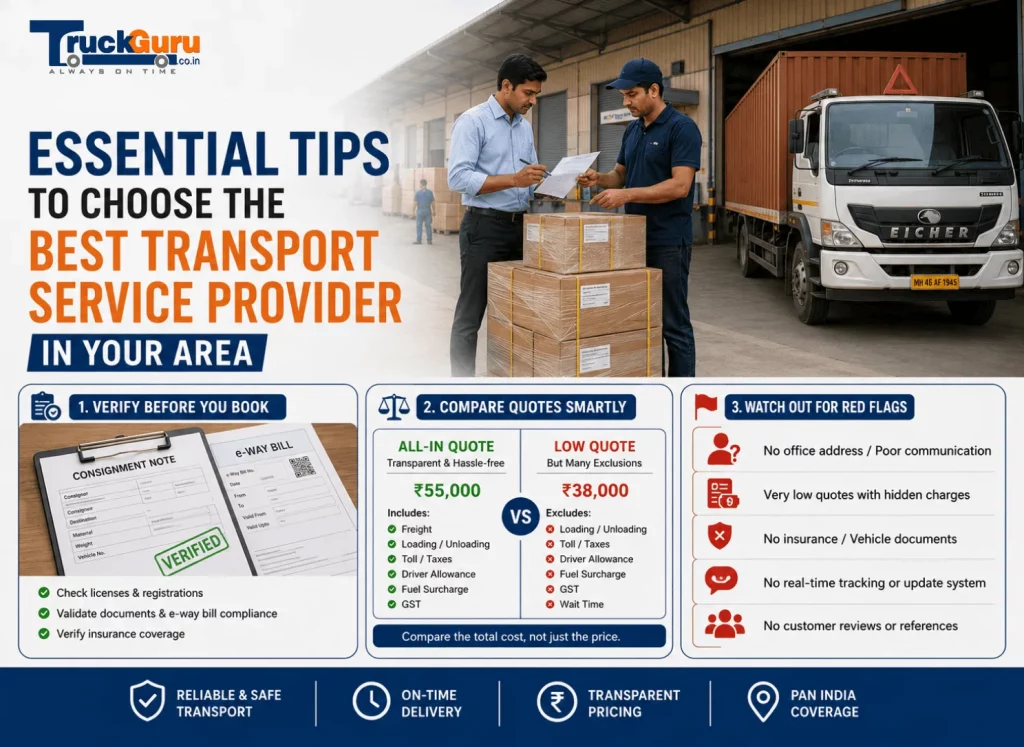
Essential Tips To Choose The Best Transport Service Provider In Your Area
A pharma distributor in Vadodara moves a consignment to Hyderabad with a transport service provider found through a WhatsApp group. The rate was good. Three cartons arrive damaged, and when the distributor asks about a claim, it turns out there was no consignment note, no declared value, and no written record of who was carrying the goods. The transporter stops answering calls. There is nothing to claim against.
Transport Service Provider: Quick Summary
Transport service provider checks that matter: GSTIN verification, consignment note, e-way bill, insurance liability, and how to read a freight quote.
This is the ordinary failure in Indian road freight, and it is a paperwork failure rather than a driving one. Choosing a transporter well is mostly about checking a short list of things before the truck is loaded, while you still have leverage. Here is what actually matters.
What a transport service provider does, and where the liability sits
A transport service provider arranges and carries goods between two points for a fee. In Indian tax terms, most road freight operators fall under the Goods Transport Agency definition, and a Goods Transport Agency is required to issue a consignment note.
That last point matters more than anything else in this article. The consignment note, still commonly called the lorry receipt or LR, is the contract of carriage. Without it you have no documented agreement about what was collected, in what condition, at what declared value, and who accepted responsibility. Any operator who will move your goods without issuing one is not a serious option, whatever their rate looks like.
Verify the business before you verify the price
Reputation checks on their own do not tell you much. Reviews are easy to fake, and a good reference from another shipper says the transporter performed on that route, not that they are financially or legally sound. Do the checks that produce documents.
- GSTIN: ask for the GST registration number and verify it on the GST portal. It takes under a minute and confirms the legal name, registration status and state of registration match what you have been told.
- Registered name and address: confirm the invoicing entity is the same one arranging your movement. Freight is heavily brokered in India, and the operator quoting you is sometimes not the one carrying the goods.
- Vehicle documentation: for the vehicle actually assigned, ask for the registration number, and confirm insurance and fitness are current. On interstate movements, check the permit covers your route.
- Written quote: a rate given only over a phone call is not a quote. Get it in writing with the route, vehicle type, load capacity and inclusions stated.
If a transport service provider hesitates on any of these, that is your answer. None of it is unreasonable to ask for, and established operators supply it without friction.
The paperwork that protects you
Three documents do the work if something goes wrong.
- Consignment note or LR: issued at loading. Check it records the correct consignee, the number of packages, the declared value and the condition of goods received. Errors here are corrected at the loading bay in two minutes and are almost impossible to correct afterwards.
- E-way bill: required under GST for consignments above a specified value, with the threshold and intrastate rules varying by state. Generate or verify it on the e-way bill portal and confirm the current limit applicable to your movement rather than relying on a figure quoted to you.
- Proof of delivery: signed and dated at the receiving end, with any damage noted at the point of receipt. Damage recorded on the POD is a claim. Damage discovered and reported two days later usually is not.
Ask who carries the risk, because the answer is often nobody
This is the question most shippers skip, and most transporters are happy not to raise.
A carrier accepting your goods carries a degree of liability, but that liability is frequently limited, and it is not the same as your consignment being insured for its value. Transit insurance covering the declared value of the goods is a separate arrangement, taken either by you or by the transporter on your behalf, and it costs money.
So ask directly: is my consignment insured, for what value, and who is the policyholder? Get the answer in writing before loading. If the response is vague, assume the goods are uninsured and decide whether you are comfortable carrying that risk on the consignment value involved. For high-value cargo such as pharmaceuticals, electronics or engineering components, arranging your own transit cover is usually the sounder route.
How to read a freight quote from a transport service provider
The headline rate is the smallest part of the comparison. Two quotes are only comparable when you know what each one excludes.
- Toll: ask whether it is included or billed at actuals. On long corridors, this shifts the total meaningfully, and it is the most common source of a final bill exceeding the quote.
- Loading and unloading: labour at either end is often not included. Confirm who arranges and pays for it.
- Detention: if your vehicle waits at the gate, charges usually start after a free period. Ask what the free period is and the rate after it, before you need to know.
- Vehicle type and load capacity: a rate quoted for a 20ft container is not comparable to one quoted for a 32ft. Confirm the body length and registered load capacity on the quote.
- Return or empty running: on routes with poor return loads, some operators price the return leg in. Others add it later. Ask.
Payment terms, and the cash question
Payment structure tells you a lot about how an operator runs. Staged payments tied to milestones, such as an amount at confirmation, the bulk at loading once the vehicle reaches your pickup point, and the balance at delivery, keep both sides accountable.
Treat a demand for full payment upfront as a warning sign. Treat cash-only insistence as a bigger one, because it usually means no GST invoice, and no invoice means no input tax credit for you and no paper trail if you need to make a claim. Bank transfer, UPI and card payment all leave a record. That record is the point.
Coverage, routes and local presence
Match the operator to the corridor rather than to a general impression of size. A transporter with strong Gujarat to Maharashtra volume may be weak on Gujarat to the Northeast, and the difference shows up as delays and vehicle placement failures rather than as anything visible in their profile.
- Ask specifically about the route you move most, not their network in general.
- Check they can place a vehicle at your pickup location, including approach road constraints in older industrial areas.
- For businesses in clusters such as Vadodara, Ankleshwar, Bhiwandi, Ludhiana or Hosur, ask about frequency on your corridor. Regular volume usually means faster placement and better rates.
- Confirm working hours and who you contact when a vehicle is delayed. A named person beats a general helpline.
Red flags worth walking away from
- No consignment note or LR issued at loading.
- Refusal to share GSTIN, or a number that does not verify on the GST portal.
- Cash-only payment, or full payment demanded before loading.
- A rate significantly below every other quote, which usually means something has been excluded rather than discounted.
- No written answer on insurance and declared value.
- The entity invoicing you is different from the one arranging the movement, with no explanation.
If you would rather not run these checks vendor by vendor, a booking platform handles the intermediary layer for you. TruckGuru operates full truck load intercity freight across 110-plus cities in India, connecting shippers with transport vendors on a documented booking, with toll included in the quoted fare rather than added at delivery. Payment runs as a Booking Amount at confirmation, 90 percent once the truck reaches your pickup location, and the balance at delivery before unloading. NEFT, IMPS, UPI and major debit and credit cards are accepted, and cash is not. Corridor pages cover specific origins, including truck booking in Mumbai and Bangalore.
If you are still deciding what vehicle your consignment needs before you approach anyone, the guide to truck sizes in India covers load capacity by class.
Key takeaways
- The consignment note is the contract of carriage. No LR at loading means no claim later.
- Verify the GSTIN on the government portal rather than trusting a number on a letterhead.
- Carrier liability is not the same as your goods being insured. Ask for the declared value and policyholder in writing.
- Compare quotes on inclusions, particularly toll, loading, labour and detention, not on the headline rate.
- Cash-only or full-payment-upfront demands are the clearest warning signs in the market.
- Judge an operator on your specific corridor, not on the size of their network.
Frequently asked questions
How do I know if a transport company is genuine?
Verify their GSTIN on the GST portal, confirm the invoicing entity matches the one arranging your movement, and check they issue a consignment note at loading. An operator who supplies all three without hesitation is almost always a real business.
What is a consignment note or LR?
It is the document issued by the carrier when goods are collected, recording the consignor, consignee, number of packages, declared value and condition of goods. It functions as the contract of carriage and is what any damage or loss claim rests on.
Who pays if goods are damaged in transit?
It depends on what was agreed and documented. Carrier liability is often limited and is not the same as full-value insurance. Unless transit cover was arranged for the declared value, and the damage was recorded on the proof of delivery at receipt, recovering the loss is difficult.
Should I choose the cheapest transport service provider?
Rarely. A rate well below every other quote usually reflects something excluded, such as toll, loading labour or return running, rather than genuine efficiency. Compare the total landed cost with inclusions listed, then decide.
Is an e-way bill always required?
It is required for consignments above a specified value, with thresholds and intrastate rules varying by state. Check the current limit for your movement on the e-way bill portal rather than assuming, since the rules are amended periodically.
What payment terms are normal in Indian road freight?
Staged payments are standard: an amount at booking confirmation, the bulk at loading once the vehicle reaches the pickup point, and the balance at delivery. Full payment demanded before loading is unusual and worth questioning.
Does a local transporter beat a national one?
Neither wins automatically. What matters is volume on your specific corridor. A regional operator running your route daily will often place vehicles faster than a larger network that runs it occasionally.
Before you confirm the booking
Run the checks in the order they appear here: verify the entity, get the quote in writing with inclusions, settle the insurance question, then confirm the LR will be issued at loading. It takes one phone call and one portal check, and it is the difference between a claim you can make and a loss you absorb. You can compare rates and vehicle options through online truck booking when you are ready to move.
Related Reading
- How to Estimate Goods Transport Rates: A Beginner’s Guide
- How Are Truck Transportation Charges Calculated in India?
- 6 Truck Booking Platforms Compared for FTL Freight in India: FR8, WheelsEye, Trukky, BlackBuck, Vahak & TruckGuru
For current rules and official notifications, see the Ministry of Road Transport & Highways.