

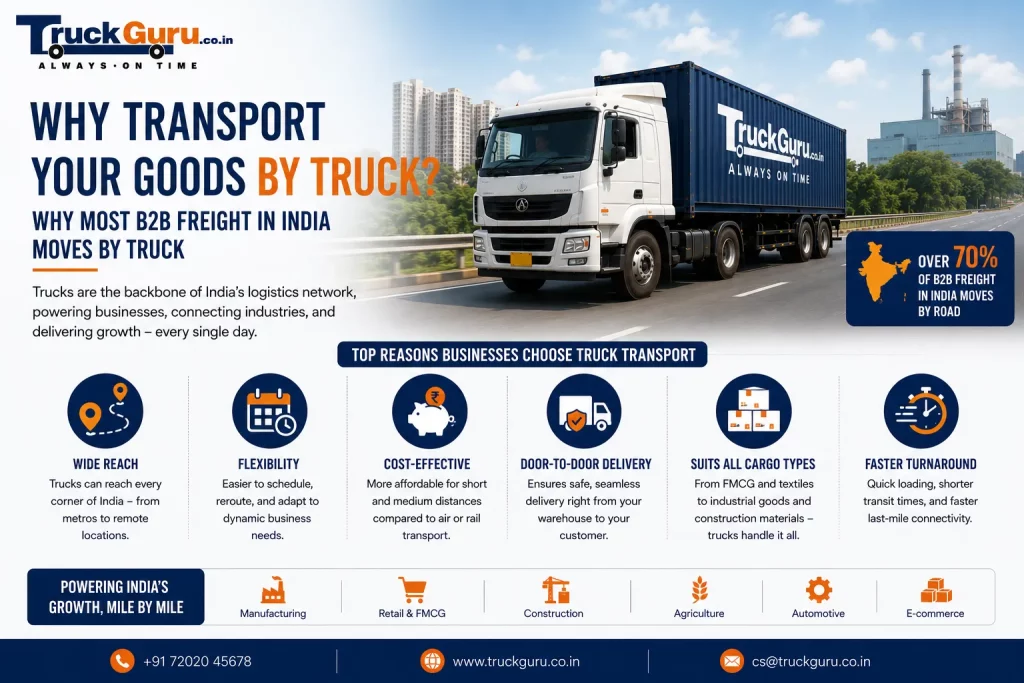
Why Most B2B Freight in India Moves by Truck
Road transport carries roughly two-thirds of India’s freight by most industry estimates, and that dominance is not an accident of habit — it reflects what trucks can do that rail and air genuinely cannot, on the routes and shipment sizes most B2B businesses actually need. Understanding the specific reasons makes it easier to decide when truck transport is the right call and when it is not, rather than defaulting to it without thinking it through.
Transport Your Goods by Truck: Quick Summary
Transport Your Goods By Truck: Learn why trucks are the best choice for efficient goods transport. Get secure, flexible and cost-effective truck.
Trucks Handle Nearly Any Cargo Type
A single truck can carry light retail packages on one trip and palletised industrial machinery on the next, which is part of why factories, retailers, builders, and farmers all rely on the same basic mode of transport for very different cargo. Cold-chain and temperature-sensitive shipments are the one category worth a direct check rather than an assumption — confirm with whichever platform you are booking through whether temperature control is actually available for your shipment, since not every truck transport service offers it as standard.
Point-to-Point Delivery, With No Transhipment
Rail and sea freight typically move cargo between fixed terminals, which means a truck (or several) is still needed at each end to get goods to and from those terminals — an extra handoff that adds time and a chance for something to go wrong. Road transport skips that step entirely: the same vehicle that picks up the cargo delivers it, with no intermediate transfer between modes. Fewer handoffs generally means less risk of damage and a more predictable timeline.
Reach That Rail, and Air Cannot Match
A truck can pick up from or deliver to locations that rail lines and airports simply do not reach — a factory on a narrow city lane, a site without direct highway access, a town with no nearby rail terminal at all. This is less about trucks being faster in absolute terms and more about flexibility: the pickup and delivery points are not constrained to wherever the nearest station or airport happens to be.
Timing That Can Be Built Around Your Schedule
For businesses in FMCG, pharma, or e-commerce, delivery timing is often as important as the delivery itself. Truck transport allows route and dispatch timing to be planned around your actual production and delivery schedule rather than a fixed timetable set by a third-party carrier, which matters when a delay has a real downstream cost — a stockout, a missed production run, a customer complaint.
How the Cost Compares to Other Modes
For most domestic distances, truck transport costs meaningfully less than air freight, which is really only competitive for very long distances or extremely time-sensitive cargo. Against rail, the comparison is closer and depends on volume and route — rail can be cheaper at very large bulk volumes on routes it actually serves directly, but it reintroduces the transhipment problem described above for anything that needs to move beyond the rail terminal itself. On a fixed-rate platform, the rate for a given route and truck size is published rather than negotiated — there are no bulk-volume discounts to chase, but there is also no price uncertainty to manage.
Check a confirmed rate on the freight calculator.
Tracking and Visibility Through the Trip
Modern truck transport comes with GPS tracking as standard rather than an add-on, which means checking an app rather than calling for a status update. This matters most on the receiving end — knowing a shipment’s actual position lets a warehouse team plan unloading staff accurately and lets you give a customer a delivery window grounded in where the truck actually is.
Matching Truck Size to Your Shipment
Trucks are not one-size-fits-all, and picking the right category matters for cost as much as capacity. On TruckGuru specifically, the range runs from a Tata Ace (750 kg) and Bada Dost (1.5 tonnes) for smaller dispatches, through 14ft and 20ft trucks for mid-to-large shipments, up to a 32ft container for bulk freight needing enclosed protection. For specialised needs like cold-chain transport or fragile-cargo handling equipment, confirm availability directly for your specific shipment rather than assuming every truck size supports it.
Full specifications: truck size guide.
Who Actually Relies on Truck Transport
The pattern holds across very different industries. Manufacturers use trucks to bring in raw materials and send finished goods out to retailers. Retailers depend on it to restock before a shelf actually runs empty, which is a timing problem more than a capacity one. E-commerce businesses build customer satisfaction substantially around fulfilment speed, which traces back to transport reliability more than warehouse efficiency alone. Construction businesses move cement, steel, and sand against project deadlines that do not move. And pharma companies need transport that can document and maintain specific handling conditions — which, again, is worth confirming directly with any provider rather than assuming as a given.
What Technology Has Actually Changed
GPS tracking, smarter route planning, and more fuel-efficient vehicles have made truck transport meaningfully more predictable over the past several years, and online booking has removed a lot of the phone-call overhead that used to sit between deciding to ship something and actually getting a truck booked. None of this changes what trucks fundamentally do well — it just makes the process of using them faster and easier to plan around.
What TruckGuru Offers
TruckGuru covers the standard truck-size range with a published rate card, live GPS tracking, and pan-India coverage across major cities, with digital documentation — Lorry Receipt and GST invoice — generated automatically after delivery. The rate confirmed at booking is the rate on the invoice, with no separate negotiation step.
Book directly or check a rate at TruckGuru.co.in.
Closing Thoughts
Truck transport’s advantages are specific rather than vague: it reaches places rail and air cannot, it skips the transhipment step those modes require, and on most domestic routes it costs less than air without the volume thresholds rail typically needs to be competitive. Choosing it well comes down to matching the right truck size to the actual shipment and confirming upfront whether any specialised handling your cargo needs is genuinely available, rather than assumed.
Frequently Asked Questions
Why transport your goods by truck instead of rail or air?
Trucks offer point-to-point delivery without the transhipment that rail and sea require, reach locations that rail and air cannot serve directly, and cost less than air freight for most domestic distances. The tradeoff is that very large bulk volumes on dedicated rail routes can sometimes be cheaper at scale.
Can trucks transport temperature-sensitive goods like medicines?
Some truck transport services offer cold-chain options, but this is not universal across every provider or every truck size. Confirm directly whether temperature control is available for your specific shipment rather than assuming it as a default feature.
What truck sizes are available for B2B shipments?
On TruckGuru: Tata Ace (750 kg), Bada Dost (1.5 tonnes), 14ft truck (3.5 tonnes), 20ft truck (7 tonnes), and 32ft container (15 tonnes). Match the size to your actual cargo weight rather than defaulting to the largest option.
Is truck transport cheaper than other shipping modes in India?
Generally, yes, compared to air freight for domestic distances. Compared to rail, it depends on volume and route — rail can be more cost-effective at very large bulk volumes on routes it serves directly, but trucking avoids the extra transhipment step rail typically requires.
How can I track my shipment during transport?
Live GPS tracking is standard on most truck transport platforms, including TruckGuru, showing the vehicle’s location and estimated arrival throughout the trip.
Call 72020 45678 or book online at truckguru.co.in for a confirmed rate on your next shipment.
Related Reading
- Reduce Manufacturing Freight Costs: India Intercity Guide
- Reduce B2B Freight Costs in India: 25 Proven Strategies
- Ship-To GSTIN Mandate August 2026 — What Shippers Must Do
For current rules and official notifications, see the Ministry of Road Transport & Highways.