

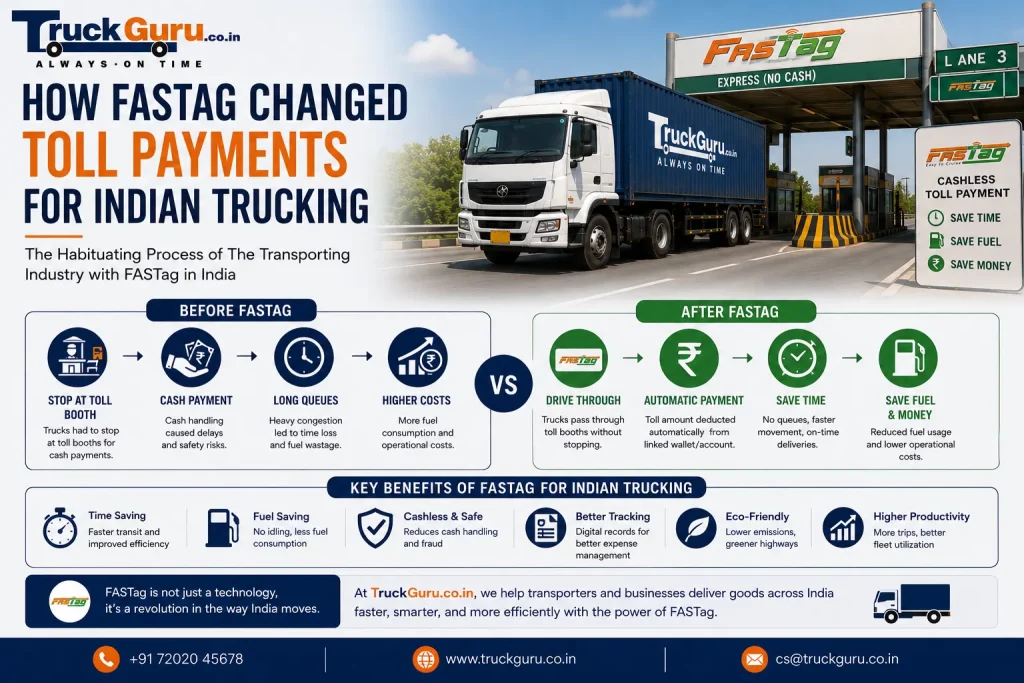
How FASTag Changed Toll Payments for Indian Trucking
By 2026, FASTag is simply how tolls get paid in India — a windshield sticker, an automatic deduction, and a few seconds through the plaza. For most fleet operators today, it barely registers as a system at all, which is exactly what makes it easy to forget how disruptive the transition actually was for the trucking industry that had to adapt to it.
Fastag in India: Quick Summary
FASTag in India: In this article, we go through how the trucking sector in India has become accustomed to using FASTag. To find out more, visit our website.
That transition matters to understand, because some of the habits it forced on small fleet operators are still the right habits today, even though the system itself has matured.
Why FASTag Was Introduced
FASTag uses radio frequency identification to read a tag mounted on a vehicle and deduct the toll automatically as it passes through a plaza, replacing the manual cash transaction that used to cause queues at every toll booth on a route. The push toward a nationwide digital tolling system followed years of friction at toll plazas — transport associations had repeatedly raised concerns about delays and collection inefficiencies, and RFID-based tolling was the government’s answer to that specific complaint.
The Transition Was Genuinely Difficult for Small Operators
Small fleet operators — the segment that has historically made up the large majority of India’s trucking capacity, often running five vehicles or fewer — were overwhelmingly cash-based businesses before FASTag arrived. Moving that segment onto a digital wallet system was not a simple switch, and the friction showed up in several specific, recurring ways during the rollout years.
Drivers unfamiliar with the difference between a FASTag-only lane and a cash lane sometimes joined the wrong one, which meant paying twice — once through the tag and again in cash, since FASTag lane misuse during the transition period carried that exact penalty. Technology issues compounded this: duplicate deductions and incorrect charges were a real, documented problem in the early rollout, and getting a refund typically meant a physical visit to an office near the toll plaza rather than anything that could be resolved online.
Operators upgrading older trucks to BS-VI emission standards around the same period sometimes ran into documentation mismatches that complicated FASTag registration further. And a meaningful number of carriers were simply reluctant to link a bank account to a FASTag wallet over security concerns, preferring to manage balances manually — a workable but genuinely time-consuming approach for trucks running national routes through dozens of toll plazas.
None of this was unique to trucking specifically, but the impact landed harder on small operators with thin margins and little administrative capacity to absorb a new compliance process on top of everything else they were already managing.
Where Things Actually Stand in 2026
FASTag has been compulsory for vehicles on national highways since 2021, and by now, it is a mature, enforced infrastructure rather than a system still finding its footing. Two things have changed recently enough to be worth flagging specifically for fleet operators.
First, “one vehicle, one FASTag” is now strictly enforced. A vehicle with multiple tags linked to different banks — something that happened informally during the rollout years when operators sometimes ended up with more than one tag through different channels — can have the duplicates deactivated. Fleet operators managing several vehicles should check that each one has exactly one active, correctly linked tag, since this is now an active compliance check rather than a loose guideline.
Second, NHAI introduced a verification change effective February 2026: banks must now confirm a vehicle’s details through the government’s VAHAN portal before activating a new FASTag, rather than activating first and verifying afterwards. The previous activate-then-verify sequence was a real source of the sudden deactivations and confusion that operators experienced for years. The new sequence should reduce that specific problem going forward, though it also means activation for a new vehicle may take slightly longer while the upfront verification completes.
What This Means for a Trucking Business Today
A few practical habits matter more than they might seem to, specifically because the system now runs on real-time automatic deduction with little tolerance for error:
- Keep vehicle registration details current and exactly matched between your FASTag account and the VAHAN record — a mismatch is one of the more common causes of unexpected suspension
- Maintain a working balance or enable auto-recharge, particularly for vehicles running long multi-state routes through dozens of toll plazas in a single trip — an empty wallet now means an on-the-spot penalty, not a grace period
- Use exactly one FASTag per vehicle and retire any duplicates from earlier years — enforcement on this specific point has tightened
- Budget toll cost as a known, calculable line item in route planning rather than a cash negotiation, since that uncertainty is no longer part of how tolling works
How This Connects to Booking FTL Transport
One genuine benefit of mature, predictable tolling is that it removes a variable that used to make freight costs harder to estimate upfront. TruckGuru’s published rate for a route and truck size is built around the route’s actual cost structure, including toll exposure — which means a shipper booking a confirmed rate is not exposed to the kind of toll-related billing surprise that was common during FASTag’s difficult early years.
Check a confirmed rate for your route on the freight calculator.
Frequently Asked Questions
Is FASTag still mandatory for trucks in India in 2026?
Yes. FASTag has been compulsory for vehicles travelling on national highways since 2021, and enforcement has tightened further in 2026 rather than loosened.
Can a fleet operator use one FASTag for multiple vehicles?
No. The one-vehicle-one-FASTag rule is strictly enforced — using a single tag across multiple vehicles, or maintaining duplicate tags from different banks for one vehicle, can result in deactivation.
What happens if a FASTag has insufficient balance at a toll plaza?
Insufficient balance now typically results in an immediate penalty rather than a grace period, since the deduction happens in real time as the vehicle crosses the plaza. Auto-recharge is the most reliable way to avoid this for vehicles running frequent or long-distance routes.
Why were duplicate or incorrect toll deductions common during FASTag’s early years?
Technology and process issues during the 2019-2021 rollout period led to documented cases of duplicate or incorrect charges, and refunds typically required an in-person visit to an office near the toll plaza. The system has matured substantially since then, though the underlying lesson — keep registration and account details accurate — still reduces the odds of a dispute.
Does toll cost affect FTL freight rates?
Yes, toll exposure is one of the factors built into a route’s cost structure. On a confirmed-rate platform, this is reflected in the published rate rather than added as a separate or unpredictable charge after the fact.
Call 72020 45678 or book online at truckguru.co.in for a confirmed rate on your next shipment.
Related Reading
- Reduce Manufacturing Freight Costs: India Intercity Guide
- Reduce B2B Freight Costs in India: 25 Proven Strategies
- Ship-To GSTIN Mandate August 2026 — What Shippers Must Do
For current rules and official notifications, see the Ministry of Road Transport & Highways.