

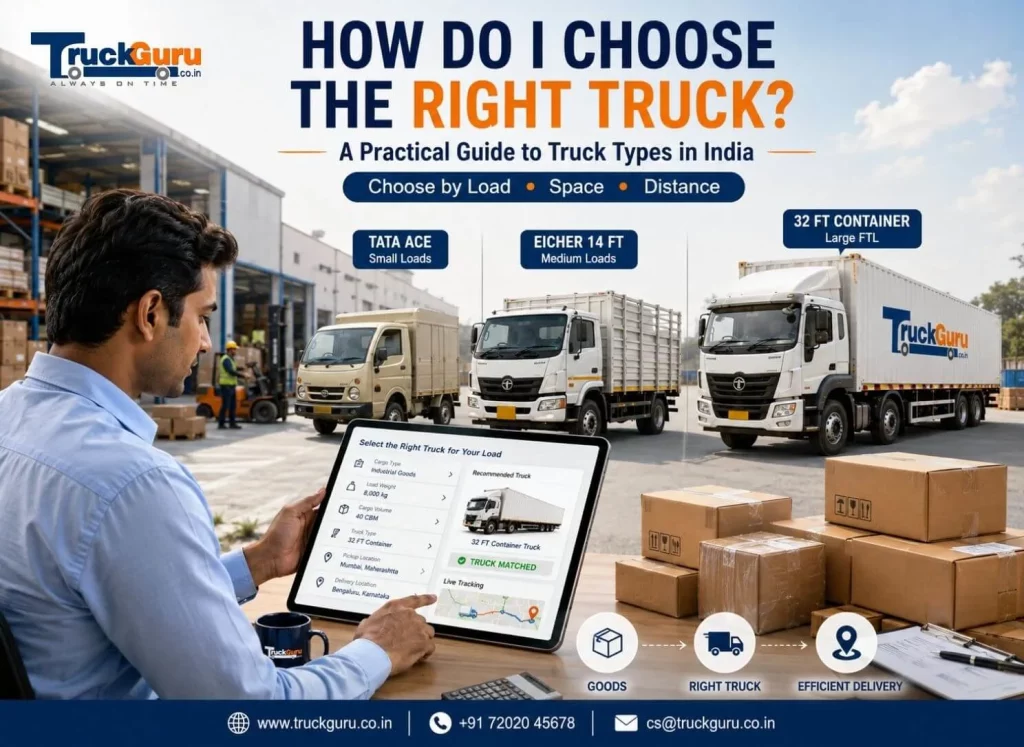
How Do I Choose the Correct Truck Type in India?
Say you are a chemicals trader in Ankleshwar with four tonnes of packaged drums going to Bhiwandi. You book a 14ft truck because four tonnes sounds like a 14ft job. The vehicle arrives, the crew loads about 60 percent of the consignment, and then stops. The drums are heavy, but they also stack badly. The deck ran out before the weight limit did. Now you are paying for a second trip on a route that should have taken one, and your receiving warehouse has a half consignment sitting at the gate.
That is the single most common booking error in Indian road freight, and it has nothing to do with not knowing your own cargo. It comes from picking a truck on one number when the decision needs two.
What the wrong truck type actually costs you
There are only two ways to get this wrong, and they fail in opposite directions.
- Undersized: part of the consignment stays behind. A second trip almost never costs half of the first one, because you are paying for a fresh vehicle placement on the same route. You also lose the delivery slot at the other end, and in most industrial estates a missed gate timing means the next morning, not the next hour.
- Oversized: you pay for deck space that travels empty. Worse, a light load in a large body moves around. On the rougher stretches of a long distance run, unsecured cargo with room to shift is how packaging gets crushed and drums get dented. Extra lashing helps, but the honest fix is booking the right size in the first place.
Freight pricing in India is not linear with truck size either. The jump from a 20ft to a 32ft container is not proportional to the jump in load capacity, so the sizing decision moves your per-consignment cost more than most shippers expect.
Truck types available in India for freight
Here is the working fleet for full truck load movements, sorted by load capacity. Note that these are the vehicle classes actually used for FTL freight. Trailers, flatbeds and over-dimensional cargo carriers are a separate category and are not covered here.
Light commercial vehicles
- Tata Ace: 750 kg to 1,100 kg. Good for small consignments and for pickups from congested market areas where a larger body cannot turn.
- Tata Intra: 1,000 kg to 1.5 tonnes. A step up in deck length over the Ace while keeping the same access advantage.
- Bada Dost: up to 1.7 tonnes in the open body and up to 1.5 tonnes in the closed container. Common for sample loads, spares consignments and urgent part shipments between industrial clusters.
- Mahindra Pickup: similar bracket to the above, widely available across most origin cities.
- Tata 407: still common on Indian roads for loads between the pickup class and a 14ft truck. For loads in this range, TruckGuru books the 14ft Eicher.
Medium trucks
- 14ft Eicher: 3 to 3.5 tonnes. This is the volume workhorse of Indian freight. Most single-pallet-count SME consignments land here.
- Eicher 17ft and 19ft: the bridge between a 14ft and a 20ft container. Useful when your cargo has outgrown the 14ft deck by volume but not by weight.
Containers
- 20ft container: 5 to 7 tonnes. Enclosed body, which matters for anything weather sensitive or requiring a seal.
- 32ft container: 15 to 18 tonnes across single axle and multi axle variants. This is the default for consolidated long distance movements.
One correction worth making, because it circulates widely on Indian logistics sites: there is no standard 24ft container in regular FTL circulation. If a vendor quotes you one, ask what the actual body length and registered load capacity are before you confirm.
Weight is only half the decision
This is where most bookings go wrong. Every truck has two limits, and your cargo hits one of them first.
Take two consignments of exactly three tonnes. The first is steel fasteners in wooden crates. It occupies a corner of a 14ft deck and hits the weight limit with most of the body still empty. The second is packaged polymer granules or garment bales. It fills a 14ft body completely at well under three tonnes.
Same weight. Completely different truck requirement. So calculate both numbers before you book:
- Total weight of the packed consignment in kilograms, including pallets, crates and packing material. Not the product weight from your invoice.
- Total volume in cubic feet, measured as length x width x height of your stacked cargo, with the stacking limit your packaging can actually take.
Book against whichever limit you reach first. If your cargo is dense, size for weight. If it is bulky, size for volume. Dense cargo includes metals, tiles, chemicals in drums, machinery and bagged agricultural goods. Bulky cargo includes textiles, foam, packaging material, plastic mouldings, furniture components and most FMCG cartons.
If you want to skip the manual calculation, the TruckGuru freight calculator sizes the vehicle against your weight and route and returns a trip rate at the same time.
Route and distance change the answer
The same consignment can justify different vehicles depending on where it is going.
- Short runs, roughly under 300 km: Vadodara to Ahmedabad, Pune to Mumbai, Coimbatore to Salem. Smaller vehicles work here because the vehicle cycles back quickly. Sending two 14ft trucks on the same day is often practical on these corridors in a way it is not over 1,500 km.
- Long distance movements: Gujarat to Delhi NCR, Bhiwandi to Bengaluru, Ludhiana to Chennai. Consolidating into a single 32ft container usually works out better than booking two 20ft trucks, both on cost and on the number of handover points where things go missing.
- Approach roads decide your ceiling: planned industrial estates like Chakan, Manesar, Hosur and Sanand handle 32ft containers without a problem. Older manufacturing pockets and city market areas frequently cannot. Check the destination approach before you size the vehicle, because the last 500 metres sets your maximum.
Container body or open body
Once you have the size, pick the body type.
- Container: enclosed and sealable. Use it for pharma, electronics, textiles, FMCG, packaged food and anything where monsoon exposure or pilferage is a real risk on the route.
- Open body: loads from the top with a crane or forklift, and takes items that exceed container internal height. Standard for machinery, structural steel, pipes and construction material.
If your cargo fits either, take the container on any route crossing a monsoon-affected stretch. The tarpaulin on an open body is a compromise, not protection.
Checks to run before you confirm the booking
- Weigh and measure the packed consignment, not the raw product. Packaging routinely adds 8 to 15 percent to both.
- Confirm loading and unloading capability at both ends. A 32ft container needs either a dock or a crew and time. Booking one into a location with neither is how detention charges start.
- Check gate and entry timings at the destination, especially for industrial estates and city areas with daytime commercial vehicle restrictions.
- Ask what the vehicle will be loaded to, not just what it can carry. Registered load capacity and practical loading limit are different numbers.
- Compare quotes on the same basis. A rate that excludes toll is not comparable to one that includes it.
For a size-by-size breakdown, the truck size guide goes deeper than this article does, and you can place a booking through online truck booking once you have settled on the vehicle. TruckGuru operates as an FTL network across 110 plus cities in India, and toll is included in the quoted fare rather than added later. Payment runs as a Booking Amount at confirmation, 90 percent when the truck reaches your pickup location, and the balance at delivery before unloading starts. NEFT, IMPS, UPI and major debit and credit cards are accepted.
Key takeaways
- Size the truck against two numbers, weight and volume, and book for whichever limit your cargo hits first.
- Dense cargo like metals, tiles and drummed chemicals fills the weight limit early. Bulky cargo like textiles and packaging fills the deck early.
- An undersized booking costs you a full second trip, not half a trip.
- On long distance corridors, one 32ft container generally beats two 20ft trucks.
- The destination approach road, not your cargo, often sets the maximum vehicle size you can use.
- Take a container body over an open body on any monsoon route where the cargo allows it.
Frequently asked questions
Which truck type should I book for 3 tonnes?
A 14ft truck with a load capacity of 3 to 3.5 tonnes handles it, provided the cargo is reasonably dense. If those 3 tonnes are textiles, foam or packaging, you will run out of deck space first and should look at a 17ft, 19ft or 20ft body instead.
How much can a 32ft container carry?
Between 15 and 18 tonnes depending on whether it is a single axle or multi axle variant. Confirm which variant you are getting, because the difference is significant at the top of that range.
What is the difference between a 20ft and a 32ft truck?
Load capacity and body length. A 20ft container carries 6.5 to 7 tonnes. A 32ft container carries 15 to 18 tonnes. The 32ft is not simply longer, it is a different weight class, which is why it is the standard choice for consolidated long distance freight.
Is a bigger truck always safer for my cargo?
No. A light load in a large body has room to shift during transit, which increases damage risk on rough road sections. A correctly sized vehicle where the cargo is packed tight against the body is more stable than an oversized one that is half full.
Can I book a truck without knowing the exact weight?
You can, but expect a revision. Give your best estimate of both weight and stacked dimensions when you book. If the actual consignment turns out larger at loading, the vehicle change happens at your cost and on your timeline.
Does TruckGuru handle part load consignments?
No. TruckGuru operates full truck load freight only. You book the whole vehicle for your consignment on a point to point basis.
What if my cargo exceeds container height?
You need an open body vehicle rather than a container. Flag the height at the enquiry stage, because it changes both the vehicle class and the route planning where low bridges and overhead clearances are involved.
Booking the right vehicle
Work out your weight and cubic feet first, then check the rate on the freight calculator. If you move freight regularly on the same corridors, the TruckGuru app (Android and iOS) keeps your saved routes and consignment profiles so you are not re-entering the same figures every week.
Related Reading
- How to Estimate Goods Transport Rates: A Beginner’s Guide
- How Are Truck Transportation Charges Calculated in India?
- 6 Truck Booking Platforms Compared for FTL Freight in India: FR8, WheelsEye, Trukky, BlackBuck, Vahak & TruckGuru
For current rules and official notifications, see the Ministry of Road Transport & Highways.