

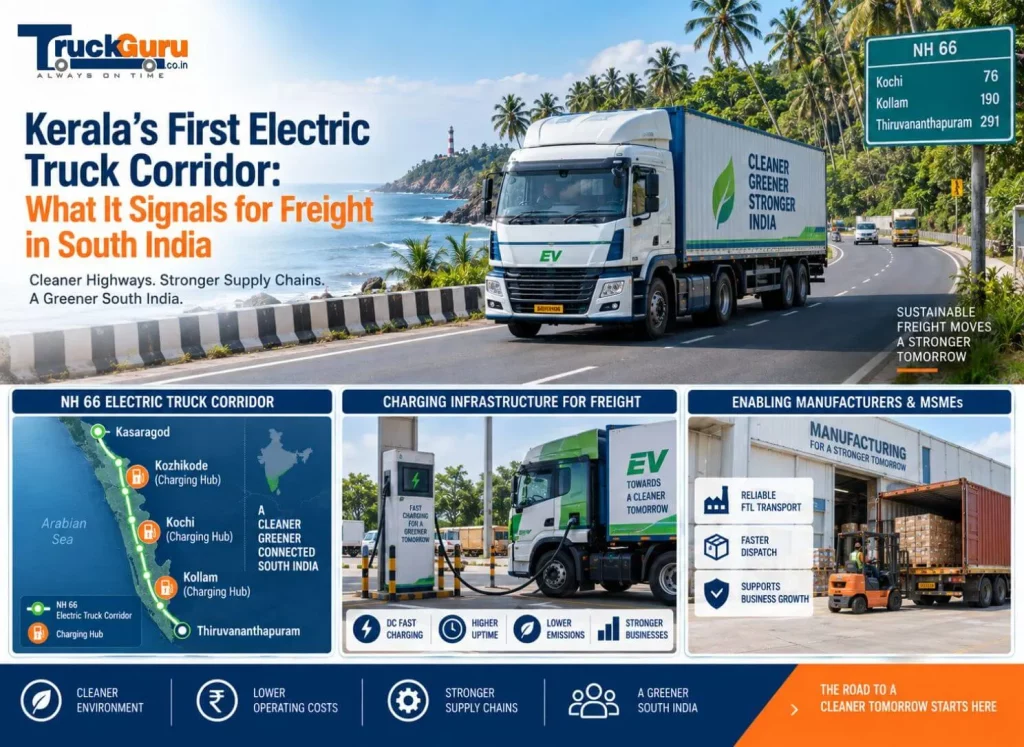
If you run freight through Kerala, you have probably noticed the state moves at its own pace on infrastructure. Sometimes slower than its neighbours, sometimes ahead of everyone by making a call nobody else is willing to make yet. The electric truck corridor announced for National Highway 66 is the second kind of move. It is early and state-led. It is also the first attempt anywhere in India to plan electric truck charging at the scale a freight corridor actually needs. Not a few chargers scattered along a highway.
Electric Truck Corridor Kerala: Quick Summary
Electric truck corridor Kerala: Kerala is planning India's first electric truck corridor on NH 66. What it means for FTL freight, manufacturers and logistics.
This matters to anyone shipping goods along Kerala’s coast. Not because electric trucks are about to replace diesel fleets here next year. Because the planning happening now will shape what is possible on NH 66 for the next two decades.
What Is Kerala’s Electric Truck Corridor?
Kerala’s electric truck corridor is a planned 622 km stretch of National Highway 66. It runs from Kasaragod in the north to Thiruvananthapuram in the south. The state is developing it as India’s first corridor designed specifically for electric truck charging infrastructure. The project sits at the planning and study stage. Not operational, not under construction.
Kerala State Electricity Board Limited released a detailed infrastructure assessment, prepared with the International Council on Clean Transportation. It was presented at the India Clean Transport Summit 2026 in Delhi.
The corridor follows Kerala’s western coast. It links the ports, industrial clusters and urban centres that already anchor the state’s freight economy. The study names Kochi, Kozhikode and Kollam as likely priority hubs for charging.
For freight operators, the practical significance is narrower than the headlines suggest. This is the first time an Indian state has sized the problem properly. How many chargers, how much power capacity, how much investment. All of it from real operational data rather than rough estimates.
Why Kerala Is Exploring an Electric Freight Corridor
Kerala’s geography makes NH 66 a logical testbed. It is a single, well-defined coastal corridor running the length of the state. Highway networks elsewhere in South India are more fragmented. That makes it easier to study end-to-end and easier to justify a phased rollout, because the corridor concentrates a large share of the state’s freight onto one route.
The study behind the plan did not rely on assumptions. Researchers used FASTag toll data alongside GPS-based truck parking data. That covered more than 13,000 unique trucks across roughly 340,000 parking events, establishing where trucks actually stop and for how long. That is a meaningfully different approach from installing chargers at fuel stations and hoping trucks turn up.
The findings are specific. An initial charging network of 12.5 MW is estimated as the starting requirement, at an investment of roughly Rs. 19 crore. Looking further out, the study projects that by 2050 the corridor could need around 1,939 chargers with a combined capacity of 204.5 MW. The gap between the near-term ask and the long-term vision tells you what this is: a multi-decade infrastructure project, not a two-year rollout.
Some of the funding path is visible. Kerala has separately secured a Rs. 63.12 crore central grant under the PM E-DRIVE scheme, covering 335 EV charging stations across the state. KSEB has also proposed 315 high-speed chargers at 277 new locations with private partners, and is seeking further central subsidy. Whether that money channels into the NH 66 corridor specifically or supports Kerala’s broader charging network is not clear from current reporting. That distinction is worth watching.
What the Corridor Could Change for Freight Operators, Eventually
The direct answer for anyone booking or operating freight on this route: nothing changes today. The corridor is at infrastructure-assessment stage, not construction, and no official completion timeline for the charging network has been stated. What the project does is set the groundwork that determines whether electric trucking on this route becomes practical at all.
When charging infrastructure does arrive along NH 66, the operational consequences are fairly predictable from how electric commercial vehicles behave elsewhere.
Charging time is the main one. Even on high-speed DC chargers, recharging a heavy electric truck takes far longer than a diesel refuel. That limits how many loaded hours a vehicle runs in a day. Route planning has to work around charger locations rather than fuel stations. Delivery schedules need a buffer for charging stops rather than assuming continuous transit.
Vehicle utilisation is the metric that will actually decide adoption speed. A diesel truck’s uptime is limited mostly by driver hours and loading time. An electric truck adds charging downtime to that equation. Until fast charging is genuinely dense along the corridor, that downtime works directly against the turnaround times FTL operators depend on for their unit economics.
What It Could Mean for Manufacturers and Shippers
For manufacturers and distributors moving plant-to-warehouse freight along the Kasaragod to Thiruvananthapuram stretch, this is worth tracking rather than acting on. The corridor’s long-term intent is to make electric trucking viable for regular freight here. If the network gets built as studied, operating costs could become more predictable than diesel. Electricity pricing tends to move less sharply than fuel.
None of that changes today’s planning. Businesses running FTL transportation between Kochi, Kozhikode, Thiruvananthapuram or points between should keep planning around diesel fleet realities. Vehicle availability, driver scheduling, loading windows. Treat the electric corridor as a multi-year infrastructure story.
For manufacturers planning intercity freight more broadly, TruckGuru’s transportation services help arrange FTL bookings through a digital process, whichever corridor or vehicle type a shipment needs. Vehicle selection matters here too. Matching truck size to actual cargo weight and volume affects cost and turnaround more than most shippers expect, which is covered in the guide to truck sizes in India.
Can Electric Trucks Handle FTL Transportation Today?
The honest answer is not yet, for most long-distance FTL work in India. The corridor’s own study reflects that, planning infrastructure in phases through 2050 rather than assuming rapid adoption.
Range and charging time remain the constraints. A diesel truck refuels in minutes and runs a full day’s route without a second thought about range. An electric heavy truck’s range depends heavily on load, terrain and driving conditions, and recharging takes considerably longer even on fast chargers.
For shorter, well-defined regional routes with predictable charging stops, electric trucks can work well. Port-to-warehouse movement and short intercity legs with return-to-base patterns are the obvious cases. Long-distance FTL across state lines is different. Trucks run multi-day routes with variable stopping points, and the charging infrastructure to support that does not exist on most Indian highways. That is precisely the gap Kerala’s study is trying to close for one route.

Where Electric Trucks Make the Most Sense First
Realistically, adoption comes first where routes are predictable, and vehicles return to base. Port-to-warehouse movement near Kochi. Intra-city and short distribution within Kerala’s urban centres. Dedicated shuttle routes between fixed points along NH 66 where charging gets built early.
India’s electric heavy truck fleet remains very small in absolute terms. Registrations have grown sharply in percentage terms, which is the normal pattern for an early-stage market rather than a mainstream one.
Diesel remains the practical choice for cross-state FTL movement, Kerala into Tamil Nadu, Karnataka or beyond, for the foreseeable future. The infrastructure simply is not there outside this one planned corridor.
The Bigger South India Opportunity
Kerala’s freight network does not operate in isolation. Goods move constantly between Kerala and Coimbatore, Salem and Chennai in Tamil Nadu, into Bengaluru and Mysuru in Karnataka, and onward into Andhra Pradesh and Telangana. If NH 66’s charging infrastructure gets built as studied, it creates a template. Possibly a starting point too, for extending electric freight into neighbouring networks. The obvious candidates are the routes where Kerala’s ports feed inland manufacturing around Coimbatore or Hosur.
That said, this is speculation. Nothing in current reporting confirms plans to extend charging infrastructure beyond Kerala’s borders. Any cross-state extension would need coordinated planning between multiple state electricity boards and highway authorities. None has been announced.
What Logistics Teams Should Watch Before Considering Electric Freight
Before any operator or shipper factors electric trucks into freight planning on this corridor, a few checks matter.
- Route length, and whether it fits realistic single-charge range for the vehicle type
- Load profile and load capacity requirements, since battery weight reduces usable cargo weight
- Charging point availability at your actual stopping locations, not just along the route
- Charging downtime measured against your delivery window flexibility
- Vehicle utilisation, meaning how many loaded hours per day the vehicle realistically achieves
- Total operating cost against diesel, including any applicable incentives
- Backup vehicle planning for charging gaps or downtime
- Infrastructure reliability, since this project is at an early stage
None of these argues against the corridor. They are the questions any logistics team should ask before moving real freight volume onto a new vehicle type on a route where infrastructure is still being built.
What This Means for the Future of FTL Transportation
Kerala’s electric truck corridor is a significant piece of infrastructure planning. Not because it changes freight operations today. Because it is the first serious, data-backed attempt in India to size charging infrastructure to what a real freight corridor needs. It positions Kerala as an early mover. The transition will take a decade or more to reach the rest of South India’s freight network, if it succeeds at all.
For now, electric trucks are a complement to diesel fleets on specific predictable routes rather than a replacement for cross-state FTL movement. Whether your freight moves through Kerala, Tamil Nadu, Karnataka or other South Indian corridors, vehicle selection and transportation planning matter as much as the rate you are quoted. TruckGuru helps businesses arrange intercity FTL transportation through a digital booking process, with upfront pricing and shipment visibility, whichever corridor your business runs on today.
FAQ SECTION
What is Kerala’s electric truck corridor?
A planned 622 km stretch of National Highway 66 between Kasaragod and Thiruvananthapuram, being developed as India’s first state-led corridor built specifically for electric truck charging infrastructure. The plan rests on a joint study by KSEBL and the International Council on Clean Transportation, presented in September 2026.
What is the route of Kerala’s electric truck corridor?
It runs 622 km along Kerala’s western coast on NH 66, from Kasaragod in the north to Thiruvananthapuram in the south. It passes through freight and industrial centres, including Kochi, Kozhikode and Kollam, which are identified as likely priority charging hub locations.
Is Kerala’s electric truck corridor operational yet?
No. The project is at the planning and infrastructure-assessment stage. A charging infrastructure study has been completed and presented publicly, but construction has not begun, and no official completion timeline has been announced.
How will an electric truck corridor affect freight transportation?
In the near term, it will not change day-to-day freight operations on NH 66. Longer term, if the planned charging infrastructure gets built as studied, it could make electric trucking viable for regional and shorter freight movements on this route, with implications for operating costs, route planning and vehicle utilisation.
Which businesses are most likely to benefit first?
Businesses running short, predictable, return-to-base routes. Port-to-warehouse movement near Kochi and intra-Kerala distribution are best positioned once charging infrastructure exists. Long-distance cross-state FTL shippers are unlikely to see near-term impact.
Can electric trucks handle long-distance FTL transportation?
Not reliably yet on most Indian routes. Range, charging time, and the scarcity of charging infrastructure outside this one planned corridor make electric trucks better suited to shorter predictable routes than multi-day cross-state movement.
What are the biggest challenges for electric freight in South India?
Charging infrastructure density, charging time against delivery schedules, vehicle range under real load conditions, and the upfront investment required. The Kerala study alone estimates Rs. 19 crore for initial infrastructure.
Will electric trucks reduce freight costs?
Not confirmed for Indian operating conditions. Electricity costs can be steadier than diesel, but higher vehicle costs, charging downtime and load capacity trade-offs currently offset potential savings for most freight uses. Reliable comparisons depend on how the infrastructure and vehicle market develop.
What does this mean for manufacturers and logistics teams?
Treat it as a multi-year infrastructure development to monitor, not a reason to change current fleet or booking decisions. Diesel-based FTL transportation remains the practical choice for cross-state freight in the near term.

Related Reading
- How to Estimate Goods Transport Rates: A Beginner’s Guide
- How Are Truck Transportation Charges Calculated in India?
- 6 Truck Booking Platforms Compared for FTL Freight in India: FR8, WheelsEye, Trukky, BlackBuck, Vahak & TruckGuru
For current rules and official notifications, see the Ministry of Road Transport & Highways.