

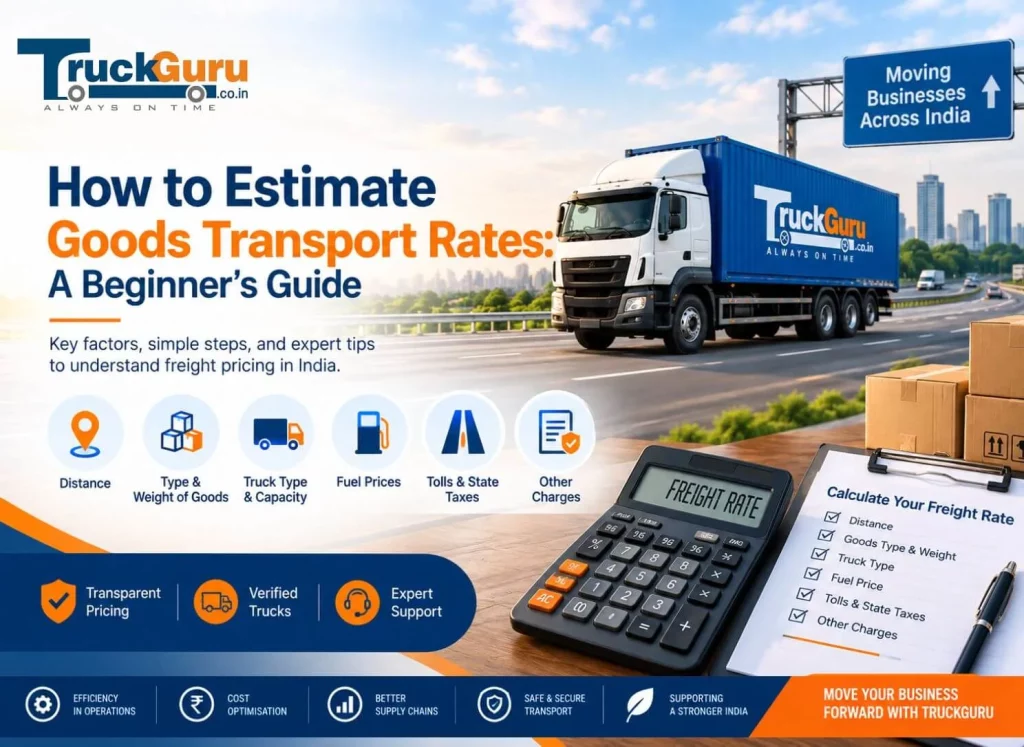
A business shipping five tons from Delhi to Mumbai for the first time usually starts by asking one transporter for a number. That number means very little on its own — distance, truck size, tolls, and season all move it, and without knowing how those pieces fit together, there’s no way to tell whether a quote is fair.
This is a practical breakdown of how goods transport rates in India actually get calculated, what typically drives the number up or down, and how to estimate a rate before you book.
Why Understanding Transport Rates Actually Matters
Knowing roughly what a shipment should cost changes three things in practice. Budgets are built on real numbers, not guesses. Quotes that are inflated become obvious rather than invisible. And negotiating for volume discounts or better terms requires knowing the baseline rate — you can’t ask for a fair price if you don’t know what fair looks like.
Businesses that ship regularly tend to compare rates through a truck size guide and a live calculator rather than relying on a single phone quote.
What Actually Moves the Price
Distance and Route
Longer trips cost more, unsurprisingly. What’s less obvious is that route matters as much as distance — a national highway corridor with steady traffic and easy return loads often prices lower per km than a similar-distance route through congested or poorly connected roads.
Goods Type and Weight
Fragile or hazardous cargo usually costs more to move because it needs special handling, padding, or a slower, more careful load. Weight matters too, but not in isolation — a dense, heavy load and a bulky, light one can cost the same per kg for very different reasons.
Truck Size
Bigger vehicles cost more per trip but less per ton once the truck is reasonably full. The mistake to avoid is booking a 32ft container for cargo that fits comfortably in a 14ft truck — that’s paying for capacity you don’t use.
Fuel Prices
Diesel is the single biggest input cost for a transporter, and it varies by state and moves with crude oil prices. Rate quotes shift accordingly, especially on longer routes where fuel is a bigger share of the total.
Seasonal Demand
Rates climb during festival season and monsoon, typically by 15 to 25%, because demand for trucks spikes while availability on some routes tightens.
Handling and Insurance
Loading and unloading charges usually run Rs.500 to Rs.2,500 per shipment depending on cargo type. High-value freight often carries optional cargo insurance on top, which covers the goods rather than the vehicle.
TruckGuru Fleet and Rate Reference
Rates below are per-km ranges for standard FTL bookings on TruckGuru.
| Truck Type | Load Capacity | Rate |
| Tata Ace | 750 kg – 1,100 kg | Rs.26 – Rs.29 per km |
| Bada Dost / Mahindra Pickup | up to 1.5 ton | Rs.26 – Rs.29 per km |
| Eicher 14FT | 3.5 ton | Rs.31 – Rs.35 per km |
| Eicher 17FT | 5 ton | Rs.34 – Rs.37 per km |
| Eicher 19FT | 7 ton | Rs.37 – Rs.41 per km |
| 20FT Container | 6.5 ton | Rs.41 – Rs.45 per km |
| 32FT Container (7/8T) | 7 – 8 ton | Rs.55 – Rs.58 per km |
| 32FT Container (16T) | 16 ton | Rs.78 – Rs.85 per km |
| 32FT Container (18T) | 18 ton | Rs.85 – Rs.91 per km |
These are ranges, not fixed quotes. Actual pricing on a specific route depends on truck availability, return load options, and how close to peak season you’re booking.
How to Estimate a Rate, Step by Step
The underlying approach transporters use is straightforward, even if the final invoice has more line items than a simple per-km figure suggests.
Start with the per-km rate for your truck category from the table above, multiply by the distance in kilometres, then add tolls (which vary heavily by corridor — a Delhi to Mumbai run alone can carry Rs.4,000 to Rs.6,000 in tolls), loading and unloading charges, and any driver allowance for longer routes. That total is roughly what you should expect to see quoted.
Running an actual route through the freight calculator gets you a live number faster than working through this by hand, but knowing the components is what tells you whether the number you get back is reasonable.
Additional Charges to Expect
Beyond the per-km freight rate, a typical invoice can include highway toll fees, state transport taxes where applicable, driver daily allowances on multi-day routes, loading and unloading charges, and waiting or detention fees if the truck sits idle past an agreed free period.
None of these is hidden if you ask upfront. The problem shippers run into is not knowing to ask before the truck is already loaded.
Seasonal Rate Patterns
| Season | Typical Rate Impact |
| Monsoon (June-September) | 15-20% increase |
| Festival season (October-November) | 20-25% increase |
| Harvest months (March-May) | 10-15% increase |
| Winter (December-February) | Stable, baseline rates |
Booking outside these windows, or a few days ahead of them when you can’t avoid the timing, is the most reliable way to sidestep the surge.
Practical Ways to Bring Costs Down
Book early where the delivery timeline allows it — last-minute bookings during high-demand periods pay a premium for availability, not just for the freight itself.
Consolidate smaller shipments into a single dispatch where possible. Splitting one week’s orders into several smaller runs often costs more in total than one full-truck dispatch, though this depends on route and volume.
And pick the truck size to match the cargo, not the other way around. Oversized bookings are one of the most common and easiest-to-avoid sources of wasted freight spend.
Using a Freight Calculator Instead of Guessing
Manually working through per-km rate, tolls, and handling gets you a reasonable estimate. A live calculator gets you the actual number for your specific route and truck type, accounting for current demand and availability rather than an average.
Enter your pickup city, delivery city, cargo weight, and truck category on the TruckGuru freight calculator to compare options before committing to a booking. For the vehicle range and specifications, see the truck size guide.
Frequently Asked Questions
1. How are goods transport rates in India decided?
Rates depend on distance, truck size, fuel prices, tolls, driver allowances, and cargo weight and type. Seasonal demand shifts the number further, sometimes by 15-25% during peak periods.
2. What factors affect transport charges per km?
Fuel cost, vehicle category, route condition, seasonal demand, and cargo weight all move the per-km rate. A route with easy return loads for the truck typically prices lower than one where the truck runs back empty.
3. What is the average truck transport cost per km in India?
On TruckGuru, rates run from roughly Rs.26-29 per km for a Tata Ace up to Rs.85-91 per km for an 18-ton 32ft container, with several sizes in between. Rates vary by operator and corridor, so treat any single average figure as a rough guide rather than a fixed number.
4. How do I estimate freight cost before booking?
Multiply the per-km rate for your truck category by the distance, then add tolls, loading and unloading charges, and driver allowances for longer routes. A freight calculator does this automatically and accounts for current demand.
5. Why do transport rates increase during festivals?
Demand for trucks rises sharply during festival season as businesses move higher volumes of goods, while truck availability on some routes tightens. This combination typically pushes rates up 20-25% in October and November.
6. Does truck size affect cost per ton?
Yes. Larger trucks cost more per trip but less per ton when reasonably full. Booking a bigger truck than your cargo needs means paying for capacity that goes unused, which raises your effective cost per ton rather than lowering it.
7. Are tolls included in a freight quote?
It depends on the operator. Some build tolls into the quoted rate; others bill them separately as actuals. Confirm this specifically when comparing quotes, since it’s one of the most common sources of a final bill that’s higher than expected.
8. What’s the difference between the Eicher truck sizes?
The 14FT Eicher carries up to 3.5 tons, the 17FT carries up to 5 tons, and the 19FT carries up to 7 tons. Each step up costs more per km but suits progressively larger shipments without needing a full container truck.
9. How much can businesses save by planning shipments in advance?
Booking ahead of seasonal peaks avoids the 10-25% rate increases those periods typically carry. Consolidating shipments and right-sizing the truck add further savings on top of that, though the exact amount depends on shipment volume and current spending patterns.
10. What is the difference between FTL and other freight options?
Full Truck Load means booking the entire vehicle for your consignment at a rate for that vehicle and route, with no other shippers’ cargo on board. It’s the right choice when your cargo fills most of a truck or needs direct, point-to-point delivery without intermediate stops.