

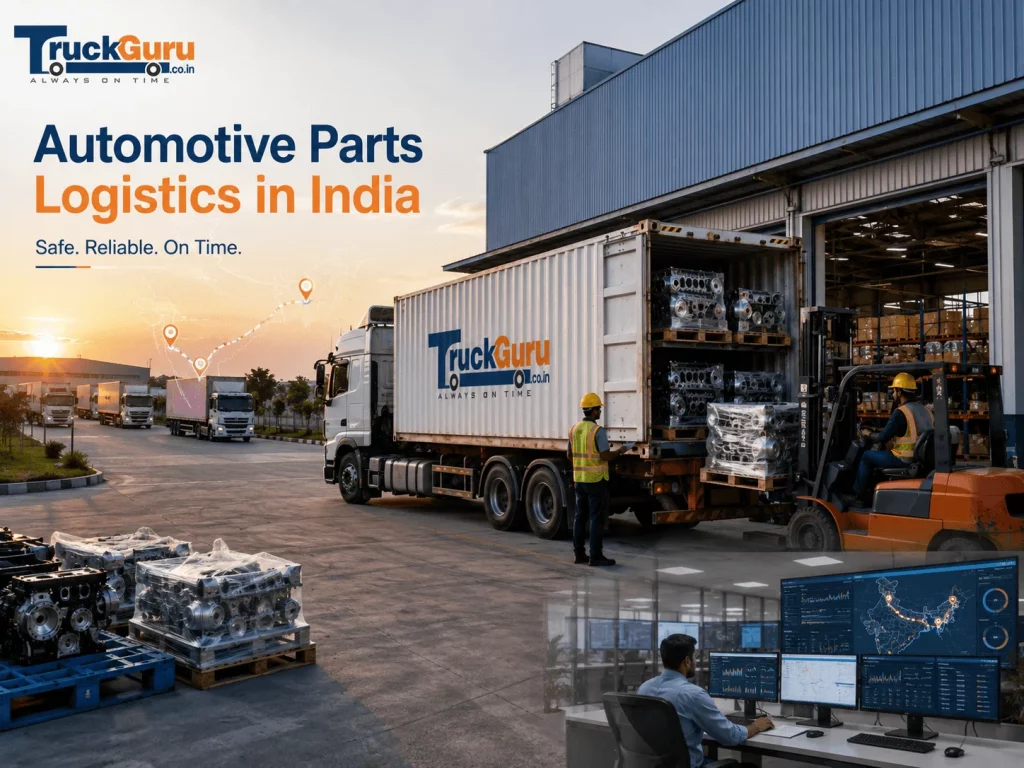
Automotive Parts Logistics in India: How to Transport Components Safely and On Time
A Tier-1 supplier in Chakan finishes machining a batch of gearbox housings on schedule. The truck booked to carry them gets held up near Talegaon because of an unfamiliar route. By the time it reaches the OEM plant, the receiving dock has moved to the next scheduled unload. What should have been a routine two-hour transfer turns into a three-hour wait, a missed production slot, and a phone call nobody wanted to make.
Automotive Parts Logistics: Quick Summary
Keep India’s automotive parts logistics on track. See how JIT/JIS plans, truck selection, and load securing protect parts and meet plant deadlines.
This kind of disruption is common in Indian automotive freight, and it rarely starts as a transportation failure. It usually starts as a scheduling mismatch, a packaging shortcut, or a truck that was not quite right for the load. Automotive parts logistics exists specifically to close these gaps — and doing it well requires understanding how production planning, truck selection, and freight execution actually connect on the ground.
Automotive Parts Logistics at a Glance
- Best transport mode: FTL when the shipment is time-critical, feeds a production line, or carries high-value or fragile components
- Truck type: Depends on weight, volume, dimensions, packaging, and route — not tonnage alone
- Most important protection: Correct packaging and load securing, not just a bigger truck
- Most important visibility tool: Real-time GPS tracking, which improves response time to delays
- Biggest avoidable costs: Detention charges, poor loading practices, emergency freight bookings, and unnecessary handling
Why Automotive Parts Logistics Is Different
Automotive component transportation operates on tighter delivery windows and thinner inventory buffers than most other freight categories. Many plants run Just-in-Time (JIT) or Just-in-Sequence (JIS) production models, in which parts arrive close to the moment they are needed on the line.
JIT-based production reduces inventory holding costs by eliminating excess stock sitting idle on the shop floor — but only if inbound transportation is reliable enough that the plant does not need a safety buffer. JIS goes further: components arrive in the exact sequence in which they will be fitted, so operators do not have to sort or search before assembly. Hyundai Glovis’s operation for Tata Motors is a working example — receiving parts, inspecting them, then sequencing and repacking for delivery in production order rather than simply dropping off a full truckload.
The practical effect is that a truck arriving early can be almost as disruptive as one arriving late, because there is often no warehouse space to absorb it. Coordination with the plant’s receiving schedule matters as much as the transportation itself.
What Happens When an Automotive Shipment Is Delayed
A delayed shipment typically triggers a chain of operational problems rather than a single isolated cost: production slowdown, emergency freight bookings to close the gap, inventory imbalances further down the line, and added pressure on dock labour trying to fit a late truck into an already-scheduled unloading sequence.
KPMG research on Indian automotive supply chains consistently identifies “integrating the entire supply chain” as one of the most significant challenges OEMs and suppliers face. Transportation delays are one of the most visible symptoms of that integration gap. The financial impact varies by plant, shift structure, and how much buffer exists elsewhere — but the disruption is real and repeating.
Which Automotive Parts Are Commonly Transported by Road
Different components carry different handling risks. Knowing this ahead of booking a truck changes how you pack and load.
- Engine components: Heavy, dense loads requiring secure strapping and even weight distribution
- Gearbox components: Precision parts needing protective crating and controlled stacking
- Electrical components: Sensitive to moisture and static; often need shielded or sealed packaging
- Sheet-metal parts: Bulky, space-consuming, prone to surface damage without dividers
- Castings: Heavy and rigid; load securing matters more than cushioning
- Body panels: High risk of cosmetic damage; need edge protection and careful stacking
- Batteries: Subject to hazmat handling rules depending on battery type and classification — confirm requirements before dispatch
- Aftermarket spare parts: Usually smaller and more urgent; speed and correct packaging matter more than volume
Batteries deserve a specific note: lithium batteries and similar components can fall under hazardous materials classifications requiring proper labelling and documentation. Confirm classification before dispatch rather than assuming standard freight rules apply.
Which Truck Is Best for Automotive Parts
There is no single best truck type for automotive components. The right choice depends on cargo weight, volume, dimensions, packaging, fragility, and the route the shipment will travel — not tonnage capacity alone.
- Tata Ace / mini truck: Small, urgent local runs between a nearby supplier and plant
- 14-ft truck (3.5T): Palletised parts in moderate volumes
- 17-ft truck (5T): Larger batches of heavier components such as castings
- 19-ft truck (7T): Bulkier sub-assemblies or mixed component kits
- 20-ft container: Sealed transport for higher-value or weather-sensitive components
- 32-ft container: Bulk inter-plant or inter-city movement on scheduled lanes
A batch of lightweight plastic trims might technically fit into a smaller truck by volume, but if the route covers 700 to 800 km of mixed road conditions, a container with proper load securing may protect the cargo better than a smaller open vehicle. The decision needs to weigh route and packaging together, not just how much space the cargo occupies.
See the full capacity breakdown on the TruckGuru truck size guide before selecting a vehicle for an automotive shipment.

When FTL Is the Right Call for Automotive Components
Dedicated Full Truck Load transport is the standard choice for time-critical, high-value, or fragile shipments feeding an active production line. TruckGuru operates FTL-only — one truck, one shipper, one consignment — which is particularly suited to automotive freight where timing, security, and handling control matter most.
FTL is the right fit when:
- The shipment ties directly into a JIT or JIS delivery window
- The components are fragile, high-value, or sensitive to handling and co-loading
- The plant needs a fixed, predictable arrival slot coordinated with receiving dock schedules
- The route conditions or cargo dimensions make shared transport impractical
For smaller, non-urgent aftermarket shipments where cost matters more than a guaranteed delivery window, other freight options exist — but these are outside TruckGuru’s FTL-only service scope.
How to Prevent Damage During Automotive Parts Transportation
Most transit damage traces back to a handful of avoidable gaps rather than bad luck on the road.
- Packaging: Match packaging to the component — foam-lined crates for precision parts, reinforced cartons for heavier items, anti-static or ESD-shielded packaging for electronics
- Palletisation: Standardised pallets reduce loading time and limit movement during transit
- Dunnage and strapping: Fill gaps and secure loads so components do not shift on turns or braking
- Load distribution: Heavier items low and centred; fragile items never underneath heavier stacked cargo
- Moisture protection: Especially relevant for metal castings and electrical components during monsoon months
- Cargo inspection: A pre-dispatch check catches loose strapping or damaged packaging before it becomes a claim
Pre-Dispatch Damage Prevention Checklist
- [-] Packaging matches component type and fragility
- [-] Pallets loaded and secured correctly
- [-] Dunnage placed to prevent shifting
- [-] Heavier items positioned low, fragile items protected on top
- [-] Moisture-sensitive components sealed appropriately
- [-] Final visual inspection completed before the truck departs
Plant-to-Plant Automotive Transportation
The journey for most FTL automotive shipments follows a consistent path: Supplier -> Pickup -> FTL Truck -> Transit -> Manufacturing Plant -> Receiving Dock -> Production Line. What varies is how tightly each handoff is scheduled.
Coordination between the pickup window at the supplier’s end and the receiving window at the plant matters more than raw transit speed. A truck that leaves on time but arrives outside the plant’s scheduled unloading slot causes the same disruption as a genuinely late shipment. Dock staff, forklifts, and line schedules are all planned around specific arrival windows, not general delivery days.
For sealed intercity movement of high-value automotive components, see container truck transport options on TruckGuru.
How GPS Tracking Helps Automotive Logistics
GPS tracking does not prevent delays on its own. What it does is give logistics teams earlier visibility into where a shipment actually is, so they can adjust plant schedules or arrange alternatives before a delay turns into a stopped production line.
Real-time location data, predictive ETAs, and automated delay alerts let a receiving plant shift a dock slot or notify the line supervisor with a couple of hours’ notice instead of finding out only when the truck fails to show up. That difference in response time is often more valuable than the tracking data itself — the goal is earlier action, not perfect prediction.
How Manufacturers Can Reduce Automotive Freight Costs
Cost reduction works better when it targets specific inefficiencies rather than chasing a lower per-km rate.
- Improve truck utilisation by consolidating shipments from multiple suppliers feeding the same plant instead of running several partly-loaded trucks
- Plan pickups around plant shift schedules to avoid detention charges from early or mistimed arrivals
- Standardise packaging and palletisation across suppliers to cut loading and unloading time at the dock
- Match truck type to cargo rather than defaulting to a larger vehicle “to be safe”
- Track detention and waiting charges closely — these often add up to more than the difference between two competing freight quotes
- Use recurring-lane bookings for predictable, high-frequency routes instead of booking at spot rates each time
- Monitor return-leg utilisation where backhaul opportunities exist
- Use digital booking platforms to compare verified transporters for routine lanes and reduce broker dependence
Check an instant freight estimate for an automotive shipment using the TruckGuru freight calculator.
Automotive Parts Transportation Checklist
- [-] Cargo weight confirmed
- [-] Dimensions confirmed
- [-] Packaging checked against component type
- [-] Pallets loaded and secured
- [-] Truck type verified against load and route
- [-] Delivery window confirmed with receiving plant
- [-] E-Way Bill and required documents ready
- [-] GPS tracking activated
- [-] Driver and vehicle details confirmed
- [-] POD/delivery acknowledgement process confirmed
For manufacturers and Tier-1 suppliers booking these movements regularly, a digital FTL platform like TruckGuru can simplify the coordination side — comparing verified trucks by type and capacity for a given route, generating a transparent freight quote without broker calls, and providing live GPS visibility and digital documentation so dispatch and receiving teams are working from the same information.
Manufacturers in Pune’s industrial hubs can explore automotive freight options from Pune on TruckGuru, or book an FTL truck online directly.
FAQ
What is automotive parts logistics?
Automotive parts logistics is the planning, transportation, tracking, and delivery of components such as engines, castings, electrical parts, and body panels between suppliers, manufacturing plants, warehouses, and distribution points, coordinated around production schedules.
How are auto components transported in India?
Most inter-city and plant-to-plant automotive components in India move by road using FTL trucking, chosen based on shipment urgency, cargo value, and volume. Larger OEM supply chains typically use dedicated FTL movements for time-critical components.
Which truck is best for transporting automotive parts?
There is no single best truck. The right choice depends on cargo weight, volume, dimensions, fragility, packaging, and route conditions, ranging from mini trucks for small local runs to 32-ft containers for bulk or high-value intercity shipments.
Is FTL suitable for automotive components?
FTL is well suited for time-critical, high-value, or fragile automotive shipments, particularly those feeding a production line under JIT or JIS schedules. It gives the shipper a dedicated truck with no co-loading and a predictable transit timeline.
What is JIT delivery in automotive logistics?
Just-in-Time delivery means components arrive at the plant close to the exact moment they are needed for production, minimising inventory holding without leaving the line short of parts.
What is JIS delivery?
Just-in-Sequence delivery extends JIT by delivering components in the precise order they will be fitted on the assembly line, reducing sorting and handling time for plant operators.
How can automotive parts be protected during transportation?
Protection depends mainly on component-appropriate packaging, correct palletisation, load securing with dunnage and strapping, and proper stacking order. Truck choice matters, but packaging quality usually determines whether parts arrive undamaged.
How does GPS tracking help automotive shipments?
GPS tracking provides real-time location and predictive ETA visibility, which helps logistics teams respond earlier to delays by adjusting plant schedules, rather than preventing delays from occurring in the first place.
How can manufacturers reduce automotive freight costs?
Practical cost reduction comes from better truck utilisation, standardised packaging, reduced detention time, right-sized vehicle selection, and recurring-lane bookings, rather than simply negotiating lower spot rates.
What documents are required for automotive freight transport?
Typical requirements include a valid E-Way Bill where applicable under GST, GSTIN details, invoice documentation, and complete pickup and delivery information, along with hazmat documentation if batteries or similar regulated items are included.
How should manufacturers choose truck capacity for auto parts?
Truck capacity should be chosen based on actual cargo weight and volume together with dimensional constraints and route conditions. An undersized truck risks overloading, while an oversized one adds unnecessary cost.
What causes delays in automotive parts transportation?
Common causes include mismatched pickup and receiving windows, inadequate packaging leading to reloading delays, route unfamiliarity, detention at loading or unloading points, and documentation gaps that hold up dispatch.
Related Reading
- How to Estimate Goods Transport Rates: A Beginner’s Guide
- How Are Truck Transportation Charges Calculated in India?
- 6 Truck Booking Platforms Compared for FTL Freight in India: FR8, WheelsEye, Trukky, BlackBuck, Vahak & TruckGuru
For current rules and official notifications, see the Ministry of Road Transport & Highways.