

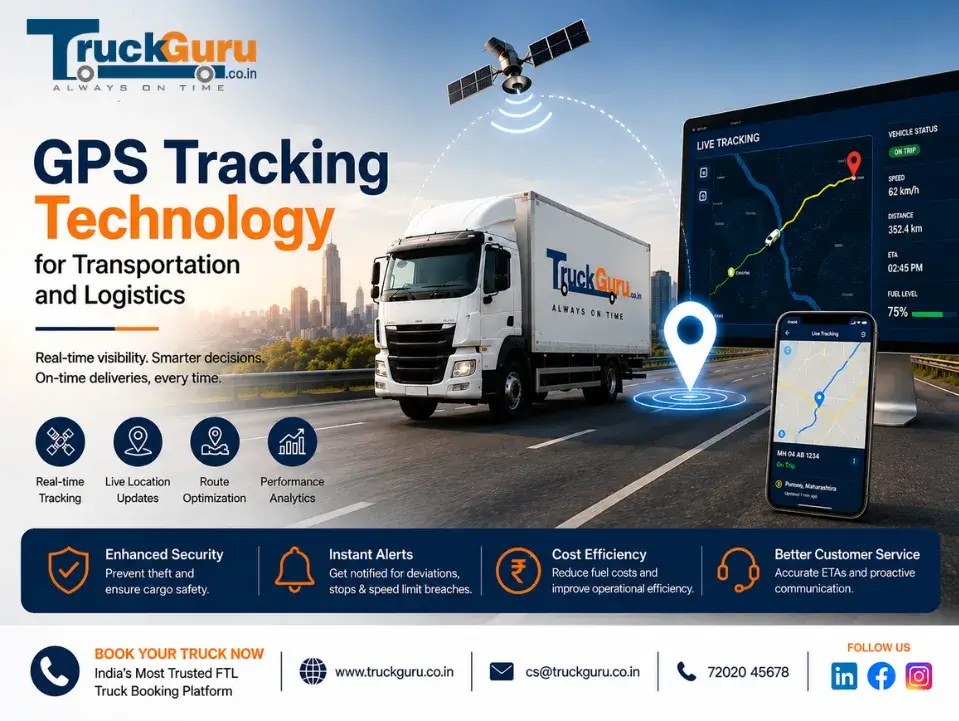
GPS Tracking for Transportation and Logistics – 10 Key Benefits
A truck carrying industrial goods leaves a factory in Surat at 8 in the morning. The consignee in Hyderabad wants to know when it will arrive. Three days ago, the honest answer would have been “sometime tomorrow.” Today, the fleet manager can give an arrival window accurate to within a couple of hours. An update goes out automatically if anything changes en route.
GPS Tracking in Transportation and Logistics: Quick Summary
GPS tracking in transportation and logistics does more than show a truck's location. Discover 10 benefits that help FTL freight businesses cut costs and serve customers better.
That shift is what GPS tracking actually delivers in the transportation and logistics sector. It is not just a navigation tool. For FTL freight operators, GPS technology connects the vehicle on the road to the office and the customer — all at the same time. It also feeds the maintenance schedule.
This article covers 10 specific benefits of GPS tracking in truck transportation and how each one translates to real operational value. It also covers how TruckGuru uses GPS tracking to give shippers visibility over their intercity freight.
What GPS Tracking Does in a Transport and Logistics Operation
A commercial GPS tracking system installed on a truck does several things simultaneously. It records the vehicle’s location in real time. It logs speed, route, idle time, and driving behaviour. Alerts fire when the vehicle leaves a designated zone, when an accident is detected, or when a delivery is completed.
Fleet managers access all of this data through a web dashboard or mobile app. Intercity FTL trucks can be on the road for days at a time. The truck is out of physical sight. GPS tracking closes that gap.
For shippers who want to track their cargo in transit, the TruckGuru mobile app provides real-time GPS tracking on all booked FTL shipments as standard — no separate subscription required.
10 Benefits of GPS Tracking for Transportation and Logistics
1. Reduces Vehicle Maintenance Costs
Vehicle maintenance is one of the highest recurring costs in any fleet operation. GPS systems address this in two ways.
First, modern GPS devices track engine diagnostics — odometer readings, engine hours, idle time, and fault codes. Fleet managers receive automatic alerts when a vehicle is due for servicing or when a malfunction is detected. This allows maintenance to be scheduled proactively rather than reactively.
Second, driving behaviour data — hard braking, sharp cornering, over-speeding — correlates directly with tyre wear and mechanical stress. When drivers know their behaviour is monitored, driving patterns improve, which extends vehicle life and reduces unplanned repair bills.
2. Controls Fuel Costs
Diesel accounts for 40 — 60% of the variable cost of a truck trip in India. GPS tracking helps control this in several ways:
- Route optimisation: GPS systems identify faster or less congested routes, reducing the total distance driven.
- Idle time monitoring: trucks left running while stationary at loading docks or toll plazas burn fuel for no movement. GPS data flags excessive idling so managers can address it.
- Over-speeding alerts: trucks driven above optimal speed consume significantly more fuel. GPS alerts at set speed thresholds help enforce fuel-efficient driving behaviour.
Even a 5 — 8% fuel saving per trip adds up across a fleet over a year on long-distance FTL corridors.
3. Monitors Driver Behaviour and Safety
Drivers are critical to the efficiency and safety of a transport operation. GPS tracking provides objective data on driving patterns. These would otherwise be invisible to a fleet manager in an office.
Speed violations, harsh braking, sharp turns, and route deviations are all logged automatically. This data serves two purposes. First, it identifies drivers who may need coaching before a behaviour pattern leads to an accident or a cargo claim. Second, it gives fleet managers a basis to recognise consistently safe drivers. In an industry where experienced drivers are always in demand, that recognition matters for retention.
4. Enables Faster Emergency Response
When a truck breaks down mid-route or is involved in an accident, response time affects both driver safety and cargo security. GPS tracking gives fleet managers the exact vehicle location instantly. The driver does not need to describe where they are or wait for a phone signal.
Breakdown coordinates can be sent directly to a roadside assistance provider. Accident location data can be shared with emergency services. For high-value FTL cargo on a remote highway stretch, this is not a luxury — it is an operational necessity.
5. Reduces Paperwork Through Automated Reporting
Fleet operations generate significant documentation: trip logs, mileage records, route reports, delivery confirmations. Traditionally, this involves manual data entry by drivers and administrative staff after each trip.
GPS systems automate most of this. Trip data — route taken, distance covered, stops made, time at each location — is captured automatically and stored digitally. Manual reporting time and data entry errors both drop. Operations managers get accurate records without chasing drivers for logbooks.
6. Can Lower Insurance Premiums
Commercial vehicle insurance providers in India have begun offering discounts on premiums for fleets equipped with certified GPS tracking devices. Tracked vehicles are stolen less often. They are recovered faster when stolen. They can also demonstrate driving behaviour data that reduces accident risk.
The actual discount varies by insurer and fleet size. When renewing commercial vehicle insurance, businesses should raise GPS tracking as a factor. The savings can partially offset the cost of the tracking system itself.
7. Improves Customer Communication and Satisfaction
In B2B freight, the consignee — the business receiving the goods — wants to know when the truck will arrive. A vague “tomorrow or day after” creates real problems. Staff are scheduled to unload. Production lines wait on components. Cold storage runs at cost.
GPS tracking allows fleet managers to give precise estimated arrival times and to proactively update consignees when delays occur. This changes the customer experience from passive waiting to informed planning. For FTL shippers, this level of visibility is often a key factor in choosing one logistics partner over another.
TruckGuru provides GPS-based shipment tracking through the TruckGuru app, giving both the shipper and consignee real-time location updates on booked FTL trucks.
8. Optimises Fleet Resource Utilisation
GPS data gives fleet managers a live picture of where every vehicle is and what it is doing. This enables better dispatch decisions. Managers assign the nearest available truck to a new booking rather than the first name in a logbook. Vehicles idling at a depot get redirected to return loads. Underutilised assets are identified before they become a dead cost.
For FTL operators managing multiple trucks, data-driven dispatch improves vehicle utilisation significantly. A truck sitting idle is a fixed cost with no corresponding revenue.
9. Reduces Vehicle Idle Time and Increases Productive Hours
Idle time — engines running while stationary — drains both fuel and vehicle life. Common causes include loading dock delays, traffic, toll queues, and overnight halts with the engine running for cabin comfort.
GPS systems flag excessive idle time automatically. Fleet managers get data to identify where the problem is and address it — whether through scheduling changes at loading facilities, driver guidance, or route adjustments.
10. Helps Recover Stolen or Missing Vehicles
A truck carrying a full load represents significant value: the vehicle, the cargo, and the business relationship with the shipper. Theft and vehicle diversion are real risks on Indian highways, particularly on remote stretches during night transit.
GPS tracking provides two layers of protection. Geofence alerts notify fleet managers in real time when a vehicle leaves its approved route or zone. If a truck goes missing, GPS provides the last known location and movement history — actionable data rather than a vague description. Recovery rates for GPS-tracked vehicles are significantly higher than for untracked fleets.
How TruckGuru Uses GPS Tracking for FTL Freight
TruckGuru is a pan-India FTL intercity truck booking platform operating across 110+ cities. GPS tracking is built into the platform as a standard feature on all booked shipments — not an optional add-on.
When a shipper books an FTL truck through TruckGuru, the assigned vehicle is GPS-tracked throughout the trip. Fleet managers at TruckGuru can monitor vehicle location, route adherence, and driver behaviour from a central dashboard. Shippers and consignees receive location updates through the TruckGuru app. Neither party needs to call the driver for a status update.
In the event of a breakdown or route deviation, TruckGuru’s operations team is alerted automatically. The team coordinates a response — a replacement vehicle, roadside assistance, or a revised delivery window for the consignee.
For businesses booking FTL freight, this GPS integration removes a common logistics friction point: not knowing where a shipment is or when it arrives.
Book an FTL truck with GPS tracking on your route: truckguru.co.in/truck-booking-online.
Key Takeaways
- GPS tracking in transportation and logistics does more than show location. It generates data that affects fuel costs, maintenance schedules, driver safety, and customer communication.
- The 10 main benefits are: reducing maintenance costs, controlling fuel spend, monitoring driver behaviour, enabling emergency response, automating trip reporting, lowering insurance premiums, improving customer communication, optimising fleet utilisation, reducing idle time, and recovering stolen vehicles.
- For FTL freight, GPS tracking is most valuable for real-time visibility. Intercity shipments keep the truck out of physical sight for multiple days — GPS closes that gap.
- TruckGuru includes GPS tracking as standard on all FTL bookings, accessible through the TruckGuru app for both shippers and consignees.
Frequently Asked Questions
What is GPS tracking in transportation and logistics?
GPS tracking in transportation and logistics uses satellite-based systems installed in commercial vehicles. These monitor position, speed, route, and driver behaviour in real time. Fleet managers access this data through web dashboards or mobile apps to improve operational efficiency and customer communication.
How does GPS tracking reduce fuel costs in truck transport?
GPS systems reduce fuel consumption by identifying shorter or less congested routes. They flag excessive idle time and alert managers when drivers exceed speed thresholds that increase fuel burn. On long-distance intercity routes, consistent monitoring of these factors can produce measurable fuel savings per trip.
Can GPS tracking lower commercial vehicle insurance premiums in India?
Some commercial vehicle insurers in India offer premium discounts for GPS-equipped fleets. The discount reflects the lower theft and accident risk associated with tracked vehicles. Businesses should confirm this with their insurer when renewing commercial vehicle coverage.
What is a geofence alert in fleet GPS tracking?
A geofence is a virtual boundary set around an approved route or operating zone. When a GPS-tracked vehicle crosses this boundary without authorisation, the system sends an automatic alert to the fleet manager. This is used to detect route deviations, unauthorised stops, and potential vehicle theft.
Does TruckGuru provide GPS tracking on FTL bookings?
Yes. GPS tracking is included as a standard feature on all FTL truck bookings through TruckGuru. Shippers and consignees can track the vehicle’s real-time location through the TruckGuru mobile app throughout the trip.
What is the difference between GPS tracking and fleet management software?
GPS tracking provides the location and movement data. Fleet management software collects, analyses, and presents that data. It combines GPS location with driver logs, maintenance records, fuel data, and delivery reports. Most commercial GPS systems include fleet management software as part of the package.
Related Reading
- How to Estimate Goods Transport Rates: A Beginner’s Guide
- How Are Truck Transportation Charges Calculated in India?
- 6 Truck Booking Platforms Compared for FTL Freight in India: FR8, WheelsEye, Trukky, BlackBuck, Vahak & TruckGuru
For current rules and official notifications, see the Ministry of Road Transport & Highways.