

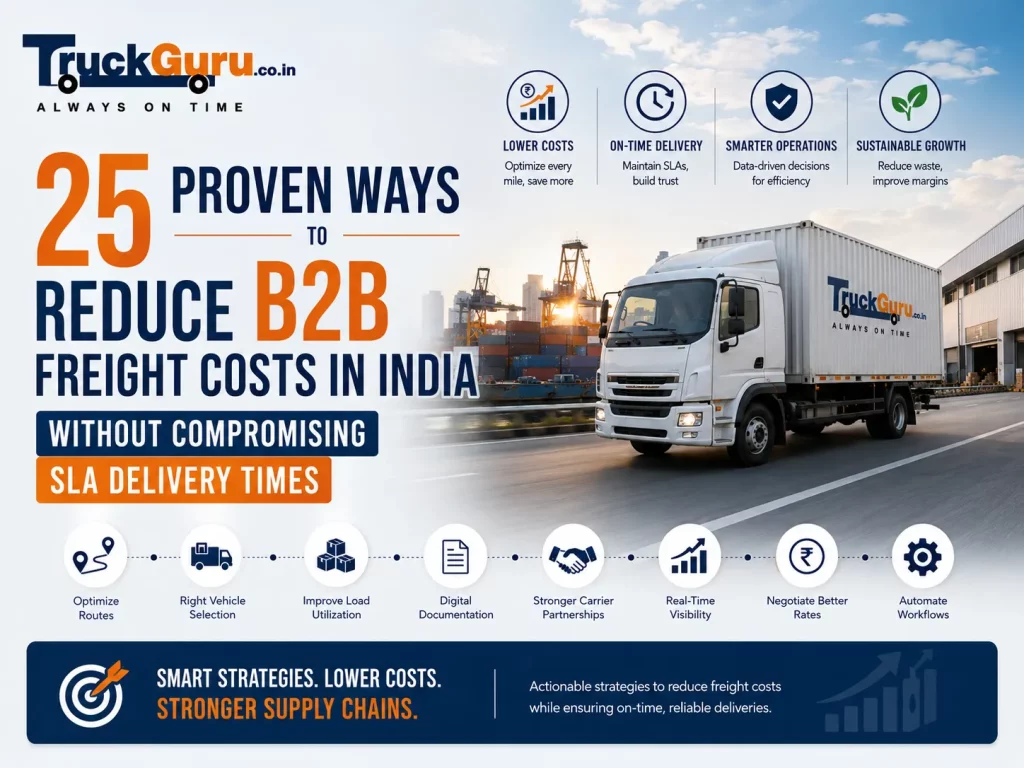
25 Proven Ways to Reduce B2B Freight Costs in India Without Compromising SLA Delivery Times
A pharmaceutical company in Hyderabad was booking a 32FT container for every cross-country dispatch because that is what their logistics team had always done. When a freight audit broke down the actual cargo weights, 60% of those shipments were under 7T — well within an Eicher 19FT’s capacity at a meaningfully lower per-km rate. They had been paying the container rate on every trip for three years. Nobody had run the calculation.
B2B Freight Cost Reduction: Quick Summary
B2B freight cost reduction: Most Indian B2B shippers overpay freight through avoidable errors. 25 proven tactics to cut intercity FTL costs without.
This is not an unusual story. Most Indian B2B shippers have at least one version of it. The overpayment is not usually because freight is expensive in India — it is because freight decisions accumulate unchecked. Wrong truck sizing, late bookings, seasonal blind spots, documentation delays, and broker margins each add a layer. Together, they push total freight spend well above where it should be on most active corridors.
This guide covers 25 specific tactics for reducing that gap — without extending transit times, downgrading carriers, or breaching delivery SLAs.
At a Glance — The Five Levers That Move the Most Spend
Before the 25 tactics, here are the five categories where most Indian B2B shippers have the largest reduction opportunity:
- Truck sizing: Booking a larger truck than the cargo weight requires is the single most common and expensive pattern. On many mid-length corridors, right-sizing alone can reduce freight cost per trip by 15-25%.
- Rate benchmarking: Negotiating without a market rate reference means the broker’s quote sets the floor. A confirmed digital rate should set it.
- Booking timing: Last-minute bookings and Q4 demand spikes on agricultural corridors push rates up significantly on affected routes.
- Documentation speed: Every hour a truck waits at loading for e-way bill generation or LR paperwork is a cost absorbed somewhere in the chain.
- Carrier performance tracking: The cheapest quote and the most reliable carrier are frequently not the same. Tracking on-time delivery by carrier, not just freight spend, reveals the true cost.
Use the TruckGuru freight calculator to benchmark your current corridor rates against confirmed market pricing before working through the tactics below.
Pricing and Rate Intelligence
Most freight negotiations in India start with the wrong number. If you have not independently confirmed what the market rate is for your corridor and truck category, you are negotiating blind — and the broker or transporter knows it.
1. Get a confirmed rate before you negotiate
Run your corridor on a digital freight platform before approaching any transporter or broker. The confirmed rate gives you a reference point — not just a starting number, but a signal of what the market actually clears at for your specific route, truck category, and approximate timing. Negotiating without this reference means accepting the first number presented rather than knowing whether it is reasonable.
2. Compare per-km rate, not per-trip total
A quote of Rs. 45,000 versus Rs. 47,000 on what sounds like the same trip can mask a significant difference if the trucks are in different categories. A 14FT Eicher and a 20FT Container have different per-km rates and different load capacities. Comparing the headline trip total without confirming the truck category is how mixed-category comparisons end up looking like fair competition. Standardise on a per-km rate for the same truck category across all your rate comparisons.
3. Audit toll charge assumptions by truck type
Toll costs on intercity routes vary by truck axle count. A multi-axle 32FT container pays significantly more in tolls than a single-axle Eicher on the same corridor — and those toll costs fall back on the shipper separately. A flat “Rs. X for tolls” estimate applied uniformly across different truck categories either overestimates for smaller vehicles or underestimates for heavy containers. Ask for actual toll data by route and truck type, not a rounded estimate.
4. Track your rate card quarterly, not annually
Diesel prices, seasonal truck supply patterns, and route demand all shift across the year. A corridor rate that was competitive in March may be notably above market in October on routes that compete with agricultural freight. Reviewing your primary corridors quarterly — rather than at annual contract renewal — catches rate drift before it compounds into significant overpayment.
5. Use digital booking to eliminate unnecessary broker margins
Traditional brokers in India typically add a margin to the transporter rate as their arrangement fee. On high-value or high-frequency shipments, this adds up. FTL booking platforms that connect directly to verified transporters with confirmed rates avoid this layer on those transactions. For shippers who continue using brokers for some routes, using a digital platform rate as a benchmark before each negotiation creates a defensible reference for the conversation.
Truck Sizing and Load Optimisation
Truck sizing is where the most money is left on the table by Indian B2B shippers. It is also where the problem is most visible once someone actually looks.
6. Right-size every shipment to verified cargo weight
The pharmaceutical company in the introduction is a representative example, not an edge case. On many corridors, shippers routinely book trucks 1-2 categories above what their actual cargo weight requires. The rate difference between an Eicher 19FT (Rs. 37-41/km) and a 32FT container (Rs. 55-91/km depending on tonnage tier) is substantial over hundreds of trips per year.
The fix is not complicated — weigh every consignment before selecting the truck category. The difficulty is that this requires a process change, and process changes face inertia. The incentive calculation is straightforward: on a 600 km corridor, a shipper who consistently right-sizes from a 32FT to an Eicher 19FT saves Rs. 10,800-30,000 per trip. At 150 annual trips on that corridor, the annual savings are material.
The TruckGuru truck size guide compares load capacity and per-km rates across all five categories to help with this decision.
7. Understand the weight versus volume conflict for your cargo type
Cargo categories split into two broad types for freight purposes. Weight-limited cargo — steel, chemicals, ceramics, auto components — hits the truck’s weight limit before the body appears full. Volume-limited cargo — packaged beverages, foam products, branded consumer goods — fills the body by volume before reaching the weight limit. Knowing which category your freight falls into prevents two different expensive mistakes: overloading a too-small truck (checkpost compliance issue) and paying for empty air in an unnecessarily large one.
Operational example: A garment exporter in Surat booking an Eicher 19FT (7T capacity) for consolidated carton shipments was consistently hitting 5-6 tonnes of weight while the truck body was already full. The right vehicle was the 20FT Container (6.5T, similar rate band) because the closed body provided better weather protection for packaged goods — not because the weight called for it. Volume, not weight, was the binding constraint.
8. Consolidate small shipments to fill a truck
A company dispatching 700-800 kg to the same destination city every two or three days is running multiple small-truck trips where a weekly consolidated dispatch could be more efficient. This is not always the right answer — some supply chains cannot tolerate weekly delivery windows — but for replenishment freight to distributors or stockists where flexibility exists, modelling the consolidation economics is worth the effort. Fewer trips, better truck utilisation, and lower coordination overhead.
9. Audit packaging for freight density
Packaging decisions are usually made to protect product or reduce per-unit cost — rarely to optimise freight density. Oversized cartons, excessive void fill, and non-stackable pack formats all increase the effective volume of a shipment without adding protection value. A packaging audit focused on how cargo fits in a truck, not just cost per unit, often reveals 10-15% load efficiency improvements that translate directly into freight cost reduction.
10. Track load utilisation per trip
If your logistics team is not tracking what percentage of truck capacity each trip actually uses — by weight and by volume — they cannot systematically improve it. A 90-day load utilisation log by corridor and truck category is usually enough to identify the highest-opportunity routes for sizing correction. The data almost always surprises people who have not looked at it before.
Timing and Planning Decisions
A significant portion of avoidable freight cost in Indian B2B logistics is a planning cost, not a market cost. The market rate is what it is. When you enter that market, and how much flexibility you have when you arrive, determines what you actually pay.
11. Book active corridors at least 48 hours ahead
On high-frequency corridors — Delhi to Mumbai, Bangalore to Chennai, Ahmedabad to Surat — trucks are available most days with reasonable lead time. On medium-frequency corridors serving smaller industrial cities, a 48-72 hour booking typically secures better vehicle selection and avoids the rate pressure that builds when multiple shippers compete for the same available trucks. The rate per km may or may not change with last-minute booking, depending on the platform, but truck selection quality almost always does.
12. Plan around the agricultural harvest season on affected corridors
October through January sees increased truck demand on corridors connecting India’s major agricultural belts — sugarcane in UP and Maharashtra, cotton in Gujarat, rice in Punjab and Andhra Pradesh. General commercial shippers on Delhi-Lucknow, Ahmedabad-Surat-Mumbai, and Hyderabad-Vijayawada corridors during these months compete with agricultural freight for the same trucks, tightening availability. Rates on affected corridors can rise meaningfully during peak harvest months. Shippers who plan dispatches around known harvest periods, or book further ahead during these windows, manage the cost impact better.
13. Front-load Q4 dispatches
Indian financial year-end (January-March) concentrates a disproportionate share of annual dispatches as companies clear inventory, fulfil institutional orders, and meet procurement deadlines. This demand spike on major corridors typically drives rate pressure upward in February and March on active routes. Companies that begin their Q4 dispatches in mid-January rather than mid-February consistently face better truck availability and more stable pricing on the same freight.
14. Use off-peak dispatch windows for flexible shipments
Not all shipments are time-critical. For stock replenishment freight where the SLA is measured in days rather than hours, a truck dispatched late on Saturday evening avoids weekday congestion, clears toll plazas faster, and often reaches the destination in shorter calendar time despite lower urgency priority. The per-km rate does not change. The effective delivery speed often improves.
15. Reduce upstream delays that create booking emergencies
Last-minute truck requirements are usually symptoms of upstream planning failures — purchase orders confirmed late, production runs delayed, dispatch dates missed, or e-way bills not generated in time. Each emergency booking forces the logistics team to accept whatever vehicle is available at that moment rather than selecting the right one for the cargo. Tracking the frequency and cause of same-day booking requirements typically reveals 2-3 upstream process issues that, when fixed, eliminate a meaningful percentage of the most expensive freight decisions.
Documentation and Compliance
Documentation failures in Indian freight are usually invisible in the cost line but visible in the time line. A truck waiting at a factory gate, a shipment held at a checkpost, or a billing dispute taking weeks to resolve — these costs are real but rarely attributed to their actual cause.
16. Generate the e-way bill before the truck arrives
An e-way bill requires the vehicle number and driver name — details that are known once the truck is assigned, before it arrives for loading. Platforms like TruckGuru share driver and vehicle details before dispatch, specifically so documentation can be generated in that window. A truck waiting 1-2 hours at a factory gate while accounts generate the e-way bill is a truck hour paid for and not used. Across hundreds of annual shipments, this time cost is material even if it never appears explicitly in the freight budget.
17. Track e-way bill validity on long-distance routes
An e-way bill covers 200 km per day of validity. A Kolkata to Chennai shipment at approximately 1,700 km gets 8-9 days of validity — generally adequate. A Visakhapatnam to Delhi shipment at approximately 1,800-1,900 km also gets sufficient time in most cases. The risk is on complex multi-stop routing or on shipments where delays extend the transit. A dispatch team that does not actively track e-way bill expiry on long routes will eventually face a checkpost detention and the associated costs. Build validity tracking into the dispatch checklist.
18. Pre-validate delivery point GSTINs before the August 2026 deadline
From August 1, 2026, the Ship-To GSTIN is a mandatory field in all Bill-To/Ship-To e-way bills under GSTN Advisory No. 661. If the GSTIN at your delivery address is missing, invalid, or mismatched to the state, the e-way bill will not generate. The truck cannot depart. For B2B shippers with dozens or hundreds of delivery points, a one-time GSTIN audit and update before the deadline costs almost nothing. The alternative — discovering the problem at dispatch on a time-sensitive shipment — is expensive in both time and relationship terms.
19. Digitise LR management
Physical Lorry Receipts get lost. A missing LR at the destination delays goods release, slows payment cycles, and creates disputes that outlast the shipment itself. Digital LR generation at dispatch — standard on structured booking platforms — eliminates the physical chain without changing what the document accomplishes. The indirect cost of manual LR management across an annual shipment volume is typically underestimated until someone calculates the hours spent on LR recovery and dispute resolution.
Carrier and Platform Strategy
Who you ship with matters as much as how you book. The best rate from an unreliable carrier is not a good rate — and in Indian B2B logistics, unreliability has a specific, calculable downstream cost.
20. Consolidate to fewer, better carrier relationships
The instinct to maintain 10-15 transporter relationships “for availability” typically produces the opposite of its intent. Fragmented volume means limited leverage with any single carrier, inconsistent rate management, and no meaningful data on performance by corridor. Companies that consolidate their primary corridor volumes to 3-4 preferred carriers — with consistent volume commitments — generally negotiate better rates and get more reliable dispatch than those spreading thin across many relationships.
21. Require GPS tracking on every shipment
GPS visibility on active shipments is no longer a premium feature — it is a baseline expectation for professional intercity FTL. Shippers without it spend significant time calling drivers for location updates, estimating delivery windows for customers, and resolving disputes without a route record. The operational cost of phone-based tracking is real. Untracked shipments also produce more damage and delay disputes because there is no location or timing record to reference. Only work with carriers that include GPS tracking as standard.
22. Track on-time delivery performance by carrier and corridor
Most Indian B2B logistics teams track freight cost by carrier. Fewer track on-time delivery rate by carrier and corridor. The gap matters: a carrier running 20-25% late on a critical corridor is not cheaper than a carrier charging 8-10% more and delivering on time, once downstream costs (production stoppages, customer penalties, expedite orders) are included. Run a simple OTD log for 90 days per carrier on your primary corridors. The picture that emerges usually prompts a carrier mix change.
23. Negotiate payment terms in exchange for volume consistency
Transport companies in India operate on tight cash flow. A shipper who offers consistent volume on a corridor — even 6-8 trips per month rather than 15-20 — has more negotiating position than volume alone suggests, because predictability has value to a transporter managing truck scheduling. The 5% at booking / 90% at loading / 5% after delivery structure is standard on structured platforms. Volume-consistent shippers sometimes negotiate the loading payment percentage to improve their own working capital position while maintaining the transporter relationship.
24. Use platform rate data to anchor broker negotiations
For shippers who continue using brokers on some routes, a confirmed digital platform rate for the same corridor and truck category is a useful negotiation anchor — particularly because it is an arm’s-length market rate rather than a competing quote from another broker. The conversation shifts from “your rate versus their rate” to “your rate versus what the market confirms.” The anchor changes the reference frame.
25. Build freight cost per unit into your P&L view
Total freight spend as a line item hides efficiency trends. A company that grows shipment volume by 30% and sees freight cost grow by 30% may be doing exactly as well — or may be failing to capture the load efficiency gains that volume growth should produce. Freight cost per kg shipped, or per unit of finished product dispatched, reveals whether the freight operation is improving or just growing. If the per-unit figure is flat or rising alongside volume growth, it is a diagnostic signal worth investigating.
Key Takeaways
- Truck oversizing is the most common, most calculable, and most fixable source of avoidable freight spend. Weigh every consignment. Check the per-km rate for the right truck category. Book that truck.
- Booking timing is a planning decision, not a market one. Harvest season, Q4 demand spikes, and last-minute requirements each carry a cost that planning avoids.
- Confirmed digital rates before every negotiation shift the reference frame. The broker’s quote should never be the starting point.
- Documentation delays are invisible in the freight cost line but visible in the timeline. E-way bill generation before truck arrival, GSTIN pre-validation, and digital LR management each reduce a specific category of operational waste.
- On-time delivery rate by carrier, tracked per corridor, is as important as the rate per kilometre. The cheapest quote and the most reliable carrier are frequently not the same entity.
What to Measure Weekly
The 25 tactics above are most effective when they are connected to a regular measurement cadence. Here is a minimal weekly freight review — five metrics that, if tracked consistently, will surface the most significant improvement opportunities:
- Load utilisation rate: average cargo weight as a percentage of truck capacity, by corridor and truck category
- Booking lead time: average hours between booking confirmation and truck departure, flagging same-day bookings for root cause review
- On-time delivery rate: actual delivery time versus SLA, by carrier and corridor
- Rate variance: difference between the confirmed platform rate and the actual invoice rate, by booking type
- E-way bill generation time: time between truck assignment and e-way bill generation, identifying documentation bottlenecks
None of these requires a separate system. A shared spreadsheet updated by the logistics team captures all five. The discipline is the hard part — not the tool.
The Practical Starting Point
If this article has surfaced three or four tactics that look like they apply to your business, start with the most calculable one. Right-sizing the truck on your highest-volume corridor is usually the fastest path to a number you can put in front of a CFO. It requires a weight check process change and a truck selection update — neither of which costs anything to implement.
Rate benchmarking is the second priority. If you are currently booking through brokers without an independent rate reference, the TruckGuru freight calculator gives you a confirmed market rate for any corridor and truck category in under a minute. Use that number before the next negotiation and see how the conversation changes.
Check rates for your primary corridors at the freight calculator. For city-specific availability and corridor booking, the truck size guide helps match cargo weight to the right vehicle before you book.
Frequently Asked Questions
How much can a B2B shipper realistically save on intercity freight in India?
The savings vary significantly by current practice. Companies that have never benchmarked rates, consistently oversize trucks, and book through brokers without independent rate references typically find a 15-25% reduction opportunity on their primary corridors. Companies with better existing discipline may find 5-10%. Truck right-sizing and broker margin elimination tend to produce the fastest and most calculable results.
Does booking in advance always produce lower freight rates in India?
On high-frequency corridors like Delhi to Mumbai or Bangalore to Chennai, same-day availability is often reliable, and rates are relatively stable. On medium-frequency routes and during seasonal demand peaks on agricultural corridors, booking of 48-72 hours typically produces better truck selection and more consistent pricing. The rate per km on a confirmed digital platform generally does not change with booking lead time, but the available truck category and quality do.
What is the most common freight overpayment pattern for Indian SME manufacturers?
Truck oversizing is the most consistent pattern — booking a larger truck than the cargo weight requires because that is what has always been booked on that route, without rechecking whether the sizing still fits the actual shipment. The second most common pattern is negotiating without an independent rate benchmark, meaning the starting point for discussion is the broker’s number rather than the market rate.
Does right-sizing the truck affect delivery SLA times?
Transit time between two cities is a function of road distance and conditions, not truck size. A Tata Ace and a 32FT container on the Bangalore to Chennai route both travel the same road in approximately the same timeframe, assuming similar departure times. Right-sizing affects freight cost, not transit time, on standard intercity corridors.
How does digital FTL booking reduce freight costs versus traditional brokers?
Digital FTL platforms remove the broker margin on confirmed transactions, provide confirmed rates before negotiation, and give shippers real-time GPS visibility that reduces the operational cost of tracking shipments by phone. The confirmed rate before dispatch also eliminates the billing ambiguity that is common when rates are negotiated verbally and invoiced separately.
What is the financial impact of slow e-way bill generation?
A truck waiting 1-2 hours at loading while accounts generate the e-way bill is a truck hour paid for and not used. On a fleet running 150-200 trips per year, that waiting time has a real cost even though it never appears explicitly in the freight budget. It also pushes the dispatch time later, which can affect delivery windows on time-sensitive routes.
What is the Ship-To GSTIN change in August 2026 and how does it affect freight?
From August 1, 2026, under GSTN Advisory No. 661, the Ship-To GSTIN is a mandatory field in all e-way bills covering Bill-To/Ship-To transactions where the billing and delivery addresses differ. If the delivery-point GSTIN is missing or invalid, the e-way bill will not generate and the truck cannot depart. Shippers should audit their delivery-point GSTIN database before August 1 to avoid dispatch delays on affected shipments.
Is FTL always cheaper than PTL for B2B freight in India?
Not always. FTL makes the most sense when cargo fills 70-100% of the truck by weight or volume. At lower utilisation rates, PTL — sharing a truck with other shippers — may cost less per kg. However, PTL introduces transit time variability because the truck makes multiple stops, which affects SLA reliability. For time-sensitive B2B shipments, FTL’s dedicated truck and direct routing often justifies the difference over PTL.
How should a logistics team start implementing freight cost reduction?
Start with the most calculable change first. For most companies, that is truck right-sizing on the highest-volume corridor — a weight check process and a truck selection update that costs nothing to implement. The second step is rate benchmarking before the next broker negotiation using a confirmed digital platform rate. Both produce visible results within 30-60 days.
Does TruckGuru offer PTL or part-load freight options?
No. TruckGuru books full truckload (FTL) only — one truck, one shipper, one consignment per booking. PTL and shared-truck options are not available on the platform.
Related Reading
- Reduce Manufacturing Freight Costs: India Intercity Guide
- Ship-To GSTIN Mandate August 2026 — What Shippers Must Do
- Common Questions FTL Shippers Ask Before Booking a Truck
For current rules and official notifications, see the Ministry of Road Transport & Highways.