

Container Truck Transport in India: What You Are Actually Booking
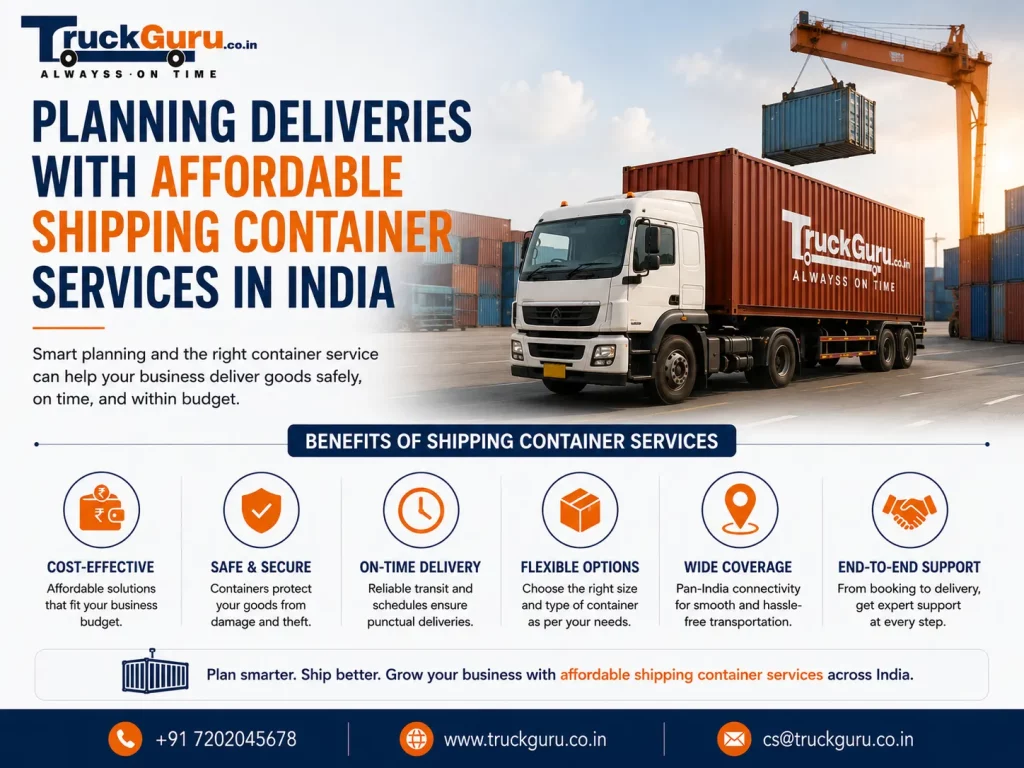
Search “container truck transport” and most of what comes up is written for ocean freight — ISO shipping containers, port handling, intermodal rail connections. None of that is what you are booking when you reserve a container truck on TruckGuru. This is a single, fixed-body 32ft truck rated for 15 tonnes, built for domestic road transport between Indian cities — not a leasable asset, not something that gets craned onto a ship, and not part of a rail-and-sea chain.
Container Truck Transport: Quick Summary
Container Truck Transport: Searching for affordable container shipping in India? Plan smooth, cost-effective deliveries with TruckGuru’s expert logistics and.
Getting this distinction right matters because the wrong mental model leads to the wrong questions. You are not deciding whether to buy a new or used container. You are deciding whether a 32ft container truck is the right vehicle for your shipment, and how it compares to TruckGuru’s other truck sizes.
Container Truck vs Shipping Container: Two Different Things
An ISO shipping container — the kind you see stacked at a port or on a cargo ship — is a standalone steel box, typically 20ft or 40ft, that gets lifted by crane between trucks, trains, and ships. It is bought, sold, or leased as an asset, and a business might keep one in service for 15-20 years.
A container truck on TruckGuru is a different category of vehicle entirely: a 32ft truck with a fixed container-style body built onto the chassis. It never leaves the truck. There is no crane handoff, no rail leg, no port involved. It exists purely to move goods by road between an origin and destination city, with the enclosed body protecting cargo from weather and giving better security than an open truck.
If your business needs an actual ISO shipping container — for export, for storage, for a sea freight leg — that is a container leasing or trading transaction, not a transport booking, and it is outside what TruckGuru offers.
Why Choose a Container Truck Over an Open Truck
The enclosed body is the entire point. Cargo sensitive to weather — electronics, pharma, packaged FMCG goods, textiles — stays protected from rain and dust in a way an open or tarpaulin-covered truck cannot match. The enclosed body also makes opportunistic theft at a highway stop meaningfully harder, since goods are not visible or easily accessible the way they are on an open flatbed.
The tradeoff is loading flexibility. An open truck or flatbed can take oddly shaped or oversized cargo that will not fit through a container’s rear doors. If your shipment is regular palletised or boxed cargo, the container truck is almost always the better call. If it is irregular, oversized, or needs side-loading, check the open truck option instead.
When a 32ft Container Truck Is the Right Booking
Matching the vehicle to your shipment matters more than the vehicle type alone:
- 32ft container (15 tonnes): bulk industrial goods, multi-pallet FMCG dispatch, or any shipment where weather and security protection matter more than loading flexibility.
- 20ft truck (7 tonnes): mid-to-large shipments that do not need the full 15-tonne capacity.
- 14ft truck (3.5 tonnes): smaller B2B dispatches — a few hundred cartons or palletised goods.
Booking a 32ft container for a 4-tonne load wastes the capacity you are paying for. The truck size guide has full specifications for matching the load to the vehicle.
What Determines the Container Truck Rate
On TruckGuru, the rate for a 32ft container truck is set by distance, using a fixed per-km rate plus a base charge — the same structure across every booking on that route, not a quote that shifts based on negotiation or which day you call. This is worth stating plainly because a lot of container transport content elsewhere talks about “comparing providers” and “negotiating rates,” which describes a broker market, not how booking actually works here.
What you can control is how fully you use the capacity you book. Since the rate is per trip, not per kg, consolidating a shipment to use closer to the full 15-tonne capacity gets more value out of the same booking than sending a half-empty container truck and a separate smaller dispatch on the same route.
Check the confirmed rate for your route and date on the freight calculator.
Loading a Container Truck: What Actually Matters
Generic container-shipping advice talks about forklifts rated for several tonnes and professional crane services — that is, port-handling advice for ISO containers, not what applies here. For a domestic container truck booking, the practical points are simpler:
- Confirm whether your pickup location has dock-level loading or whether goods need to be lifted into the truck manually — this affects how long loading takes and whether you need extra labour on-site
- Photograph the cargo and loading position before the truck departs, particularly for high-value goods — this is your reference point if a damage question comes up later
- Distribute weight evenly across the container floor rather than concentrating it at one end, which matters for both vehicle handling and avoiding axle overloading at weighbridges
- Declare the actual shipment weight accurately on the e-way bill — a mismatch between declared and actual weight is one of the more common causes of delay at state border checks
Booking a Container Truck Online
- Go to TruckGuru or open the mobile app
- Enter pickup and destination cities, select the 32ft container truck
- Check the confirmed rate on the freight calculator before booking
- Confirm — no advance deposit required
- Receive driver name, vehicle number, and direct contact before dispatch
- Track live via GPS through the TruckGuru mobile app from pickup to delivery
- Digital LR and GST invoices are generated automatically after delivery
See the full container truck page for corridor-specific rates: container truck transport service.
Frequently Asked Questions
Is a container truck the same as an ocean shipping container?
No. An ocean shipping container is a standalone steel box used in sea freight, bought or leased as an asset. TruckGuru’s container truck is a fixed truck body used only for domestic road transport — it never leaves the vehicle and has no port or rail involvement.
What is the load capacity of a container truck on TruckGuru?
15 tonnes on the 32ft container. For smaller loads, the 20ft (7 tonnes) or 14ft (3.5 tonnes) trucks are usually a better fit — booking the 32ft for a small shipment means paying for unused capacity.
How is the container truck rate calculated?
By distance, using a fixed per-km rate plus a base charge for the route — the same structure for every booking, not a negotiated quote. Check your route on the freight calculator for a confirmed number.
Should I book a container truck or an open truck?
Container truck for regular palletised or boxed cargo, especially anything weather-sensitive or higher-value. Open truck for oversized or irregularly shaped cargo that will not fit through container doors.
Does TruckGuru sell or lease shipping containers?
No. TruckGuru provides FTL road transport using container trucks. Buying, selling, or leasing an actual ISO shipping container is a separate kind of transaction outside what TruckGuru offers.
Call 72020 45678 or book online at truckguru.co.in for a confirmed container truck rate on your next shipment.
Related Reading
- Reduce Manufacturing Freight Costs: India Intercity Guide
- Reduce B2B Freight Costs in India: 25 Proven Strategies
- Ship-To GSTIN Mandate August 2026 — What Shippers Must Do
For current rules and official notifications, see the Ministry of Road Transport & Highways.