

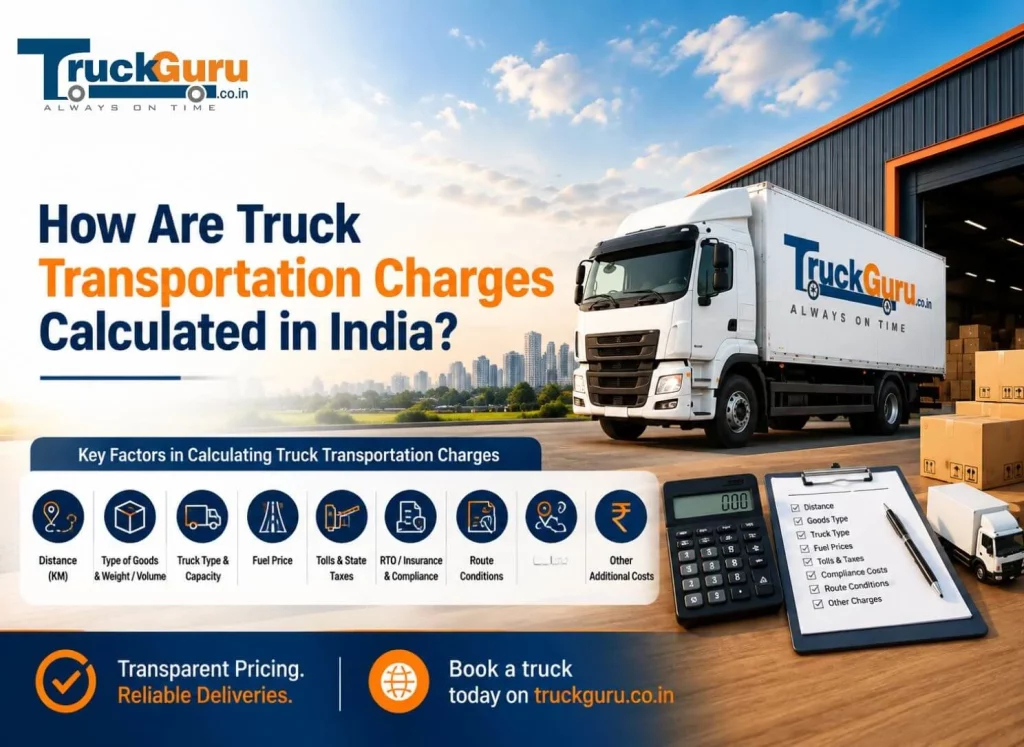
A shipper moving goods from Ahmedabad to Pune once told us he’d gotten four quotes for the same 20ft truck load, and no two numbers matched. That’s not unusual. Freight pricing in India depends on truck type, distance, route congestion, cargo, and the season you’re booking in. Change one variable and the quote moves.
This breaks down exactly how FTL truck transportation charges get calculated in India, what you’re actually paying for, and where the real savings are.
Truck Types and Load Capacity: What You’re Actually Booking
Before you look at cost, match your cargo to the right vehicle. Overbooking capacity is the single most common way shippers overpay.
- Tata Ace — 1,250 kg. Small B2B consignments, urgent spare parts, sample shipments.
- Bada Dost — 1.5 tonnes. Mid-size cargo, regional distributor restocking.
- 14ft Eicher truck — 3.5 tonnes. FMCG, electronics, medium-volume intercity loads.
- 20ft truck — 6.5 tonnes. Large appliances, industrial goods, bulk B2B cargo.
- 32ft container — 7 to 18 tonnes across variants. Full-load factory dispatches, plant-to-warehouse movement.
Not sure which one fits your shipment? Check the truck size guide before you book.
How Truck Transportation Cost Is Calculated
Transporters build a quote from two buckets: fixed costs and variable costs. Knowing both tells you whether a rate is fair or padded.
Fixed Costs
These stay the same no matter how far the truck travels.
- Vehicle EMI or depreciation: Rs.20,000 to Rs.50,000 a month for medium trucks.
- Insurance: Rs.30,000 to Rs.80,000 a year, depending on truck type and insured value.
- Permits and registration: interstate permits and fitness certificates run Rs.15,000 to Rs.50,000 a year.
- Driver salary: Rs.18,000 to Rs.35,000 a month, plus allowances on longer routes.
Variable Costs
These move with distance, route, and cargo.
- Diesel: the highest single cost. Loaded trucks typically return 3 to 5 km per litre, and diesel prices shift by state.
- Maintenance and tyres: roughly Rs.2 to Rs.3 per km for servicing, tyre wear, and breakdowns.
- Tolls: FASTag handles collection on national and state highways. A Delhi to Mumbai run on NH-48 alone can add Rs.4,000 to Rs.6,000 in tolls.
- Loading and unloading labour: Rs.500 to Rs.2,500 per shipment, depending on cargo and handling.
The formula transporters actually use:
Total cost = Fixed costs + (Variable cost x Distance)
On top of that, operators add a margin, usually 10 to 20%. Busy corridors like Pune to Bengaluru run thinner margins because more trucks compete for the same loads. Remote routes push margins higher because trucks often return empty.
What TruckGuru Trip Rates Look Like
Rates below are ranges for standard FTL bookings on TruckGuru, shown as final trip cost. No formula, no per-km breakdown, since that’s how we quote every job on the platform.
- Tata Ace / Bada Dost: short intercity runs under 300 km, roughly Rs.4,000 to Rs.15,000.
- 14ft Eicher: mid-distance corridors between 300 and 700 km, roughly Rs.12,000 to Rs.35,000.
- 20ft truck: long-distance interstate freight from 700 to 1,500 km, roughly Rs.28,000 to Rs.70,000.
- 32ft container: pan-India movement above 1,500 km, roughly Rs.55,000 and up, scaling with the container variant booked.
These are indicative. Actual quotes depend on truck availability, return loads, and season. Check truck type options to see which vehicle fits your route, then get a live number before you commit.
What’s in the Final Invoice
A trip rate rarely tells the whole story. Here’s what usually shows up on the bill.
Base freight charge. The core cost: vehicle, driver, and fuel for the route.
Handling charges. Loading and unloading, sometimes bundled into the quote, sometimes billed separately. Typically, Rs.500 to Rs.2,500 per delivery.
GST. Truck transportation attracts 5% GST without input tax credit, or 12% with ITC. Most SME shippers use the 5% option. Larger businesses with GST registration often prefer 12% to claim ITC against their own liability.
Cargo insurance. Optional, but worth it for high-value freight. Runs 0.3% to 0.5% of declared cargo value per trip. This covers the goods, not the truck; vehicle insurance is separate and doesn’t protect your cargo.
Detention charges. If loading or unloading runs past the agreed free time, expect Rs.1,000 to Rs.3,000 a day in detention fees.
Why Rates Change by Route and Season
Geography and demand both move the number on your quote.
High-volume corridors, Mumbai to Delhi, Chennai to Hyderabad, Pune to Bengaluru, tend to run 10 to 15% cheaper than similar-distance routes with less traffic. More trucks operating means easier return loads and tighter competition on price.
Routes to hill stations or less-connected districts cost more per km. When a truck can’t find a return load, that dead run gets priced into what you pay going out.
Three windows push rates up across the board:
- Festive season (October-November): Diwali and Navratri dispatch volumes spike.
- Harvest months (March-May): agricultural movement competes with commercial freight for the same trucks.
- Monsoon (June-September): road conditions worsen on certain routes and transit times stretch.
Expect rates to climb 15 to 20% during these windows. Booking a few days ahead of the surge is the cheapest way around it.
FTL vs. PTL: Why This Matters for Pricing
FTL (Full Truck Load) means you book the whole vehicle. You pay a flat trip rate whether the truck is full or not, and your cargo moves point-to-point with no stops for other shippers’ goods.
PTL (Part Truck Load) means your cargo shares space with other consignments. Pricing runs per kg or tonne with a minimum chargeable weight, and the truck makes multiple stops, so transit takes longer.
TruckGuru runs FTL only. If your cargo fills 60% or more of a truck, is time-sensitive, or needs direct delivery without intermediate stops, FTL is the right call. For smaller loads where PTL makes more sense, that’s a separate market from what we book.
Five Ways to Cut Your Truck Transportation Bill
Right-size the truck. Booking a 32ft container for cargo that fits a 14ft Eicher is the most common overspend we see. Match the vehicle to actual weight and volume.
Consolidate shipments. Splitting a week’s orders into three small runs almost always costs more than one full-truck dispatch. Batch where your delivery timeline allows it.
Compare rates by corridor, not by city. A competitive rate on Mumbai to Pune tells you nothing about Mumbai to Nagpur. Get quotes specific to the actual route.
Book ahead of seasonal peaks. Festive season and financial year-end (January-March) compress dispatch volumes into short windows. A few days of lead time avoids the last-minute premium.
Track carrier performance, not just price. The lowest quote isn’t always the lowest total cost. A carrier with frequent delays or cargo damage generates costs downstream: replacement shipments, storage, customer complaints, that erase whatever you saved on the trip rate.
Run your corridor through the TruckGuru freight calculator to see current market rates before you book, or go straight to truck booking online if you already know what you need.
Key Takeaways
- Truck transportation cost combines fixed costs (EMI, insurance, permits, driver salary) with variable costs (diesel, tolls, maintenance, labour).
- FTL pricing is a flat trip rate for the vehicle. PTL is priced per kg or tonne with a minimum chargeable weight.
- TruckGuru trip rates for FTL bookings range from roughly Rs.4,000 for short local runs on a Tata Ace to Rs.55,000 and up on a 32ft container for pan-India distances.
- GST is either 5% without input tax credit or 12% with ITC. Most SME shippers use the 5% option.
- High-volume corridors run 10 to 15% cheaper than comparable distances on quieter routes.
- Festive season, harvest months, and monsoon can push rates 15 to 20% above off-peak levels.
- Right-sizing the truck, consolidating dispatch, and booking ahead of peak windows are the biggest levers you control.
FAQs
How much does truck transportation cost in India?
It depends on truck type, distance, and corridor. A short run under 300 km on a Tata Ace can cost Rs.4,000 to Rs.15,000. A long-distance 32ft container trip above 1,500 km can run Rs.55,000 or more. Rates also shift by season and route.
How is truck transportation cost calculated?
Transporters combine fixed costs (EMI, insurance, permits, driver salary) with variable costs (diesel, tolls, maintenance, labour), then add a margin. For FTL, the quote comes out as a single trip rate for the vehicle and route.
What’s the difference between FTL and PTL pricing?
FTL means booking the whole truck at a flat trip rate. PTL means sharing a truck with other shippers, priced per kg or tonne with a minimum chargeable weight. TruckGuru handles FTL only.
Why do rates go up during festivals?
Demand for trucks spikes during the festive season, harvest months, and financial year-end. More shippers competing for the same trucks on the same corridors pushes rates up, often by 15 to 20%.
What GST applies to truck transportation in India?
Either 5% without input tax credit or 12% with ITC. Most SME shippers use the 5% option. Businesses with GST registration sometimes prefer 12% to claim ITC against their own liability.
How can I bring my truck transportation costs down?
Right-size the truck to your actual cargo volume, consolidate shipments to cut trip frequency, book ahead of seasonal demand spikes, get quotes specific to your corridor, and track carrier reliability, not just price.
Are tolls included in TruckGuru’s freight quotes?
Yes. Toll charges are built into the quoted rate on TruckGuru, so what you see is what you pay at the toll booth level. Some operators quote base freight separately from tolls, so confirm this when comparing quotes elsewhere.
Does the trip rate change if my truck runs partly empty?
No. FTL pricing is for the vehicle, not the load fill. You pay the same trip rate whether the truck is full or half-loaded, which is why right-sizing the vehicle before booking matters.
What’s the minimum notice period for booking a truck?
There’s no fixed minimum, but booking 2-3 days ahead during normal periods and 4-5 days ahead during festive or harvest season gets you better truck availability and avoids surge pricing.
Can I get a rate for my specific route before booking?
Yes. Use the TruckGuru freight calculator to see a live rate estimate for your corridor before you commit to a booking. TruckGuru’s transportation services cover FTL bookings across all approved truck types.
Why do two quotes for the same route sometimes differ?
Trucks aren’t interchangeable even on the same route. One vehicle may already be positioned near your pickup point; another may need to travel in first. One transporter may have a good chance of a return load from your destination; another may expect to run back empty. Timing, truck condition, and availability on the day all move the number.
Should I always book the cheapest quote?
Not necessarily. Compare quotes on the same terms first: same truck type, same route, same toll treatment, same free waiting time before detention kicks in. A lower headline rate that excludes tolls or offers less free loading time can cost more once your account for what it leaves out.
Explore TruckGuru’s transportation services for the full list of routes and truck types covered.