

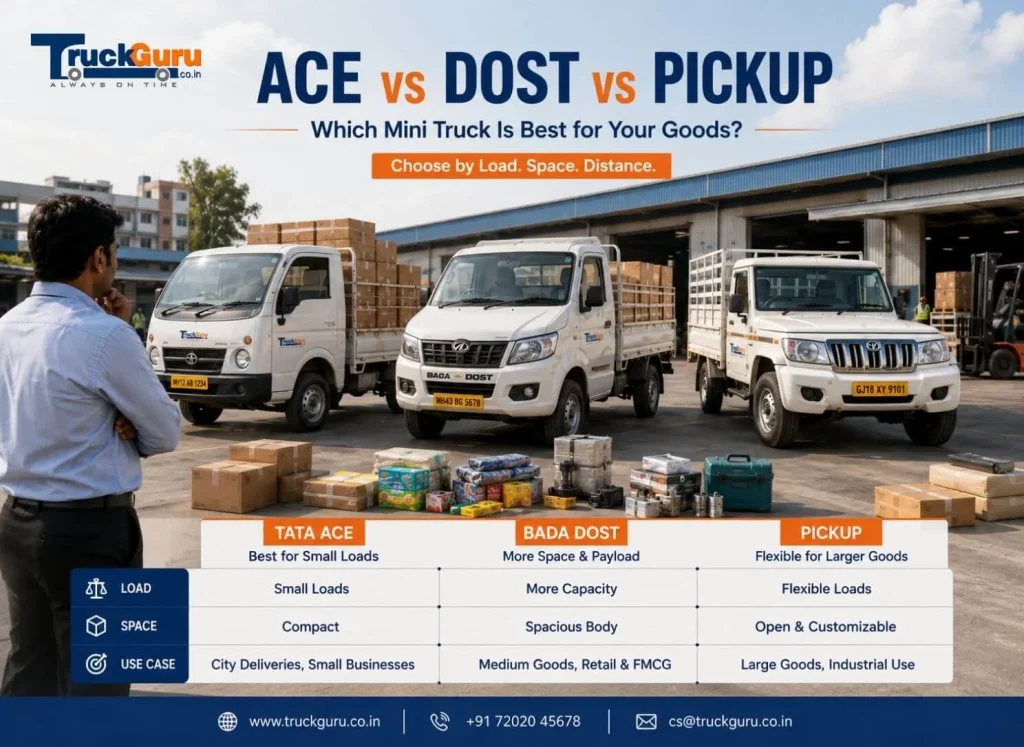
Ace vs Dost vs Pickup: Which Mini Truck Is Best for Your Goods?
Short answer: it comes down to weight and where you are driving. Under 1,100 kg on city roads, the Tata Ace. Between 800 kg and 1.5 tonnes with a mix of city and highway, the Ashok Leyland Dost. Above 1.5 tonnes or on rough rural roads, the Mahindra Bolero Pickup.
That covers most cases. However, the choice gets more interesting once you factor in what you are actually carrying and where it has to go.
The Three Vehicles, Briefly
The Tata Ace has been the default small commercial vehicle in India since 2005. Compact enough for Chandni Chowk or Crawford Market, available in petrol, diesel, CNG, and now electric. Payload sits between 750 kg and 1,100 kg depending on the variant.
The Ashok Leyland Dost, on the other hand, is the step up. More engine, more payload, and a body that handles highway running better than the Ace does.
Meanwhile, the Mahindra Bolero Pickup is a different animal altogether. Longer body, stronger frame, 75 to 80 HP.
Side by Side
Parameter | Tata Ace | Ashok Leyland Dost | Mahindra Bolero Pickup |
Payload | 750-1,100 kg | 800-1,000 kg | 1,100-1,500 kg |
Engine | 30 HP (petrol/CNG), 14.7 kW (diesel) | 70 HP (diesel), 45 HP (CNG) | 75-80 HP (diesel) |
Mileage | 21-22 kmpl petrol, 27-30 km/kg CNG | 19.6 kmpl diesel, 32 kmpl CNG | 14-17 kmpl diesel |
Fuel options | Petrol, diesel, CNG, electric | Diesel, CNG | Diesel, CNG |
Best suited to | City delivery, FMCG, light electronics | Medium cargo, pharma, city plus highway | Heavy goods, construction, rural routes |
Specifications from manufacturer published data. Actual mileage varies with load, terrain, and driving conditions.
Ace vs Dost: The Real Difference
On paper the payload gap looks small. In practice, however, it matters more than the numbers suggest.
An Ace carrying 900 kg is near its limit. By contrast, a Dost carrying the same 900 kg has headroom. As a result, this shows up in suspension behaviour on bad roads and in how the vehicle holds up over a few thousand kilometres of that load.
Fuel tells the other half of the story. The Ace does 21 to 22 kmpl on petrol, while the Dost does around 19.6 on diesel. However, diesel is cheaper per litre and the Dost carries more. Therefore, cost per kilogram moved often works out closer than the mileage figures imply.
Where the Ace clearly wins, though, is turning circle. For example, if your route includes Sadar Bazaar in Delhi, Chickpet in Bengaluru, or the lanes behind Manek Chowk in Ahmedabad, the Dost will struggle where the Ace does not.
Ace vs Pickup: Not Really a Comparison
In truth, these two rarely compete for the same job. The Pickup has more than twice the engine power and carries roughly 50% more weight. So if your load is under 1,100 kg and stays in the city, the Pickup is more truck than you need. Moreover, you will feel it at the fuel pump — 14 to 17 kmpl against the Ace’s 21 to 22.
That said, the Pickup earns its keep on routes the Ace cannot handle: unmetalled approach roads, gradient, long stretches at highway speed with a full load. For instance, construction material heading to a site off the Mumbai-Nashik highway is Pickup work. Cartons of packaged snacks going from a Bhiwandi warehouse to retailers in Thane, on the other hand, is not.
Dost vs Pickup: Where It Gets Close
This, in contrast, is the genuinely difficult comparison. Both handle around a tonne comfortably. In addition, both run city and highway.
The Dost is easier to place in traffic and cheaper to run. The Pickup, meanwhile, takes more abuse and carries more when you need it. Therefore, if your typical load is 900 kg with occasional runs at 1,400 kg, the Pickup avoids the problem of being stuck with a vehicle that cannot take the heavy jobs.
That said, if 1,400 kg happens only twice a year, simply book a bigger truck those two times and run the Dost the rest of the year.
Matching Vehicle to Cargo
A few patterns worth knowing from how Indian B2B freight actually moves:
First, FMCG and packaged goods split between Ace and Dost depending on drop density. For example, many small drops in a dense area favours the Ace. Conversely, fewer and larger drops across a wider area favours the Dost.
Second, pharma tends toward the Dost. Because cartons stack better in the longer body, there is less temptation to overload — and overloading is where damage claims come from.
Third, electronics and appliances go in the Ace when volume is low. Additionally, the lower load floor makes manual handling easier and reduces drop damage during unloading.
Finally, construction material, farm produce, and anything heading somewhere with a bad approach road is Pickup territory.
Rent or Buy?
The maths is simpler than it looks. In short, owning a mini truck means the vehicle cost, driver salary, insurance, fitness renewal, permits, maintenance, and the cost of the vehicle sitting idle between jobs.
That works out if you are running the same route most days of the month with a reliable return load. However, below roughly 15 to 20 trips a month on a fixed corridor, booking works out cheaper. In other words, you pay only for the trips you actually run.
TruckGuru books all three vehicle types on FTL intercity routes at Rs.26-29 per km with toll included. Check a rate for your corridor on the freight calculator.
FAQ
What is the best mini truck for goods transport in India?
It depends on weight and route. Firstly, the Tata Ace suits city loads up to 1,100 kg. Secondly, the Ashok Leyland Dost handles 800 kg to 1 tonne across city and highway. Finally, the Mahindra Bolero Pickup covers 1,100 to 1,500 kg or rough rural routes.
Tata Ace or Ashok Leyland Dost — which is better for delivery?
The Ace works better for tight urban lanes and gives better mileage on petrol. The Dost, on the other hand, offers higher payload and handles highway running. So if your route includes narrow market areas, choose the Ace. Alternatively, if it is mostly main roads with heavier loads, choose the Dost.
Is the Tata Ace better than a Pickup for city deliveries?
For city work, yes. It has a smaller turning circle, easier parking, and 21-22 kmpl against the Pickup’s 14-17. However, the Pickup only makes sense in the city if your loads regularly exceed 1,100 kg.
Which mini truck has the highest payload?
The Mahindra Bolero Pickup, at 1,100 to 1,500 kg depending on variant. Ashok Leyland Dost follows at 800 to 1,000 kg. Tata Ace runs 750 to 1,100 kg.
Is the Ashok Leyland Dost good for commercial use?
Yes, particularly for pharma, FMCG, and parcel work where loads sit around 800 kg to 1 tonne and routes mix city and highway. In addition, the longer body helps with carton stacking.
Which mini truck is most fuel-efficient?
The Tata Ace leads at 21-22 kmpl petrol and 27-30 km/kg CNG. Next, the Dost gives 19.6 kmpl diesel and 32 kmpl CNG. Finally, the Pickup manages 14-17 kmpl. However, compare cost per kg moved rather than just mileage, because a heavier vehicle carrying more can work out cheaper per unit.
What does it cost to book a mini truck on TruckGuru?
Rs.26-29 per km for FTL intercity routes, toll included. The rate is confirmed before dispatch and is what appears on your invoice. Check your specific route on the freight calculator.
Book a Tata Ace, Bada Dost, or Mahindra Pickup for intercity FTL freight across 110+ cities. Rate check at the freight calculator or call 72020 45678.