

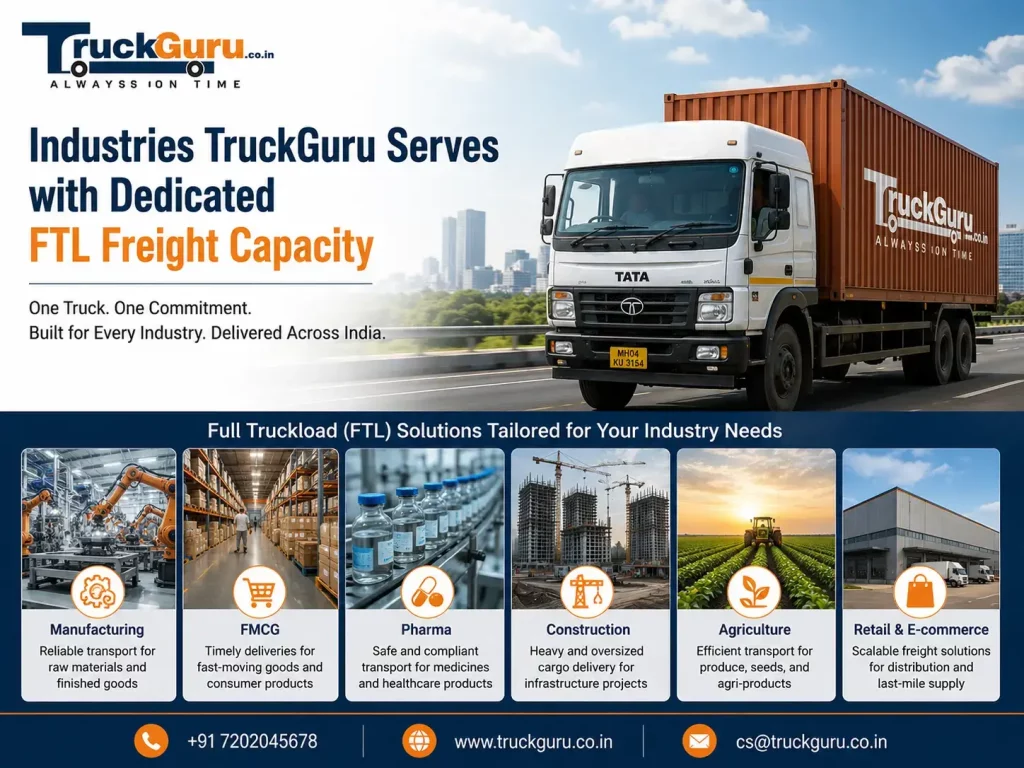
Industries TruckGuru Serves with Dedicated FTL Freight Capacity
Full Truckload (FTL) intercity only | Verified trucks | Confirmed rates | 110+ cities
FTL Freight Services India: Quick Summary
FTL freight services India: TruckGuru provides dedicated FTL freight for FMCG, engineering goods, drone logistics, home interiors, and events freight..
Industries TruckGuru Serves with Dedicated FTL Freight Capacity include FMCG, engineering goods, drone logistics, home interior products, and events freight. These industries need dedicated trucks, confirmed rates, and clean documentation because their shipments are often time-sensitive, fragile, or high-value. That is why TruckGuru focuses on dedicated FTL intercity freight rather than shared transport.
That is what full truckload (FTL) freight means in practice. And it is what TruckGuru provides across five industries that have moved away from broker-coordinated part-load arrangements — FMCG, engineering goods, drone logistics, home interior products, and events freight.
For each, the freight challenge is different. The solution is the same: a verified truck, a confirmed rate, and live GPS tracking from pickup to delivery.
Check your freight rate: freight calculator. FTL intercity only — no part load, parcel, or local within-city transport.
Why Dedicated FTL Matters for B2B Manufacturers
In an FTL booking, your goods travel alone from pickup to delivery in a dedicated vehicle. No intermediate stops, no co-loading, no consolidation hub. The truck goes from your loading point directly to your buyer’s address.
For industries with fixed delivery windows, high-value or fragile goods, multi-state documentation requirements, or buyer-specific receiving conditions, FTL is not a preference — it is often the only model that works operationally.
TruckGuru operates FTL intercity only. Five truck types cover 750 kg to 15 tonnes. Every booking generates a digital Lorry Receipt at dispatch and a GST invoice after delivery. For a full capacity overview: truck size guide.
1. FMCG: Distributor Replenishment on Weekly Cycles
Fast-moving consumer goods is India’s highest-frequency B2B freight category. Branded manufacturers — packaged food, personal care, beverages, household goods — run weekly or fortnightly distributor replenishment cycles across hundreds of city pairs. A mid-size FMCG brand with 20 distributors across Maharashtra, Rajasthan, and UP can generate 80–100 FTL trips per month.
India’s FMCG market was estimated at USD 236 billion in 2024 and is projected to reach USD 778 billion by 2030. FMCG distribution remains highly freight-intensive, especially in Tier 2 and Tier 3 markets, where repeated replenishment cycles and dealer-level delivery windows create constant intercity transport demand.
- Delivery windows are fixed. Miss a distributor’s Wednesday receiving slot, and the next available may be the following week — retailer orders in the interim go unfilled.
- Mixed-SKU consignments need dedicated space. Co-loading another shipper’s goods creates damage risk and complicates LR documentation for mixed product lines.
- Rate consistency matters for reconciliation. FMCG finance teams reconcile freight against hundreds of distributor invoices monthly. Broker rate variances compound that overhead across every trip.
TruckGuru’s confirmed rate at booking matches the invoice. 14ft truck for most distributor replenishments, 20ft for heavier mixed-SKU loads. Book an FTL truck for FMCG.
2. Engineering Goods: Heavy, Irregular, Time-Critical
Engineering goods freight — precision auto components from Pune and Coimbatore, capital equipment from fabrication workshops, machine tools from Rajkot’s tool-making cluster, structural steel for infrastructure projects — is one of India’s largest freight categories by weight and one of the most demanding by documentation.
India’s engineering goods exports crossed USD 107 billion in FY24. Domestic intercity freight from the same sector adds several multiples of that in truck movement annually.
- Irregular dimensions need upfront planning. A CNC machine base or fabricated heat exchanger does not fit standard pallet configurations. Truck selection, loading method, and LR description must be determined before the vehicle arrives — not after.
- Capital equipment has a project timeline. A machine tool delayed two days in transit is a factory installation delay. The downstream cost is typically a multiple of the freight cost itself.
- Multi-state routes require clean documentation. A Coimbatore-to-Gurgaon shipment crosses five state borders. One e-way bill error stops the truck. Engineering goods shippers who receive the vehicle number at booking — before loading — can generate accurate bills in advance.
GPS tracking gives installation teams live position throughout the run. Check engineering goods freight rates.
3. Drone Logistics: India’s Fastest-Growing High-Value Freight Category
Composite example: a Hyderabad-based drone manufacturer supplying agricultural drone fleets to state government programmes across Rajasthan and Madhya Pradesh. Name used for readability only. Anil manages logistics for a Hyderabad-based drone manufacturer supplying agricultural drone fleets to state government programmes across Rajasthan and Madhya Pradesh. Each delivery involves 12 to 20 assembled drones worth Rs. 3–8 lakh per unit, packed in foam-lined cases, moving to district-level agriculture offices that have no freight dock and sometimes no address on Google Maps.
For two years, he booked trucks through a local broker. “Every trip was a negotiation,” he says. “The rate changed based on who was available. One shipment sat at a broker’s yard for six hours because the replacement truck was smaller than the original. We lost a government client over that delay.”
His company moved to TruckGuru. Rate confirmation dropped from 4–6 hours to under an hour. Damage incidents from co-loaded transit went to zero over six months. Government client delivery disputes: from four escalations to none.
Anil’s situation reflects where India’s drone sector is heading. The market has grown from near-zero to a Rs. 900-crore industry in under five years, following the PLI scheme and Drone Rules 2021. It is projected to reach USD 1.8 billion by 2030. Enterprise fleet deployments — agriculture, surveillance, industrial inspection — are driving domestic freight demand that the broker model cannot reliably serve.
- High unit value and fragility. An assembled multi-rotor drone costs Rs. 3–12 lakh. Co-loading damages goods and loses accountability — two things a drone manufacturer cannot afford.
- LiPo battery compliance. Lithium polymer batteries are permissible for ground FTL transport under standard hazmat declarations but require accurate LR documentation. Broker-arranged freight rarely carries this correctly.
- Defence supply chain confidentiality. Manufacturers supplying government or paramilitary clients under NDAs need a closed-chain FTL movement, not an informal fleet with unknown co-loaders.
4. Home Interior Products: Factory to Showroom, B2B Only
Home interior products, freight covers, manufactured goods moving from factory to trade — furniture from manufacturing clusters in Bengaluru, Hyderabad, and Chennai to dealer showrooms and warehouse hubs across Mumbai, Delhi-NCR, Ahmedabad, and Jaipur; modular kitchen units from Pune to showrooms across South and West India; sanitaryware and engineered flooring to project supply points nationwide.
India’s home furniture market is valued at USD 27.27 billion in 2026 and is projected to reach USD 40.53 billion by 2031, growing at 8.24% annually (Mordor Intelligence, 2026). The freight from this sector is high-volume, corridor-specific, and damage-sensitive.
Furniture and home interior goods are among the most damage-sensitive cargo categories in intercity B2B logistics. Solid wood pieces, glass panels, veneer surfaces, and upholstered components do not survive loading alongside unrelated cargo — industrial hardware, FMCG cartons, or machine parts — stacked without knowledge of what is inside the boxes. A 30-hour long-haul run from Bengaluru to Delhi or Hyderabad to Mumbai is a long time for a glass-topped dining table to sit against a crate of steel components.
- Loading control: because the truck carries only the manufacturer’s consignment, the loading sequence is set by the manufacturer’s own dispatch team. Heavier pieces go to the base. Fragile components are positioned against the interior wall. Corner guards and stretch wrap are applied before the doors close.
- Container sealing: a dedicated vehicle sealed at the factory loading point and opened only at the showroom eliminates intermediate handling. In co-loaded freight, every stop is a handling event. Dedicated FTL has none.
- Driver briefing before departure: showroom-specific delivery requirements — ground floor only, scheduled unloading window, no mechanical equipment — reach the driver in advance, not at the showroom gate after arrival.
- Live GPS for showroom coordination: the receiving team can schedule unloading labour and dock space based on live ETA rather than a driver’s estimated arrival call.
- Digital LR and e-POD: a digital Lorry Receipt is generated at dispatch before the truck departs. Electronic Proof of Delivery captured at the receiving point creates a clean audit record that aligns with e-way bill closure, GST invoice settlement, and insurance documentation.
Household shifting and packers-and-movers services are not offered. Check freight rates for home interior and furniture transport.
5. Events and Exhibitions: When the Deadline Cannot Move
The events team at a Bengaluru tech company learned this in February 2025. Their stall materials for a three-day industry expo at BIEC were in a truck that broke down 140 km outside the city at 11 PM on setup night. The driver called—no backup vehicle. The broker was unreachable at midnight. They missed the venue’s setup window and paid for a stall they could not use.
The next event they booked on TruckGuru. Confirmed rate. Driver’s number shared before dispatch. GPS tracking on the coordinator’s phone. The truck arrived at BIEC at 5:45 AM — fifteen minutes before the venue opened for setup.
That gap — broker at midnight versus GPS tracking at 5:45 AM — is what separates events freight that works from events freight that does not.
India’s event and exhibition market was estimated at USD 5.66 billion in 2025 and is projected to reach USD 8.44 billion by 2030. In practical terms, event freight is less forgiving than FMCG freight: when a truck misses the setup window, the stall does not get built, and the event schedule is immediately affected.
- 14ft and 20ft trucks cover most single-company exhibition freight requirements.
- Return freight after the event close can be booked before the show ends, scheduled for the venue’s move-out window.
- For large organisers moving multiple stalls, a 32ft container provides maximum capacity in a single trip.
FTL vs PTL: The Decision Framework
All five industries above have one operational characteristic in common: their freight requirements favour dedicated capacity. Part truckload works for standardised, robust, time-flexible goods. For goods that are fragile, high-value, deadline-sensitive, or documentation-intensive, PTL’s co-loading model creates problems that TruckGuru’s FTL model does not.
- Choose FTL when: load is above 1.5 tonnes, goods are fragile or high-value, delivery timing is fixed, co-loading creates damage or documentation risk, or live GPS tracking is needed for buyer coordination.
- PTL may work when: the load is under 500 kg, the corridor has daily consolidation, and delivery can flex by 1–2 days without commercial consequence.
For FMCG, engineering goods, drone logistics, home interior products, and events freight, at least three dedicated FTL criteria apply to most booking scenarios.
FAQs — Dedicated FTL Freight for Industries
Which industries does TruckGuru cover for FTL freight?
TruckGuru provides FTL intercity truck bookings for all commercial and industrial goods categories. The five industries covered here are highlighted because their freight characteristics particularly favour dedicated capacity. Any business dispatching commercial goods on intercity corridors above 100 km can book FTL through TruckGuru.
Can drone manufacturers book FTL trucks for LiPo battery shipments?
Yes, for ground transport. Lithium polymer batteries are permissible under standard hazardous materials declarations for road freight. The LR must accurately describe the goods, including battery type and quantity. Confirm e-way bill and GST documentation requirements before dispatch.
What truck size is right for FMCG distributor replenishment?
The 14ft truck (up to 3.5 tonnes) covers most mid-size distributor replenishments for single-brand mixed-SKU consignments. For larger refills, the 20ft truck carries up to 7 tonnes. Use the truck size guide at truckguru.co.in/truck-size to match your load weight to the right vehicle.
How does TruckGuru handle freight with fixed delivery windows?
Book with a confirmed rate and specific dispatch time. TruckGuru shares the driver’s direct contact number before the truck departs. The TruckGuru mobile app gives the events coordinator live GPS tracking to plan setup crew readiness at the venue.
Is household shifting available alongside home interior freight?
No. TruckGuru provides B2B commercial FTL freight for manufactured goods moving from the factory to trade — dealer replenishment, showroom inventory, and project supply. Household shifting, packers-and-movers, and personal relocation services are not offered.
What documentation does TruckGuru generate for industrial freight?
Every booking generates a digital Lorry Receipt at dispatch and a GST-compliant freight invoice after delivery. The rate confirmed at booking is the rate on the invoice. Vehicle registration number and transporter ID are shared at booking confirmation to support e-way bill generation before the truck is loaded.
Conclusion
Five different industries. Five completely different freight problems. One solution that works for all of them.
Whether it is an FMCG brand running weekly distributor cycles, a drone manufacturer delivering to a government agriculture programme, a furniture company supplying showrooms across Mumbai and Delhi, or an events agency shipping exhibition stalls to a venue that opens at 6 AM — the requirement is the same: a dedicated truck, a confirmed rate, clean documentation, and the ability to track the consignment in real time.
TruckGuru operates this model across all five industries and across 110+ cities in India. Check your route and freight rate — the rate on the calculator is the rate on your invoice after delivery.
Book dedicated FTL freight: freight calculator | online truck booking | logistics service | Call 72020 45678
About TruckGuru
TruckGuru is a dedicated full truckload freight platform based in Vadodara, Gujarat, connecting manufacturers, traders, and SMEs with verified transporters for intercity goods movement across India. The platform covers dedicated FTL intercity transport only — no PTL, no parcel, no within-city movement. The fleet range covers Tata Ace (750 kg) through 32ft containers (up to 15 tonnes) on corridors spanning Gujarat, Maharashtra, Rajasthan, Delhi, Karnataka, Tamil Nadu, Andhra Pradesh, Telangana, and beyond.
Every booking generates a digital Lorry Receipt, auto-calculates e-way bill validity against route distance, and provides live GPS tracking across all active shipments. The transporter network is verified for vehicle registration, fitness certification, permit coverage, and driver licence compliance. For freight rates, visit truckguru.co.in/freight-calculator.

Related Reading
- Reduce Manufacturing Freight Costs: India Intercity Guide
- Reduce B2B Freight Costs in India: 25 Proven Strategies
- Ship-To GSTIN Mandate August 2026 — What Shippers Must Do
For current rules and official notifications, see the Ministry of Road Transport & Highways.