

FASTag for Trucks: What It Actually Changed for Freight
A consignment leaves Vadodara for Bhiwandi. The rate was agreed on the phone. At delivery, the bill arrives higher, and the difference is toll, billed at actuals with a set of plaza receipts attached that nobody can meaningfully check.
That argument used to be unwinnable. FASTag for trucks changed it, and not for the reason the original version of this page gave. The point was never the queue at the plaza. It was that toll stopped being a cash number a driver reported and became a transaction record you can audit.
What FASTag for trucks is now
An RFID tag on the windscreen, read by a gantry at the plaza, deducting from a linked account or wallet. It is mandatory on national highways, so the adoption question that filled articles like this one years ago is settled.
The system sits across three parties: the bank that issued your tag, the acquiring side connected to plaza operations under the National Highways Authority of India, and the settlement layer run by the National Payments Corporation of India. Knowing which of the three is involved matters when something goes wrong, because the fix is different in each case.
VERIFY: Confirm current mandate scope, issuing bank list, tag validity period and any active fee or cashback structure before publishing. The original carried figures from 2017 are long dead, and I have deliberately published none of them because I cannot verify the present position.
The change that matters commercially
Toll became an auditable per-trip cost. That sounds administrative. In freight, it settles a whole category of dispute.
Before, toll on a long run was a cash figure reported after the fact, and a shipper had no practical way to test it. Now the deduction is a transaction against an account, tied to a plaza and a timestamp. Either the vehicle passed that plaza, or it did not.
The follow-on effect is on quoting. Once toll is verifiable, it becomes reasonable to quote it inside the fare rather than as a variable added later. Any operator still billing toll at actuals on a fixed corridor is choosing to, not being forced to by uncertainty.
FASTag for trucks: what to check in a freight quote
The single most useful question when comparing two rates on the same route.
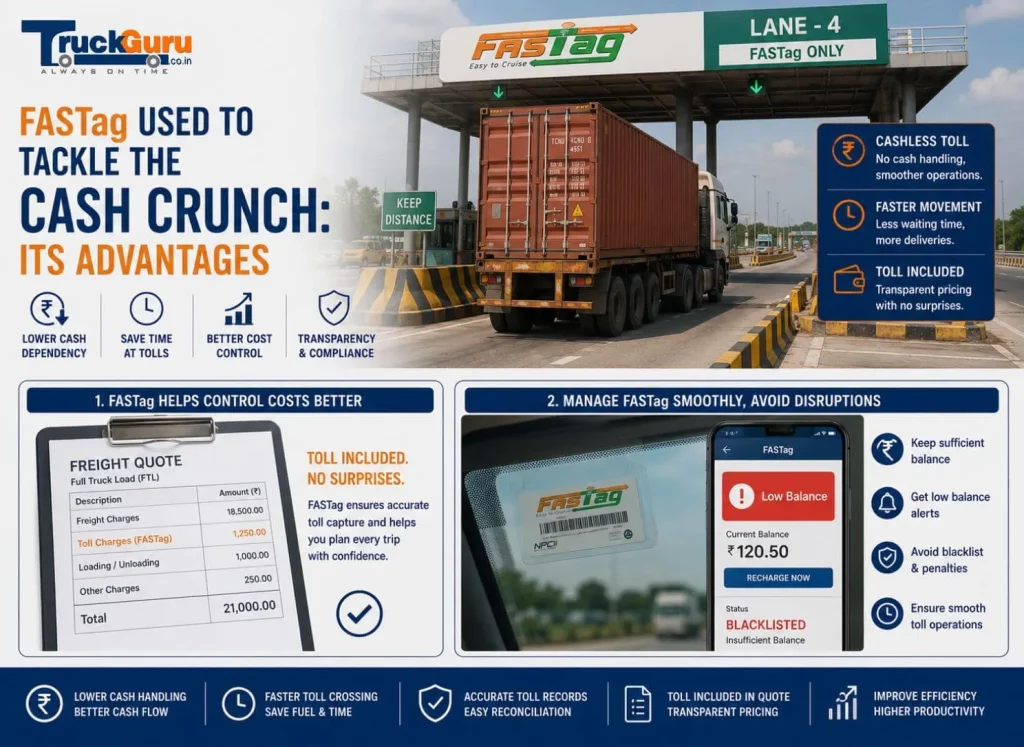
- Is toll included or billed at actuals? On long corridors this moves the total meaningfully, and it is the most common reason a final bill exceeds a quoted rate.
- If at actuals, against what evidence? Ask for the plaza-wise deductions rather than a lump figure. The data exists now.
- Does the comparison quote include it? A cheaper headline rate excluding toll is not cheaper. Two quotes are only comparable when you know what each one covers.
- What else sits outside the rate? Loading labour, detention free period and the rate after it. Toll is the one people ask about and rarely the only exclusion.
Where FASTag for trucks still causes problems
Worth knowing, because these are the situations that hold a vehicle at a plaza and cost you a delivery slot.
- Low balance. The most common operational failure. A tag without sufficient balance can be refused at the lane, and in the long run with several plazas, the balance drains faster than owners expect. For fleet operators, the discipline is a recharge threshold checked before dispatch rather than after a call from the driver.
- Tags get blacklisted for reasons including insufficient balance, KYC issues or vehicle document mismatches. The vehicle is then stuck paying at the lane in whatever manner the plaza permits, with the delay that implies.
- Class mismatch. If the tag is registered to the wrong vehicle class, deductions come out wrong. It is worth checking when a vehicle changes hands or a tag is transferred.
- Reading failures. A damaged tag, or one fitted incorrectly on the windscreen, may not read. Fitment position is not cosmetic.
One practical note from experience: the cost of a FASTag problem is rarely the toll. It is the vehicle standing at a plaza during the window when it needed to be at the receiving gate.
What it did not solve
- It does not tell you the vehicle took the shortest route. It tells you which plazas it crossed.
- It does not prevent detention charges or gate delays at either end.
- It does not remove the need for a consignment note. Toll records are not a contract of carriage.
- It does not make freight rates transparent by itself. It makes one component of them checkable.
How TruckGuru handles toll
Toll is included in the quoted fare rather than added at delivery. That is a commercial choice made possible by FASTag, because toll on a known corridor is now predictable enough to price rather than pass through. TruckGuru runs full truck load intercity freight across 110-plus cities in India, with vehicle type, route and rate stated before loading, and payment staged across confirmation, loading and delivery with no cash accepted. Check a rate on the freight calculator, or see the transporter page if you supply capacity.
FASTag also sits in the broader pattern of Indian freight digitisation happening through regulation, covered in applications of IoT in transportation and logistics and alongside the tracking requirement in AIS 140 GPS.
Key takeaways
- FASTag for trucks is mandatory on national highways. Adoption is no longer a decision.
- The real change was toll becoming an auditable per-trip transaction rather than a cash figure reported afterwards.
- Ask any operator whether toll is inside the quoted rate or billed at actuals. It is the most common source of bill-versus-quote disputes.
- Low balance and blacklisting are the failures that actually cost money, through delay rather than toll.
- Set a recharge threshold checked before dispatch instead of reacting to a driver call at a plaza.
- Toll records do not replace the consignment note.
Frequently asked questions
Is FASTag for trucks mandatory?
Yes, on national highways. Electronic toll collection through FASTag applies across commercial vehicle categories, so the practical question is managing it rather than whether to adopt it.
Why does a FASTag get blacklisted?
Common reasons include insufficient balance, incomplete KYC and mismatches between the tag registration and vehicle documents. The consequence is delay at the lane, which usually costs more than the toll itself.
Should toll be included in a freight quote?
On a known corridor, it reasonably can be, because FASTag makes toll predictable and checkable. If an operator bills at actuals, ask for plaza-wise deductions rather than a lump figure.
How do I compare two freight rates fairly?
Establish what each excludes. Toll, loading and unloading labour, and the detention-free period and rate are the four that most often turn a lower quote into a higher bill.
Does FASTag prove the route my truck took?
Only partially. It records which plazas the vehicle crossed and when. It does not confirm the full route or that the shortest path was used.
What balance should a fleet keep on a tag?
Enough for the full outbound and return legs of your longest routine corridor, with margin. The failure mode is a driver stopped mid-route, so set a threshold checked before dispatch rather than topping up reactively.
Does FASTag replace any freight paperwork?
No. The consignment note remains the contract of carriage, and the proof of delivery still governs damage claims. FASTag records a toll transaction, nothing more.
The short version
FASTag stopped being a story about queues years ago. What it left behind is one freight cost you can actually verify. Use it: ask whether toll sits inside the rate, and if it does not, ask to see the plaza-wise numbers.