

Applications of IoT in Transportation and Logistics: What Actually Runs in India
Most writing on IoT in transportation and logistics describes a fleet where every vehicle streams tyre pressure, coolant temperature and driver behaviour to a dashboard that predicts failures before they happen.
IOT in Transportation and Logistics: Quick Summary
IoT in transportation and logistics, assessed for India: what is actually deployed on trucks and cargo today, what is not, and which parts are mandatory.
Now picture the actual Indian road freight market. A large share of trucks belong to owners running one to five vehicles. The question is not what sensors can do. It is which ones are on the truck carrying your goods, and the honest answer is narrower than the pitch and more interesting than you would expect, because the parts that did get adopted got adopted for a specific reason.
The IoT that is already on every truck
Two systems reached near-universal adoption in Indian freight, and both did it the same way: they were made mandatory.
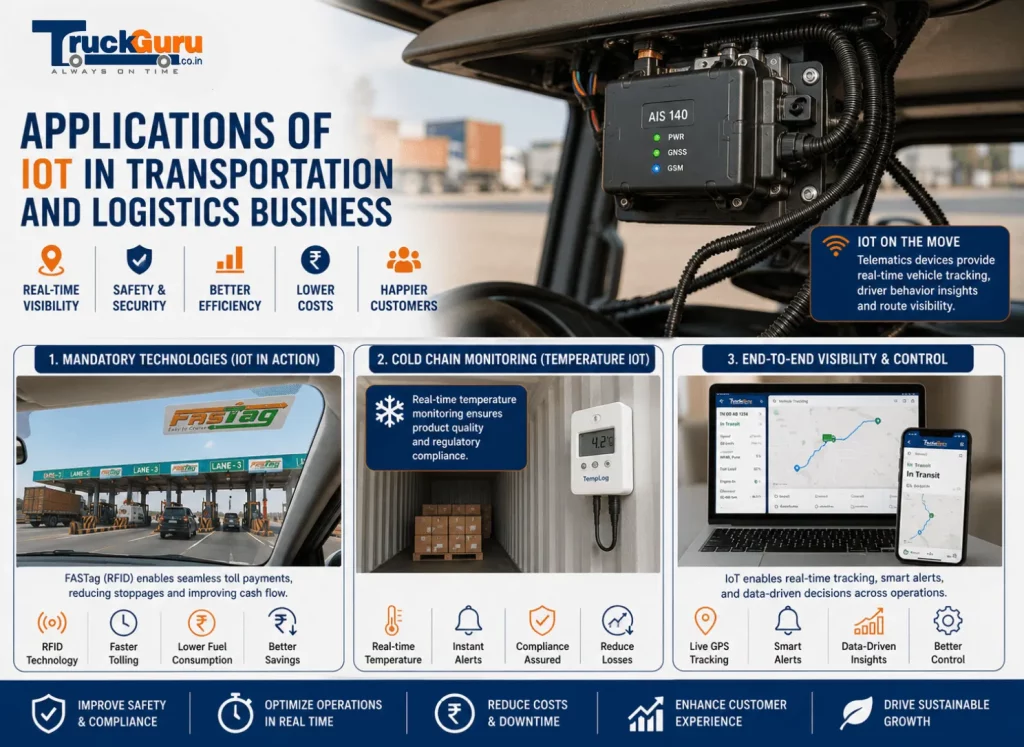
- An RFID tag on the windscreen read by a gantry at the toll plaza, deducting from a linked account. This is IoT in the plainest sense, a networked sensor reading, and it is on effectively every commercial vehicle on national highways. It cut plaza queue time and turned toll into an auditable per-trip record instead of a cash figure the driver reported. The National Highways Authority of India publishes details.
- AIS-140 vehicle location tracking. India mandated vehicle location tracking devices for specified commercial vehicle categories under the AIS-140 standard. That put GPS telematics into vehicle classes that would never have bought it voluntarily. Current applicability by vehicle class sits with the Ministry of Road Transport and Highways and varies by state, so check rather than assume.
That pattern is the whole story of IoT in transportation and logistics in India. Where adoption happened at scale, regulation drove it. Where it was left to commercial judgment, small operators did the arithmetic and mostly said no.
IoT in transportation and logistics: what runs on some fleets, not most
- Fuel level sensors. Popular with larger fleets because fuel is the biggest running cost and pilferage is a real problem. The return is measurable, which is why this one gets bought without a mandate. Less common on owner-operator vehicles where the owner often is the driver.
- Temperature data loggers. Standard for pharmaceutical and perishable cargo, because the buyer demands proof of the cold chain. The adoption driver here is the customer, not the operator. A pharma consignment from Ankleshwar or Baddi will carry monitoring because the receiver requires the record.
- Door and seal sensors. Used on high-value cargo, electronics and pharma mostly. On general FTL freight, the physical seal plus the consignment note does the same job for a fraction of the cost.
- Tyre pressure monitoring. Genuinely useful, since underinflation and highway tyre failure are strongly linked. Adoption is patchy and tends to follow fleet size.
What mostly does not exist yet on Indian FTL
This is the part worth being blunt about, because it is where most articles on this subject describe another country.
- Predictive maintenance driven by machine learning on sensor data. This requires a fleet large enough to generate patterns and a maintenance operation able to act on them. Very few Indian road freight operators have both.
- Warehouse RFID and automated reordering. Real technology, but it belongs to warehousing and retail operations rather than to road freight, and the original article spent a third of its length there.
- Consumer-facing reorder sensors. That is e-commerce, not logistics.
- Autonomous vehicles in distribution. Not a near-term factor on Indian highways.
What this means if you ship goods
The practical translation of IoT in transportation and logistics, for a shipper, is short.
You can expect the vehicle carrying your consignment to be locatable, because tracking requirements pushed telematics into commercial categories. You cannot expect the truck to be reporting its own coolant temperature to anyone. If your cargo needs temperature or shock monitoring, that is something you specify and usually pay for, not something that comes with the vehicle.
One judgment from experience: the sensor conversation distracts from the thing that costs shippers most. Freight losses in India overwhelmingly come from paperwork that was not completed properly at loading, not from an absence of telemetry. A consignment note filled in correctly protects you better than a door sensor, and it costs nothing.
That is the same pattern the blockchain in freight rewrite describes from a different direction, and the operator side of it is covered in mobile apps for logistics.
Does TruckGuru use IoT?
No. TruckGuru runs on conventional infrastructure and does not operate sensor networks or telematics hardware.
Vehicles in the network carry whatever tracking their vehicle class requires under AIS-140, the same as any other commercial vehicle on the road. That is a regulatory fact about Indian trucks, not a TruckGuru feature, and it would be dishonest to present it as one.
What the platform does is the unglamorous part: full truck load intercity freight across 110-plus cities in India, with the vehicle type, route and rate stated before loading, toll included in the quoted fare, and staged payment across confirmation, loading and delivery with no cash accepted. See online truck booking or the container truck transport service page for temperature-sensitive and sealed movements.
VERIFY: If the platform does provide customer-visible shipment tracking, this section is understated and should be rewritten. I have held the claim back because it is not confirmed to me.
Key takeaways
- IoT in transportation and logistics reached scale in India where it was mandated, not where it was pitched.
- FASTag RFID and AIS-140 vehicle tracking are the two systems present across the commercial fleet.
- Fuel sensors and temperature loggers get bought where the return is measurable or the customer demands the record.
- Predictive maintenance on sensor data needs fleet scale that most Indian operators do not have.
- Warehouse RFID belongs to warehousing, not road freight, and does not apply to an FTL movement.
- Correct paperwork at loading prevents more loss than any sensor on the vehicle.
Frequently asked questions
Is IoT in transportation and logistics actually used in India?
Yes, but narrowly. FASTag RFID at toll plazas and AIS-140 vehicle location tracking are present across commercial vehicle categories. Broader sensor deployment such as fuel monitoring and temperature logging is concentrated in larger fleets and specific cargo types.
What is AIS-140?
An Indian standard mandating vehicle location tracking devices, along with emergency buttons, for specified commercial vehicle categories. It is the main reason GPS telematics is present on vehicle classes that would not have adopted it commercially.
Does FASTag count as IoT?
Yes. It is an RFID tag read by roadside infrastructure and linked to an account over a network, which is a networked sensor reading. It is also the most widely deployed example in Indian road transport.
Is cold chain temperature monitoring mandatory?
Requirements depend on the cargo and the regulatory framework applying to it, and in practice the receiving party often drives the requirement contractually. For pharmaceutical and perishable consignments, expect monitoring to be specified and expect to pay for it.
Will my FTL truck have sensors on the cargo?
Not by default. A standard full truck load movement carries no cargo-level sensors. If you need temperature, shock or seal monitoring, specify it at the enquiry stage as a separate requirement.
Does IoT reduce freight theft?
Monitoring helps you find out sooner. It does not prevent the event, and on general freight a physical seal plus a correctly completed consignment note gives you most of the practical protection at far lower cost.
Is predictive maintenance realistic for a small fleet?
Rarely. It needs enough vehicles to generate usable patterns and a maintenance setup able to act on the output. Below that scale, scheduled servicing and attention to tyres and fuel figures deliver more.
The short version
The sensors that matter in Indian freight today are the ones somebody was required to fit or a customer insisted on. Everything else is still a proposal. Before paying for monitoring, work out what the loss it prevents actually costs you, and check whether better paperwork prevents the same loss for nothing.

Related Reading
- How to Estimate Goods Transport Rates: A Beginner’s Guide
- How Are Truck Transportation Charges Calculated in India?
- 6 Truck Booking Platforms Compared for FTL Freight in India: FR8, WheelsEye, Trukky, BlackBuck, Vahak & TruckGuru
For current rules and official notifications, see the Ministry of Road Transport & Highways.