

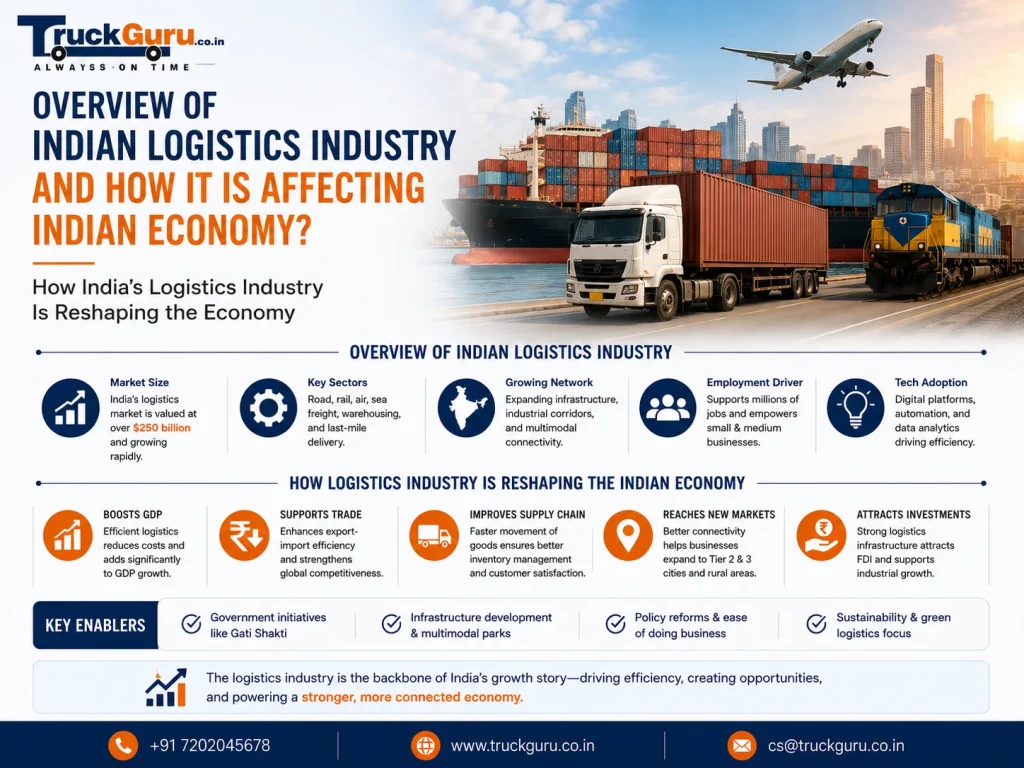
How India’s Logistics Industry Is Reshaping the Economy
Most of what moves through India’s economy travels by road, and most of that movement is invisible to the person who eventually buys the product. A bag of cement, a carton of medicine, a box of electronics components — each one passes through a chain of trucks, warehouses, and paperwork that nobody outside the industry thinks about until something goes wrong with it. That invisible chain is now large enough and important enough that it is worth understanding on its own terms rather than as background noise to everything else in the economy.
Indian Logistics Industry: Quick Summary
Explore the Indian logistics industry overview, its impact on the economy, growth trends, infrastructure, challenges & future opportunities driving development.
This piece looks at what the logistics industry in India actually covers, how large it has become, where it still struggles, and where a platform like TruckGuru — which handles one specific piece of this much larger system, FTL truck booking — actually fits into the picture.
What “Logistics” Actually Covers
The word gets used loosely, so it is worth being precise. Logistics spans road transport (trucks moving goods between cities), warehousing (storage between production and sale), last-mile delivery (the final leg to a doorstep or retail shelf), sea and air freight for international trade, and the tracking technology that ties all of it together. It is a genuinely large system, and no single company operates across all of it — a trucking platform, a warehouse operator, and a courier service are each doing one piece of the same broader chain, not competing to do all of it.
TruckGuru sits specifically in the road-transport piece, booking full truckload trips between cities, which is worth saying upfront before getting into numbers that describe the industry as a whole.
The Market’s Real Scale
Industry estimates put India’s logistics market at roughly USD 228 billion in 2024, with projections suggesting it could grow to somewhere in the high USD 300 billion by 2030, expanding at a high single-digit annual rate. These figures vary somewhat depending on which research firm is doing the estimating, so treat any single precise number with some caution — but the directional story is consistent across sources: this is a large and still-growing sector, and transportation specifically accounts for the largest share of revenue within it, ahead of warehousing and other logistics services.
What This Actually Means for the Economy
The clearest economic impact is employment. Logistics in India supports an estimated 20 million jobs or more — truck drivers, warehouse workers, delivery staff, and a long tail of supporting roles like mechanics and fuel station attendants that rarely get counted in headline figures but depend on the same trucks moving. That scale of employment, spread across both major cities and the towns those trucks pass through, is one of the more underappreciated reasons logistics gets policy attention.
There is also a more direct effect on prices and market access than people tend to assume. Better, cheaper transport lowers the landed cost of goods, which retailers can pass on rather than absorb — a genuinely meaningful effect at scale, even when it is invisible at the level of a single transaction. It works in the other direction, too: a farmer who can reliably move produce to a city market a state away, rather than relying only on local buyers, has more pricing power than one who cannot.
Better transport access does not guarantee a farmer a better price, but it removes one of the constraints that prevents them from finding one.
Online retail growth and the logistics industry have effectively grown together over the past several years — e-commerce expansion is not possible without delivery infrastructure reaching further into the country, and that infrastructure investment in turn made more of the country reachable for sellers who previously could not justify the cost. Foreign investment follows a similar logic: a country that can move goods efficiently is a more attractive place to manufacture or distribute from, which is part of why logistics infrastructure investment shows up in conversations about attracting international business, not just domestic trade.
Where India Still Lags
India’s logistics costs run close to 14% of GDP, noticeably higher than the 8-9% more typical of developed economies. That gap is the single number most often cited to argue the sector still has real room to improve, and it is a fair one — the underlying causes are specific and identifiable rather than vague.
Road quality in rural areas remains a genuine constraint — villages without reliable all-weather roads mean slower, costlier last-mile movement regardless of how efficient the highway network connecting major cities becomes. Skilled labour is in short supply too: trained drivers, warehouse managers, and logistics planners are harder to find than the industry’s growth would suggest, which puts upward pressure on costs and downward pressure on service quality at the smaller end of the market. A large share of small transport operators still run on paper-based documentation rather than any digital system, which is slower and more error-prone than it needs to be, but switching costs and a lack of familiarity with the alternatives keep adoption gradual.
Cold storage capacity for food and pharmaceuticals also remains genuinely short of what the country’s production volumes would justify, and congestion in and around major cities continues to push both delivery times and pollution in the wrong direction.
What Is Actually Changing
Several concrete improvements are underway rather than merely promised. Highway and expressway expansion is cutting transit times on major corridors in measurable ways. The GST system replaced a patchwork of state-level taxes with a single structure, which has genuinely simplified moving goods across state borders — a point worth its own deeper look, which we have covered separately. New port and airport capacity is speeding up loading and shipping turnaround at the international trade end of the chain.
And digital tracking — apps and software that show where a shipment actually is in real time — has moved from a premium feature to something most shippers simply expect now, which has quietly raised the baseline for the entire industry rather than just benefiting whoever adopted it first.
Looking Ahead, With Some Caution
A lot of “future of logistics” coverage leans heavily on robotics, drones, and AI-driven warehouse automation as though these are already standard. In practice, these remain concentrated in pilot programs and large enterprise operations rather than something the average shipper interacts with today. Electric trucks and vans are a more grounded near-term trend, with adoption growing steadily as charging infrastructure and vehicle costs both improve. Predictive demand planning — using past order data to position inventory closer to where it will actually be needed — is genuinely spreading among larger retailers and is likely to keep doing so.
On employment, logistics is widely expected to remain one of India’s largest job-creating sectors over the coming years, adding to the roughly 20 million people already working in it. Precise multi-year employment forecasts are difficult to pin down with confidence, and figures that circulate online vary considerably depending on assumptions, so it is worth treating any specific headline number for a future year with some scepticism rather than repeating it as a settled fact.
Where TruckGuru Fits Into This Picture
None of the broader trends above describes what TruckGuru itself offers — it is worth being direct about that rather than letting the scale of the industry-wide story blur into a claim about one company. TruckGuru books full truckload transport between Indian cities: a confirmed rate at booking, GPS tracking through the trip, and a digital Lorry Receipt and GST invoice once the shipment is delivered.
It does not manage warehousing, does not run last-mile delivery, and is not a 3PL or 4PL handling a business’s entire supply chain — it is the trucking piece of that much larger system, done with the digital booking and tracking layer that the broader industry trend section above describes.
For a business deciding whether to book FTL transport directly or work through a broader outsourced logistics arrangement, check a confirmed rate for your route to see what the trucking piece alone actually costs.
Frequently Asked Questions
What is the Indian logistics industry, and how does it affect the economy?
It is the combined system of road, rail, sea, and air transport, warehousing, and delivery infrastructure that moves goods across the country. It affects the economy directly through employment (an estimated 20 million-plus jobs), through its effect on retail prices and farmer market access, and indirectly by making India a more attractive place for foreign companies to manufacture and distribute from.
Why are India’s logistics costs higher than those of other countries?
India’s logistics costs run close to 14% of GDP against roughly 8-9% in developed economies. Rural road quality, a shortage of skilled logistics labour, slow technology adoption among smaller transport operators, and limited cold storage capacity are the main identifiable causes.
Is automation, like robots and drones, already common in Indian logistics?
Not yet, for most of the industry. These remain concentrated in pilot programs and large enterprise operations. Digital tracking and GPS-based visibility are the technology improvements that have actually become standard for most shippers.
Does TruckGuru provide warehousing or full supply chain management?
No. TruckGuru books FTL truck transport between cities — confirmed rate, GPS tracking, and digital documentation. Warehousing, last-mile delivery, and full supply chain management (3PL/4PL) are separate categories of service that TruckGuru does not provide.
Call 72020 45678 or check a confirmed rate at truckguru.co.in/freight-calculator for your next FTL shipment.
Related Reading
- Reduce Manufacturing Freight Costs: India Intercity Guide
- Reduce B2B Freight Costs in India: 25 Proven Strategies
- Ship-To GSTIN Mandate August 2026 — What Shippers Must Do
For current rules and official notifications, see the Ministry of Road Transport & Highways.