

Strategic Alliance in Logistics: Quick Summary
A strategic alliance in logistics lets small Indian fleet owners cover more corridors without buying trucks. What works, what fails, and how to protect yourself.
Strategic Alliances in Logistics: What Works Between Transport Operators
A five-truck operator in Ludhiana runs north India well and has nothing south of Nagpur. An operator in Hosur has the opposite problem. Neither can afford to buy vehicles for the other territory, and neither wants to turn away a customer who ships both ways.
So they send each other loads. That is a strategic alliance in logistics, stripped of the vocabulary. It is the most common growth move in Indian road freight and the one most likely to go wrong, because it usually happens on a phone call with nothing written down.
Why Transport Operators Form a Strategic Alliance in Logistics
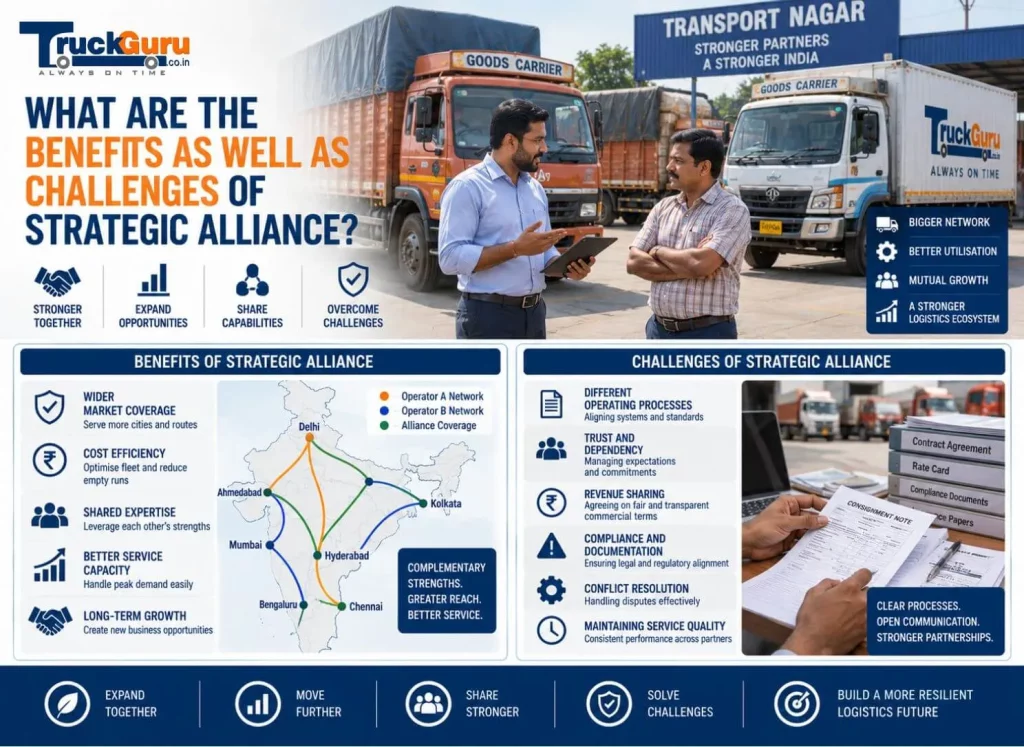
- Corridor coverage without capital. You quote a route you cannot serve yourself, and a partner runs it. Your customer stays with you, and you did not buy a truck to keep them.
- Return loads. Empty running is the highest cost in owner-operator economics. An operator at the destination end who can fill your vehicle for the return leg is worth real money, often more than a better outbound rate.
- Peak capacity. Quarter-end and festival periods create demand you cannot meet with your own fleet. A partner covers the overflow rather than you losing the customer to whoever could.
- Specialised vehicles. You may not want to own a 32ft container for the four times a year a customer needs one. Someone who already has it does.
- Local knowledge. A partner in the destination city knows the approach roads, gate timings and which industrial estates take which vehicle sizes. That knowledge takes years to build and cannot be bought.
Where a Strategic Alliance in Logistics Fails
Almost always on one of four things, and none of them are about strategy. A strategic alliance in logistics breaks on commercial detail, not on vision.
- Nobody wrote anything down. The rate split, who bears detention, who pays if the load is damaged, and what happens if a vehicle does not arrive. These get settled on trust until the first time something goes wrong, at which point there is nothing to settle from.
- Your customer is now their customer. You handed over the consignment, the contact and the corridor. If the partner is capable and the relationship is unbalanced, there is nothing structural stopping them approaching your customer directly next quarter.
- Documentation gets muddled. Whose consignment note, invoiced by which entity, and does the paperwork match the party actually carrying the goods? When subcontracting is informal, the documentation frequently does not reflect who did what, which is a problem for your customer as much as for you.
- Payment timing. You get paid on your terms, your partner expects payment on theirs, and the gap comes out of your working capital. This breaks more small transport partnerships than service quality does.
What to agree before the first load
- Rate split, and who quotes the customer.
- Who carries responsibility for damage or loss, and what insurance applies to a subcontracted movement.
- Detention terms at both ends, and who absorbs them.
- Documentation: which entity issues the consignment note and invoices the customer, and how tax is handled between you.
- Payment timing between the two of you, stated in days rather than as soon as the customer pays.
- Whether either side may approach the other party customers directly, and for how long.
For anything beyond load-by-load subcontracting, a written agreement is worth the cost of drafting. If the arrangement becomes substantial, the Ministry of Corporate Affairs sets out the structures available, including LLP, which is a common form for shared transport ventures in India.
How to judge a potential partner
The same checks you would run on any transporter, because that is what they are, and your customer will hold you responsible for their performance.
- Verify the GSTIN and confirm the invoicing entity matches the one arranging the movement.
- Check they issue proper documentation, including the consignment note, on every movement.
- Ask about their strength on the specific corridor you need, not their fleet size overall.
- Talk to another operator who has subcontracted to them, not a shipper reference.
- Start with a small share of volume. A partnership that survives four loads is worth expanding. One that fails on the first has cost you one customer, not your business.

The honest limitation
A partnership makes you responsible for work you do not control. Your customer contracted with you, and if the partner vehicle is late or the goods arrive damaged, your name is on it.
That trade is worth making when it lets you keep a customer you would otherwise lose. It is not worth making to chase volume on corridors you do not understand, with an operator you have not checked, on terms nobody wrote down.
Where TruckGuru Fits
A booking platform is a version of the same arrangement with the terms already fixed. TruckGuru provides full truckload intercity transportation across 110+ cities in India, connecting shippers with independent transport vendors, with upfront freight pricing and the vehicle type, route and rate stated before loading. Toll is included in the quoted fare. Dispatched bookings carry live GPS tracking, and digital documentation includes the LR and delivery records. If you run vehicles and want load access outside your own corridors, see the transporter page. If you need capacity you cannot supply yourself, you can book a truck online.
For the checks worth running on any operator, see choosing a transport service provider. For the shipper side of these relationships, see MSME logistics.
Key Takeaways
- A strategic alliance in logistics usually means covering corridors you cannot serve without buying vehicles.
- Return loads are often the real value. Empty running is the highest cost in operator economics.
- These partnerships fail on rate splits, customer poaching, muddled documentation and payment timing, not on strategy.
- Write down the rate split, damage responsibility, detention, documentation and payment days before the first load.
- Vet a partner exactly as a shipper would vet you, because your customer holds you responsible for their work.
- Start small. Four loads tell you more than any conversation will.
Frequently Asked Questions
Why do operators form a strategic alliance in logistics?
To cover corridors they cannot serve with their own vehicles, to find return loads at the destination end, to handle peak demand, and to access vehicle types they do not own. It is how a small fleet grows territory without capital.
What is the biggest risk in a transport partnership?
Having nothing written down. Rate split, damage responsibility, detention and payment timing get settled on trust until the first problem, when there is nothing to settle from. Customer poaching is the second risk.
Who is responsible if a subcontracted load is damaged?
Commercially, your customer holds you responsible, because they contracted with you. What you can recover from your partner depends entirely on what was agreed and documented between you, and on what insurance applies to the movement.
How do I stop a partner taking my customer?
Agree in writing whether either side may approach the other party’s customers directly and for how long. Beyond that, the practical protection is staying the party that quotes, invoices and handles the relationship.
Should the paperwork show who actually carried the goods?
The documentation should reflect the entity actually responsible for the transportation, and your customer needs invoicing that matches. Informal subcontracting frequently produces paperwork that does not, which creates problems for everyone, including the shipper.
How much volume should I give a new partner?
Start with a small share. A partnership that handles four loads cleanly is worth expanding. One that fails on the first has cost you one customer rather than a corridor.
The Short Version
Partnering lets a small operator sell corridors they cannot drive. It works when the rate split, damage responsibility and payment days are written down before the first load, and it fails when they are not. Vet the partner as carefully as your own customers vet you.
Related Reading
- How to Estimate Goods Transport Rates: A Beginner’s Guide
- How Are Truck Transportation Charges Calculated in India?
- 6 Truck Booking Platforms Compared for FTL Freight in India: FR8, WheelsEye, Trukky, BlackBuck, Vahak & TruckGuru
For current rules and official notifications, see the Ministry of Road Transport & Highways.