

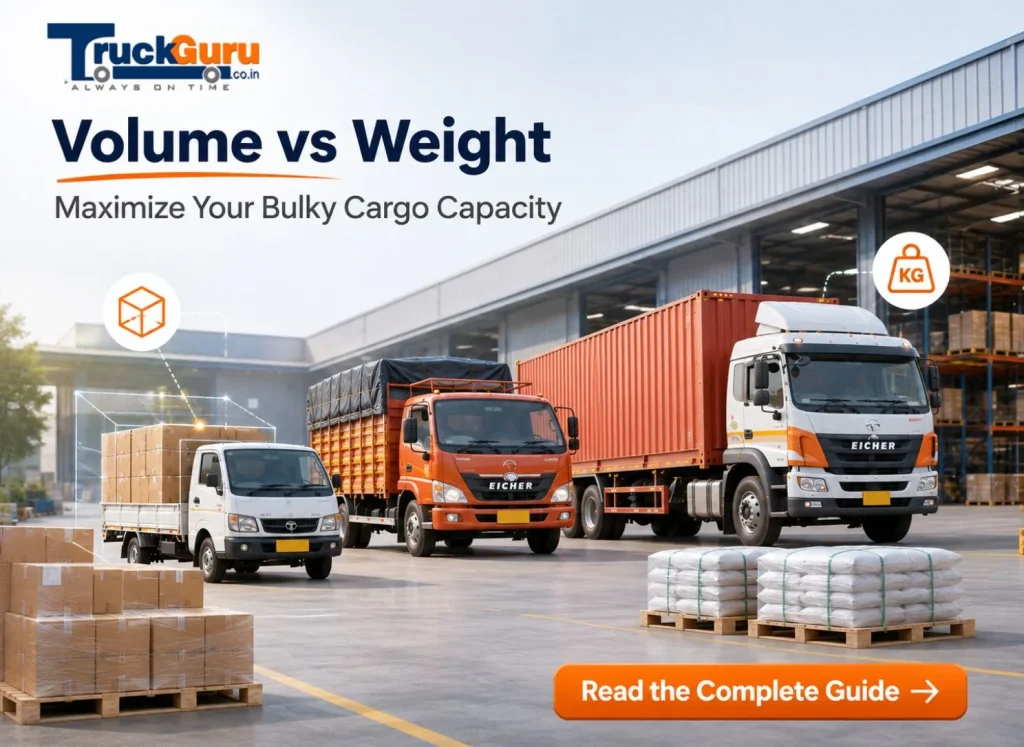
Picture a garment exporter in Surat booking a 14 ft Eicher for 2 tonnes of cartons. On paper it’s a comfortable fit, since the truck is rated for 3.5. Then loading starts, the body fills up, and 40 cartons are still sitting on the dock. Now someone is hunting for a second vehicle.
The cause is usually simple: the truck was booked on kilograms alone. Boxes of clothes, foam or plastic take up a lot of room without weighing much. So the space runs out first.
This guide gives you cubic feet, carton counts and pallet counts for every truck TruckGuru books, from the Tata Ace to the 32 ft container. There’s also a quick check to see which limit your load hits first.
Quick Answer: How Many Cartons Fit in a Truck?
With a standard 50 x 40 x 30 cm carton and about 85 percent of the body usable, expect roughly 50 to 65 cartons in a Tata Ace, 190 to 220 in a 14 ft Eicher, 370 to 390 in a 19 ft Eicher, 540 to 570 in a 20 ft container and 820 to 870 in a 32 ft container. Light cartons are limited by space. Heavy ones are limited by load capacity.
Why Weight Alone Picks the Wrong Truck
A truck has two limits, not one. There’s the weight it’s rated to carry, and there’s the space inside the body. Whichever your load reaches first is the one that matters.
Tiles are the classic example of the first kind. Load a 14 ft with them and you’ll hit the weight limit with half the floor still showing. Garments, foam, moulded plastic and empty boxes go the other way. The body is packed to the roof and the weight is still low.
Don’t forget the packaging either. Pallets, crates and stretch wrap usually add another 8 to 15 percent to both the weight and the volume. So measure the load the way it will actually go on the truck, not what the invoice says.
Cubic Feet, Cartons and Pallets by Truck
The body sizes here are common on Indian roads, but trucks vary, so check the exact body when you book. Carton counts use a 50 x 40 x 30 cm box (about 2.1 cubic feet) stacked neatly to the roof, with roughly 15 percent of the space lost to gaps and loading room. Pallet counts use a 1200 x 1000 mm industrial pallet, one layer, turned whichever way fits more.
Cartons: 50 x 40 x 30 cm box. Pallets: 1200 x 1000 mm, one layer. t = tonnes. On mobile, swipe the table sideways.
| Truck | Body (ft) | Cubic feet | Cartons | Pallets | Max load |
|---|---|---|---|---|---|
| Tata Ace | 7 x 4.8 x 4.8 | 160 | 50-65 | 1-2 | 1.1 t |
| Bada Dost (closed) | 9.5 x 5.5 x 5 | 260 | 100-110 | 2 | 1.5 t |
| 14 ft Eicher | 14 x 6 x 6.5 | 546 | 190-220 | 4 | 3.5 t |
| 17 ft Eicher | 17 x 6 x 7 | 714 | 280-300 | 5 | 5 t |
| 19 ft Eicher | 19 x 7 x 7 | 931 | 370-390 | 8 | 7 t |
| 20 ft container | 20 x 7.9 x 8.5 | 1,340 | 540-570 | 10-12 | 6.5 t |
| 32 ft single axle | 32 x 8 x 8 | 2,048 | 820-870 | 16-18 | 7-8 t |
| 32 ft multi-axle | 32 x 8 x 8 | 2,048 | 820-870 | 16-18 | 16-18 t |
Notice the two 32 ft rows. Same body, very different load capacity. If your cargo is light, the single-axle version will be full of boxes long before it gets close to its weight limit, so paying for a multi-axle buys you nothing.
The 20 ft container is a borderline case. Twelve pallets only go in when the inside width is close to 8 ft. On a narrower body, plan for 10.
Which Limit Will Your Load Hit First?
Here’s the quick check. Take the packed weight in kilograms and divide it by the packed volume in cubic feet. That’s your cargo’s density.
Then do the same sum for the truck. A 14 ft Eicher carries 3,500 kg in 546 cubic feet, which works out to about 6.4 kg per cubic foot. If your cargo comes in lighter than that, the body fills before the weight limit. Heavier, and it’s the other way round.
Most textile and packaging cartons sit under 5 kg per cubic foot. That’s why a 14 ft packed full of garment cartons often weighs only about 2 tonnes. Put 2 tonnes of ceramic tiles in the same truck and you’d barely cover part of the floor.
A Worked Example
Say you’re sending 260 cartons, each 50 x 40 x 30 cm and 8 kg. That comes to 2,080 kg and roughly 551 cubic feet.
Going by weight, the 14 ft Eicher looks fine. 2,080 kg is well under 3.5 tonnes. Going by space, it isn’t. The body is 546 cubic feet, and once you lose the usual 15 percent to gaps you have about 464 left. That’s room for around 219 cartons, which means about 40 stay behind.
Step up to a 17 ft Eicher and you get roughly 607 usable cubic feet. Everything goes in one trip.
Now turn it around. Same 260 cartons, but filled with ceramic tiles at 30 kg each. The load is now 7.8 tonnes, and the space it needs hasn’t changed at all. No Eicher and no 20 ft container can legally carry that. You’re looking at a 32 ft container, and since an 8-tonne single-axle would be right at its limit, the multi-axle is the one to book.
What Changes the Count on the Day
Stacking height is the big one. Only go as high as the bottom cartons can take, or you’ll unload crushed boxes even though the total weight was legal. You’ll also want a bit of room at the rear for loading and unloading, which is why the usable figure is closer to 85 or 90 percent than 100.
Ask what body you’re getting. An open 14 ft and a closed 14 ft don’t give the same usable height, and a container body is a fixed box. With garments, foam or empty packaging, look at the volume column first. Weight almost never decides it.
Last, a 32 ft truck can sail down the highway and then get stuck at a narrow lane a kilometre from your customer’s gate.
Before You Book
Before you book, weigh and measure the packed load, pallets included, and check both numbers against the table. Close to either limit? Go one size up. When you book with TruckGuru, the team calls to confirm your load details and checks that the truck you picked actually suits it, so have your carton size and count ready. The truck size page has full details for each vehicle. Small carton loads often fit a Tata Ace, while mid-size bulky loads usually go in a 14 ft, 17 ft or 19 ft Eicher.
Truck Rates
Freight rates are not fixed. The price for your load depends on the route, the truck, the cargo, the pickup date and how many trucks are running on that lane that week. With bulky cartons, the truck size is usually set by space, so you pay for the body you need, not for the kilograms on the invoice.
TruckGuru, a freight pricing transparency platform for FTL bookings, quotes per trip at the time of booking, with toll included.
For the live rate on the truck that actually fits, use the TruckGuru freight calculator.
Payment is split into three parts: Booking Amount at booking confirmation, 90 percent at loading once the truck reaches the pickup location, and the remaining Balance at delivery before unloading begins. Payments can be made via bank transfer, UPI, or card through an encrypted payment gateway, with a digital record for every transaction. Cash and cheque are not accepted.
Key Takeaways
- Check kilograms and cubic feet. Whichever runs out first decides the truck.
- Plan on about 85 percent of the body being usable.
- Both 32 ft versions hold the same volume; only the weight limit differs.
Frequently Asked Questions
How many cartons can I load in a 14 ft truck?
Around 190 to 220 standard 50 x 40 x 30 cm cartons, depending on how high you stack and how much room you leave for loading. With light cartons you’ll run out of space well before the 3.5 tonne limit.
How many pallets fit in a 32 ft container?
About 16 to 18 industrial pallets (1200 x 1000 mm) in one layer on the 32 x 8 ft floor. A second layer depends on how tall the cargo is, the roughly 8 ft inside height, and the weight limit of the version you book.
Will the count change if my cartons are heavier?
The number that fits doesn’t change. The weight does. 260 cartons of garments come to about 2 tonnes, while 260 cartons of tiles can be close to 8.
What is the cubic feet of a 20 ft container truck?
About 1,340 cubic feet inside, from a body of roughly 20 x 7.9 x 8.5 ft. Plan on around 1,140 once you allow for walls and loading space.
My load is only 2 tonnes. Why would I need a bigger truck?
Because 2 tonnes of light cartons can still fill a 14 ft body. Garments, foam, plastic mouldings and empty packaging run out of space long before they get anywhere near the weight limit.
Can I send cartons in a Tata Ace?
For small batches, yes, up to 1,100 kg. The body is only about 160 cubic feet, roughly 50 to 65 standard cartons, so anything bigger needs a Bada Dost or a 14 ft Eicher.
How do I work out the cubic feet of my cartons?
Multiply one carton’s length, width and height in feet, then multiply by the number of cartons. Add 8 to 15 percent for packing and pallets, and compare that with 85 percent of the truck’s internal volume.
Does a closed body change the pallet count compared with an open body?
Not for a single layer, since the floor is the same size. The difference is height. A closed body has a fixed roof, while an open body can take taller loads within legal height limits, as long as they are covered and tied down.
Does axle configuration affect volume on a 32 ft truck?
No. It stays at about 2,048 cubic feet. What changes is the weight: 7 to 8 tonnes on a single axle, 16 or 18 tonnes on a multi-axle.
Where do I check the rate once I know the truck size?
Put your pickup, drop and the right truck size into the TruckGuru freight calculator. Rates are not fixed and move with route, cargo, date and availability, so confirm the current rate at booking.