

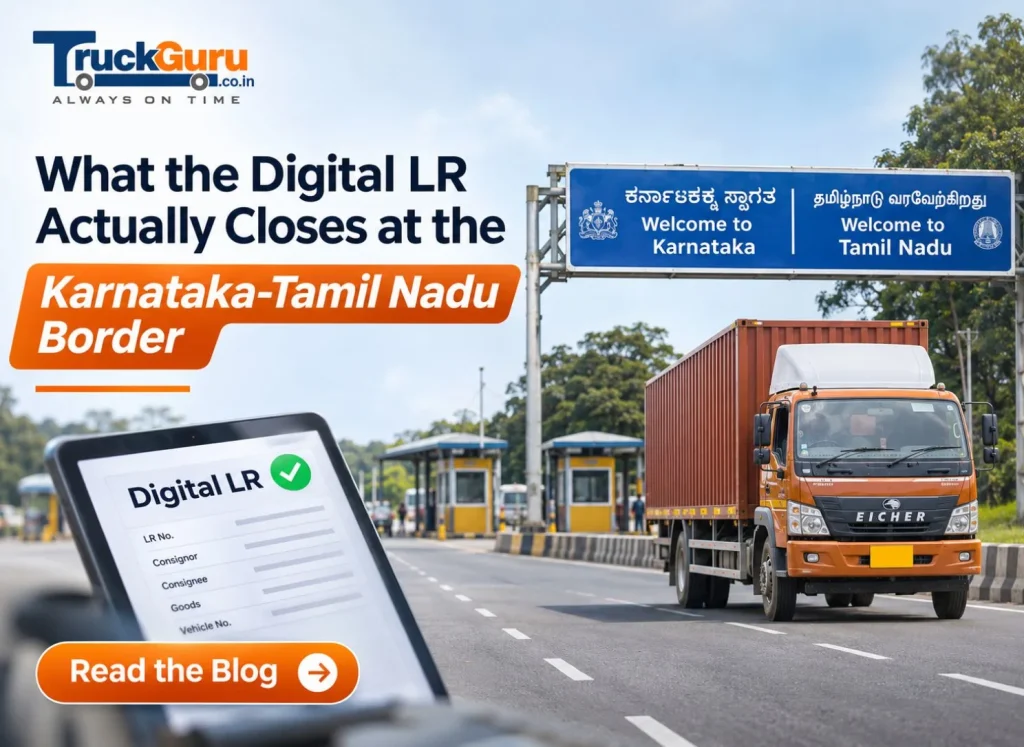
Picture a 14 ft Eicher leaving a component maker’s unit in Hosur at 6 am, bound for a warehouse off Bengaluru’s Hosur Road. The trip is barely 40 km. It still crosses a state line a few kilometres in, at Attibele, which makes it an interstate movement under GST. The invoice is in order and the e-way bill is generated. Then a mobile squad stops the truck and asks for the transport document number. The one on the e-way bill doesn’t match the handwritten lorry receipt in the cabin, because someone misread a smudged carbon copy.
A digital LR is built to stop exactly this. Nobody broke a rule. Still, the truck sits by the road while somebody at the factory gets on the phone to explain a typo. So it’s worth asking plainly: which of these headaches does a digital LR really fix, and which ones does it leave alone?
Quick Answer: What Does a Digital LR Change at the Border?
It puts one LR number, one set of consignment details and one handover time in front of everybody, at the same moment. Mismatched numbers, lost carbon copies and “how many boxes did you actually load?” arguments mostly disappear. What it won’t do is stand in for the GST invoice or the e-way bill, keep an officer from stopping the truck, or insure what’s inside.
What Is a Lorry Receipt in Law?
Strip away the jargon and the LR is a receipt. Under Section 9 of the Carriage by Road Act, 2007, a common carrier has to hand one over when loading finishes, or when it takes charge of the goods. Three copies, with the original for the consignor. The law treats it as prima facie proof of what was loaded: the weight, the description and the number of packages. It also has to say what the carrier is liable for.
Those three copies are where things go wrong. The consignor keeps one. The driver keeps one. The consignee is supposed to get the third. Half the time all three are written by hand on a loading bay with a truck engine running. Go digital and the legal content stays exactly the same; you just stop having three bits of paper that slowly stop agreeing with each other.
How the LR and the E-way Bill Are Linked
Ask most shippers and they’ll tell you the LR and the e-way bill are two unrelated documents. Look at the official Form GST EWB-01 on the national e-way bill portal and you’ll see they aren’t. Part A is the tax side: invoice, value, HSN code, who is selling to whom. Part B is the transport side. Field B.1 is the vehicle number. Field B.2 is the transport document number, and the form’s own note says that means the carrier’s goods receipt. On a truck, that’s your LR.
An officer at the roadside, then, isn’t checking one document. They’re checking whether three of them tell the same story. Invoice, e-way bill, LR. If the truck number or the LR number or the value doesn’t line up, you’re explaining yourself on the shoulder of the highway.
On a Bengaluru-Hosur trip that’s easy to underestimate, precisely because the run is so short. Within one state, a consignor sending goods up to 50 km to a transporter doesn’t need Part B. Cross into another state and that exemption is gone. So a 40 km hop from Hosur to Bengaluru still needs Part B completed, vehicle number and LR number included.
Five Gaps the Digital LR Closes
1. Numbers that don’t match
If the LR number is created digitally first, whoever generates the e-way bill copies it from the same record the driver will carry. No squinting at carbon paper before sunrise. On short border runs this is the snag that comes up most, and it’s the simplest one to get rid of.
2. The copy nobody can find
Paper gets left on a desk in the site office. It gets wet in the cabin. It goes missing at the security gate. A digital LR opens on the driver’s phone, on the dispatch clerk’s laptop and on the receiving manager’s screen, all at once.
3. “We sent 120, you got 118”
The LR is what both sides pull out when cartons go missing, because the law treats it as evidence of the count. A digital one stamps the number of packages with a date and time at handover. That ends the argument a lot faster than two people holding handwritten slips up to the light.
4. Knowing it actually arrived
Delivery is the other end of the LR. Once proof of delivery comes back digitally, the consignor knows the goods reached the dock without chasing a scanned slip or ringing the driver. On TruckGuru bookings, the balance is paid at delivery before unloading begins, so both sides care about having that record straight.
5. A breakdown halfway
Say the truck breaks down near Krishnagiri and the cargo goes onto another vehicle. Part B has to be updated with the new truck’s number before the goods move on. Having the original LR on record helps you show the load on the second truck is the same consignment, not a different one.
What the Digital LR Does Not Close
Software brochures tend to skip this bit.
- It isn’t an e-way bill. Goods worth more than Rs.50,000 going between Karnataka and Tamil Nadu still need one, plus the invoice, bill of supply or delivery challan.
- It won’t stop the truck being checked. The old commercial tax checkposts at state borders were dismantled when GST came in during 2017. Mobile squads were not. They can still pull a truck over and verify the goods, and transport officials still look at permits and overloading.
- A wrong invoice stays wrong. If the value or the HSN code is off, a tidy LR won’t rescue it.
- The penalty doesn’t shrink either. From 1 January 2022, goods caught without proper documents can be detained under Section 129 of the CGST Act, and the penalty is 200 percent of the tax payable if the owner comes forward to pay.
- There’s no insurance in it. The carrier’s liability is capped by law unless a higher value is declared, so anything valuable needs its own goods-in-transit policy from an insurer.
- And it can’t conjure up a dock slot. Perfect papers or not, a truck can wait for hours at a warehouse that hasn’t planned for it.
The Numbers That Matter on This Corridor
For normal cargo, an e-way bill stays valid one day for every 200 km or part of it, counted from when Part B is first filled in. On the main lanes across this border, that plays out like this.
- Hosur to Bengaluru is about 40 km, so one day of validity, for a trip that usually takes a few hours.
- Bengaluru to Chennai, going through Hosur and Krishnagiri, is roughly 350 km. That earns two days of validity, and a full truck normally does it inside one.
So validity almost never runs out on these routes. What goes wrong is the truck pulling out before Part B is done, or Part B quoting an LR number nobody can match.
What does the trip itself cost? A 14 ft Eicher (3 to 3.5 tonnes) from Bengaluru to Chennai, about 350 km, is indicatively Rs.10,900 – Rs.12,300 for the trip, toll included (checked November 2026). Rates are not fixed, and the number moves with the date, the truck and whether there’s a load coming back. Check your own route on the freight calculator.
Five Things to Check Before the Truck Leaves
- Does the invoice or delivery challan match what’s actually being loaded?
- Is the value and HSN code right in Part A of the e-way bill?
- Does Part B show the real vehicle number and the real LR number, not a placeholder?
- Can the driver pull up both the LR and the e-way bill on their phone, with a printout as back-up?
- Does the package count on the LR match what’s sitting on the truck?
Where TruckGuru Fits
TruckGuru, a freight pricing transparency platform for full-truckload bookings across 110+ cities, issues digital LRs, helps with e-way bill details, and provides digital proof of delivery and GST-compliant invoices. Dispatched trucks carry live GPS tracking, which you can watch in the TruckGuru app. None of that replaces your own invoice or e-way bill. What it does is make sure the transport paperwork agrees with them.
Frequently Asked Questions
Is a digital LR legally valid in India?
Yes. The Carriage by Road Act requires a goods receipt but doesn’t say it must be on paper, and the Information Technology Act, 2000 recognises electronic records. It just needs to carry the required details and the carrier’s liability undertaking.
Do I need an e-way bill for a short Hosur to Bengaluru trip?
Yes, once the goods are worth more than Rs.50,000. Hosur is in Tamil Nadu and Bengaluru in Karnataka, so it’s an interstate move, and Part B with the vehicle number must be filled in however short the distance.
Where does the LR number go on the e-way bill?
Part B, field B.2, Transport Document Number. Form EWB-01 explains it as the carrier’s goods receipt number, which on the road is the LR number.
Does a digital LR replace the e-way bill?
No. One is a GST document, the other is the carrier’s receipt. The truck needs the invoice or delivery challan, the e-way bill and the LR.
How long is an e-way bill valid from Bengaluru to Chennai?
At about 350 km, two days for normal cargo. The rule is one day per 200 km or part of it.
What happens if goods move without a valid e-way bill?
They can be detained under Section 129 of the CGST Act. Since January 2022 the penalty has been 200 percent of the tax payable when the owner comes forward, and higher when nobody does.
Does TruckGuru insure the goods?
No. TruckGuru does not offer goods insurance. If the load is valuable, get goods-in-transit cover from an insurer before dispatch.
What if the truck changes mid-route?
Update Part B with the new vehicle number before the goods carry on, and keep the original LR so you can show it’s the same consignment.