
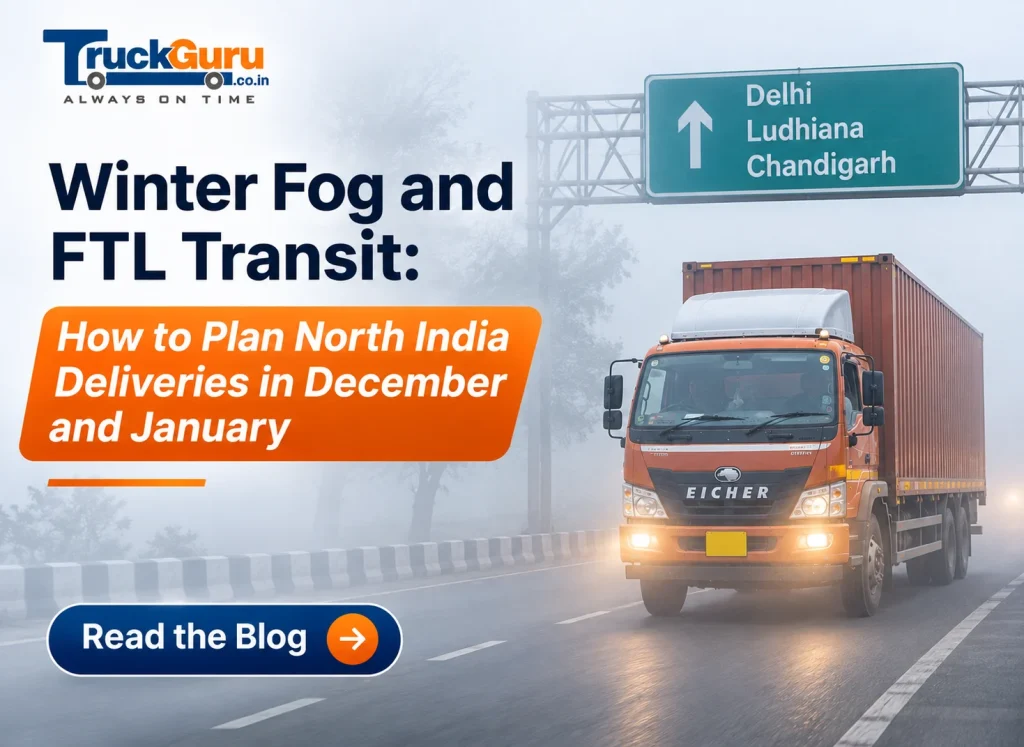
Winter fog North India delays are the reason your Ahmedabad to Ludhiana truck, due on Thursday, did not arrive until Saturday. Dense fog on the Haryana and Punjab stretch held it there. The load arrived, but your receiver had already shut the warehouse for the weekend, the e-way bill had one day left, and explaining what happened took three calls.
This is not a rare event. It happens every year, to shippers who did not account for winter conditions when they set their delivery window.
Here is what causes fog delays on North India highways, which routes are most affected, and how to plan your December and January FTL dispatches around it.
Winter fog North India: why it slows truck transit
Fog reduces visibility on highways, often to 25-50 metres in the worst conditions. At that point, a driver moving at normal highway speed cannot stop in time for what appears ahead. So drivers slow down, sometimes to a crawl, and when visibility drops to near-zero, many pull over and wait for it to lift.
The India Meteorological Department (IMD) records “dense” to “very dense” fog conditions across the North Indian plains every year from roughly the last week of December through January. In some years it extends into early February. This is a structural seasonal feature of the region, not a rare weather event.
Dense fog typically forms at night and in the early morning hours, lifting through mid-morning as temperatures rise. A truck dispatched in the afternoon may drive normally for the first few hours, then hit the fog belt at 2 or 3 AM and slow to a fraction of its usual speed. What was planned as a 20-hour run can stretch to 30 hours or more, depending on when and where the driver enters the fog.
Which belts are affected
IMD satellite imagery consistently shows dense fog cover over Punjab, Haryana, Delhi, Uttar Pradesh, northeast Madhya Pradesh, and Bihar during peak winter months. The fog layer typically stretches from Punjab across the Indo-Gangetic plains.
For FTL shippers, the high-impact corridors are:
Punjab and Haryana: The Amritsar-Ambala-Delhi stretch of the national highway is among the worst affected, with dense fog at several places and maximum temperatures running well below normal. Loads moving to or from Ludhiana, Chandigarh, Jalandhar, Ambala, and Karnal all pass through this belt.
Delhi NCR: Visibility can fall as low as 25-50 metres in parts of Delhi during peak fog, and trucks transiting through the NCR to connect to eastern or western destinations face compounded delays when fog and congestion overlap.
Western Uttar Pradesh: Meerut, Ghaziabad, Agra, Mathura, Kanpur — loads to and from these cities pass through fog-affected stretches. Early morning fog in northwest India has impacted road, rail, and air traffic since the end of December in multiple consecutive winters.
Bihar: Dense fog has been reported across Bihar, Jharkhand, west Rajasthan, and Assam during peak winter periods, with the fog layer extending from Punjab to West Bengal across the plains. Loads to Patna or further east face fog risk on a large portion of the route.
If your load moves to, from, or through any of these states between late December and late January, factor fog into your planning.
Setting a transit buffer without guessing
Do not ask your transporter for a guaranteed delivery time during fog season. The honest answer is that no one can give you one.
What you can do is set a realistic window rather than a single day.
A standard North India FTL run of 800-1,200 km typically takes 18-26 hours in normal conditions. During peak fog weeks, the same run can take longer depending on the time of day the truck passes through fog-affected stretches, local visibility conditions, and driver judgment calls about waiting out the worst of it.
When booking FTL loads for December and January North India routes, plan delivery windows rather than delivery dates. Add buffer on top of your transporter’s normal transit estimate. The right buffer depends on your route, the time of year, and how critical the delivery window is.
For loads where late arrival has a real cost — a production line waiting for raw material, a retailer with a fixed unloading schedule, a perishable consignment — book earlier in the week so you have room to absorb a delay without it spilling into a weekend or a gap in receiver availability.
Dispatch timing also matters. A truck that leaves your pickup location in the late afternoon will hit the worst fog windows in the early hours of the morning. A morning dispatch on the same route may pass through the high-risk stretches while they are still manageable.
For more on how dispatch timing and route decisions interact, see Route Planning for Full Truck Load Transport: Why It Matters.
E-way bill validity during fog delays
This is the part that catches shippers by surprise.
Under GST rules, e-way bill validity is calculated at 1 day per 200 km of transit distance. A 900-km load gets an e-way bill valid for approximately 4-5 days. The core rule is that for every 200 kilometres (or part thereof) of travel, the e-way bill is valid for one day.
If a fog delay pushes your transit past that validity window, you need to extend the bill before it expires — or at the latest within 8 hours after expiry. Extension can be requested from 8 hours before expiry to 8 hours after expiry. A bill that expired more than 8 hours earlier cannot be extended.
The extension process is done on the official e-way bill portal. When selecting the reason, weather delay or natural calamity is a valid option. Valid reasons listed include vehicle breakdown, natural calamity, trans-shipment delay, and law-and-order disruption.
From January 2025, e-way bill validity extensions are capped at 360 days from the original generation date. This is not relevant to fog-related extensions on individual shipments, but worth knowing if you have standing or long-duration movements.
What this means in practice:
- For long-haul loads (1,000+ km) through fog-affected corridors, calculate your e-way bill validity before dispatch and confirm it covers a delayed scenario.
- If the standard validity is tight for your route, generate the bill on the actual day of dispatch, not days earlier.
- Keep the consignor’s contact number ready. If the driver reports a significant delay mid-route, extension may need to be initiated remotely through the portal before the window closes.
- Ask your transporter to flag any detention or waiting time that could push transit beyond the validity period.
For a full breakdown of e-way bill rules as they stand in 2026, see E-Way Bill Compliance India: June 2026 Rules Explained.
Keeping your receiver informed
A delayed truck is a planning problem for the receiver, not just for you. A warehouse that expected a truck on Thursday may have allocated its unloading crew and dock space for that day. If the truck arrives Saturday with no notice, the receiver may not have capacity to handle it.
A short message — “Truck is delayed due to fog near Ambala, now expected to reach Friday evening” — lets the receiver adjust. It also protects you: if there is a dispute later about whether the delay was notified, you have a timestamp.
Build this into your process for winter dispatches:
- Confirm expected arrival time with the transporter at the time of booking.
- Check on truck status at the midpoint of the expected transit window.
- If the truck is running more than four hours behind, notify the receiver immediately.
- Update again when the truck is 2-3 hours out from the delivery point.
Receivers who are kept informed generally cooperate. Receivers who get a delayed truck with no prior notice often do not.
GPS tracking during fog delays
When a truck is somewhere on the NH-44 at 3 AM in zero visibility and you have no information, the uncertainty is as much a problem as the delay itself. You cannot give the receiver an updated ETA. You cannot tell your operations team whether the load will make its window or not.
GPS tracking runs on every dispatched booking through the TruckGuru Android app. When fog slows the highway, you can see where your truck is, check whether it is moving or waiting, and give your receiver an updated ETA based on actual location — not an estimate made at the time of booking.
Every TruckGuru truck has live GPS, so you can see where your load is when fog slows the highway. Book your next North India load at truckguru.co.in/truck-booking-online.
Winter FTL planning checklist for December and January
Use this before booking any North India FTL load during the fog season:
- Check if your route passes through Punjab, Haryana, Delhi NCR, western UP, or Bihar
- Add a delivery window rather than a single delivery date
- Plan dispatch timing — consider whether a morning dispatch reduces fog exposure for your specific route
- Calculate e-way bill validity for the full route distance, then add your buffer; generate the bill on dispatch day
- Save the e-way bill portal login details and confirm who is responsible for extending if needed
- Share the receiver’s contact and unloading hours with your transporter before dispatch
- Agree on a mid-transit check-in point with the transporter
- Notify the receiver if the truck is running more than four hours behind schedule
- Confirm GPS access through your booking app so you can track location during the delay
Frequently Asked Questions
Which months have the worst fog on North India highways?
Late December and January are consistently the most affected. Some years the fog extends into the first two weeks of February, particularly in western UP and Bihar. The IMD issues advisories at the start of each fog season; check them for the current year before planning your dispatch calendar.
Can I extend an e-way bill if fog delayed my truck?
Yes. Weather delay and natural calamity are accepted reasons for e-way bill extension on the GST portal. You need to request the extension within 8 hours of expiry — not after. The process is done online and requires the e-way bill number and the vehicle number.
My transporter says the truck will arrive on time. Should I still plan a buffer?
Your transporter is giving you an estimate based on normal conditions. During December and January, conditions on North India highways are not normal. Plan your own buffer independently of whatever ETA the transporter gives you.
Does fog affect all North India routes equally?
No. The Punjab-Haryana-Delhi NCR stretch and western UP are most consistently affected. Loads running south of the Vindhyas or through central/peninsular India face less fog-related risk. If your load moves entirely within Gujarat, Maharashtra, or the South, this is less of a concern.