

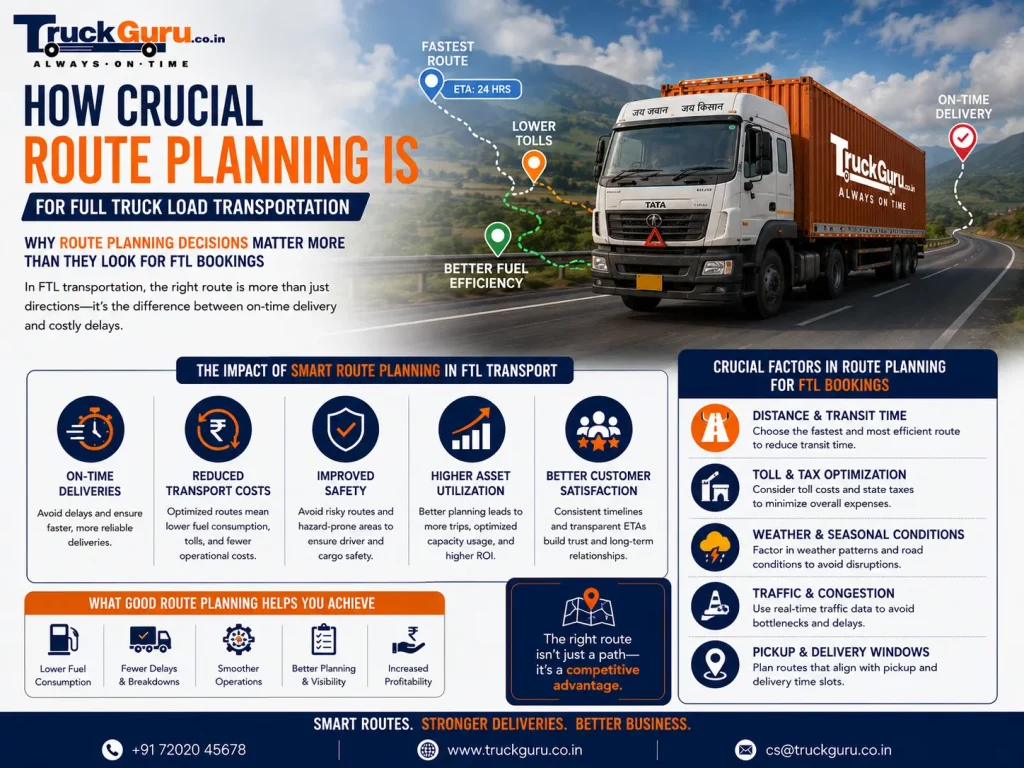
Why Route Planning Decisions Matter More Than They Look for FTL Bookings
Most “route planning in logistics” content is written for a company dispatching its own fleet of drivers across many stops — optimising which driver goes to which customer, in which order, at what time. That is a genuinely complex problem worth serious software and planning effort.
Route Planning for Full Truck Load: Quick Summary
Route Planning For Full Truck Load: Wondering why route planning matters? Learn how strategic planning enhances full truck load delivery speed, fuel.
Route planning for a single full-truckload booking is a simpler, distinct question: you are moving one truck from one pickup point to one delivery point along one route. The decisions that matter look quite different from the multi-stop dispatch problem, and confusing the two leads to spending energy on the wrong things.
What follows is specific to truck booking on a per-FTL basis — not to fleet management or last-mile delivery planning.
Corridor Selection: The Route Decision That Actually Happens
For intercity FTL shipments, the route question is usually about corridor choice rather than turn-by-turn navigation — the driver handles the latter. As a shipper, the decisions worth thinking about are: which road corridor connects the origin and destination most directly, whether that corridor has a history of weighbridge issues or seasonal bottlenecks that affect transit time, and whether the pickup and delivery addresses can actually accommodate the truck size being booked.
A 32ft container on a route with narrow delivery-point access is a problem that should be identified before booking, not on arrival.
Why Transit Time Estimation Matters at the Booking Stage
Getting transit time right upstream — at the planning stage, not after the truck has already left — changes how a receiving team can prepare. A warehouse that knows a truck will arrive between 10am and 2pm the next day can schedule unloading staff accordingly. A warehouse that finds out a truck has arrived at 7am after an overnight run that completed faster than expected is scrambling to open early without advance notice.
For common intercity corridors, transit times are reasonably predictable. Bangalore to Chennai covers about 346 km and typically runs 5 to 6 hours in standard conditions. Hyderabad to Mumbai spans roughly 710 km and generally takes 11 to 13 hours, depending on road conditions and border transit. Building these realistic windows into a booking confirmation rather than leaving them as “sometime tomorrow” is a small planning step with a noticeable effect on receiving operations.
Check rate and plan timing together on the freight calculator before confirming a booking.
Timing the Dispatch to Avoid Predictable Bottlenecks
Traffic congestion at city entry and exit points is the most consistent variable on most Indian intercity routes — the highway stretch itself is usually predictable, but the first and last hour in each city is where transit time gets eaten up. Dispatching early in the morning from a major industrial hub like Pune or Surat, rather than at peak commute hours, tends to result in noticeably faster clearance through the city outskirts. This is the kind of timing decision that costs nothing to get right, and nothing is lost by planning it upfront.
Seasonal factors matter too, especially for agricultural and perishable freight corridors during harvest periods, when truck availability on certain routes tightens and transit times get less predictable. Building a booking ahead of those periods, rather than at them, is the practical mitigation available on a per-trip basis.
Documentation as Part of Route Planning
A shipment that crosses a state boundary requires an e-way bill valid for the corridor distance being covered. Getting this wrong — wrong value, wrong vehicle, expired validity — creates a border delay that affects transit time regardless of how well everything else was planned. Sorting e-way bill requirements and transporter documentation before the truck leaves is not an afterthought; it is part of planning the route in the sense that it determines whether the truck can actually complete the journey without being held at a checkpoint.
Driver name, vehicle number, and transporter ID are all confirmed through TruckGuru at booking, so documentation can be prepared in advance.
Pickup Point Efficiency
The pickup address for a large truck — a 20ft vehicle or 32ft container — needs to have sufficient access for that vehicle to enter, load, and exit without a turnaround problem. Industrial estates and warehouses on designated freight corridors generally do. Residential areas, narrow lanes, and congested market areas generally do not. Confirming this before the booking is placed, rather than on the day the truck arrives, avoids the situation where a correctly-booked truck cannot physically complete the pickup.
Match the truck size to the actual access available as well as the cargo weight — see the truck size guide for dimensions.
The Cost Impact of Route Planning Done Right
Getting these decisions right before a truck leaves does not just improve transit time — it reduces the cost of the problems that arise when they are skipped. A documentation hold at a state border can add hours to a delivery, with knock-on effects at the receiving end. A truck that cannot access the pickup point may incur a wasted trip charge. A shipment booked on the wrong truck size for a tight delivery address creates a problem with no good solution once the vehicle has arrived. None of these is expensive to prevent at the planning stage; all of them are expensive to resolve once they have already happened.
Explore transportation services for your corridor, or use the tempo service guide for smaller loads that may have more flexibility on access.
Closing Thoughts
Route planning for a single FTL booking comes down to a handful of specific decisions made before the truck leaves: corridor selection, transit time estimation, dispatch timing, documentation, and pickup point access. None of these requires specialist software or a dedicated logistics team — they require spending 20 minutes on the planning that prevents a day of problem-solving after something goes wrong.
Frequently Asked Questions
Why is route planning important for full truckload transportation?
For FTL specifically, the key route planning decisions — corridor choice, transit time estimation, timing, documentation, and pickup access — determine whether a shipment arrives as planned. Getting these wrong at the booking stage creates problems that are significantly more expensive to fix mid-shipment than they would have been to prevent beforehand.
What makes FTL route planning different from last-mile delivery route planning?
Last-mile route planning involves dispatching multiple drivers across many customer stops, optimising for order and timing across a complex network. FTL route planning for a shipper is simpler: one truck, one pickup, one destination. The relevant decisions are corridor choice, transit time expectations, documentation, and access — not multi-stop sequencing.
How does documentation affect FTL route planning in India?
Cross-state shipments require a valid e-way bill matched to the corridor distance and vehicle. A documentation error can hold a truck at a state border checkpoint, adding hours to a trip that may have been planned to the minute up until that point. Preparing documentation before the truck leaves is part of planning the route correctly.
Does TruckGuru offer local or city transport services?
No. TruckGuru books intercity FTL transport between cities on routes above 100 km. Local within-city transport and last-mile delivery are not part of what TruckGuru offers.
Call 72020 45678 or book online at truckguru.co.in for a confirmed rate on your next intercity shipment.
Related Reading
- Ship-To GSTIN Mandate August 2026 — What Shippers Must Do
- Common Questions FTL Shippers Ask Before Booking a Truck
- How to Increase Truck Mileage to Save Fuel Cost
For current rules and official notifications, see the Ministry of Road Transport & Highways.