

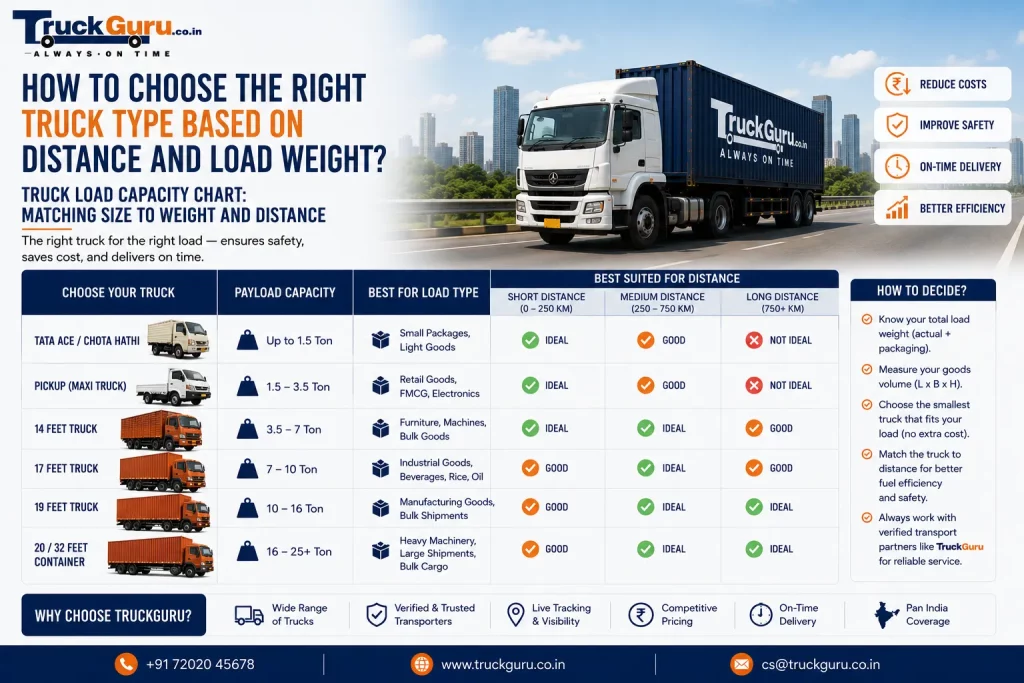
Truck Load Capacity Chart: Matching Size to Weight and Distance
Booking a bigger truck than your shipment needs means paying for space that travels empty the whole route. Booking a smaller one means overloading — which damages cargo, risks a penalty at a weighbridge, and is genuinely dangerous on a long highway run. Both mistakes are common, and both come from skipping the same basic step: matching actual cargo weight and route distance to the right truck size before booking.
Truck Type: Quick Summary
Truck Type: Tata Ace to 32ft container – matching cargo weight and route distance to the right truck category. A practical size guide for Indian B2B freight.
The chart and guidance below are built specifically around TruckGuru’s five actual booking categories, for intercity FTL shipments — not the wider commercial vehicle market in general, which includes plenty of vehicle types that are not relevant to a B2B shipper deciding what to book today.
Two Factors That Actually Determine the Right Truck
Weight tells you the minimum capacity required. Distance affects which size makes practical sense for the route — a 750kg shipment going 800km still needs a small truck, but the longer the haul, the more it matters that the vehicle is suited to highway running rather than short hops. For TruckGuru’s intercity bookings, distance breaks down roughly into same-day corridors (100-300km), medium intercity routes (300-600km), and long-distance hauls (600km and above).
TruckGuru’s Actual Truck Load Capacity Chart
Truck Type | Load Capacity | Best Distance Range | Best For |
Tata Ace | Up to 750 kg | Same-day to long-distance intercity | Samples, spare parts, small commercial batches |
Bada Dost | Up to 1.5 tonnes | Same-day to long-distance intercity | Same rate as Tata Ace, double the capacity |
14ft Truck (Eicher/Tata) | Up to 3.5 tonnes | Medium intercity, 300-600km | Mid-sized B2B dispatches, palletised goods |
20ft Truck | Up to 7 tonnes | Medium to long-distance intercity | Larger shipments need fewer trips |
32ft Container | Up to 15 tonnes | Long-distance, multi-state | Bulk freight, multi-pallet loads, weather/security protection |
This chart reflects TruckGuru’s actual fleet, not the wider Indian commercial vehicle market — a lot of “truck capacity chart” content online lists models that simply are not available to book here, which leads to confusion when the names do not match what you see at checkout.
Full specifications: truck size guide.
Matching Truck Size to Route Distance
Same-day intercity (100-300km)
Routes like Bangalore-Chennai or Pune-Mumbai fall in this range — a morning dispatch can reach the destination city the same day. Any of the five truck categories works here, depending purely on cargo weight; distance is not the constraint at this range.
Medium intercity (300-600km)
Routes such as Bangalore-Hyderabad sit here, typically an 8-9 hour single dispatch. Mid-to-large categories — 14ft and 20ft trucks — are common at this range simply because shipment volumes on these routes tend to be larger than short hops, not because smaller trucks cannot make the trip.
Long distance (600km and above)
Routes like Mumbai-Kolkata or Delhi-Bangalore run a full day or more. For long hauls specifically, weight distribution and vehicle stability matter more than on shorter trips — an unevenly loaded truck is more likely to develop a problem over many highway hours than over a two-hour local stretch.
Light vs Heavy Truck Tradeoffs
Smaller trucks load and unload faster and can access pickup or delivery points that a large container truck might find tight — a factory gate on a narrow lane, a smaller loading dock. Heavier trucks carry more per trip, which matters once shipment volume on a route is consistently large enough to justify the bigger booking. Neither is inherently better; the right choice depends on actual cargo weight and how the pickup or delivery location is laid out, not on the route distance alone.
Tips for Choosing the Right Truck
- Weigh the actual shipment rather than estimating — a load that “feels like 3 tonnes” but runs 3.8 needs the 20ft truck, not the 14ft
- Check road conditions on the actual route, not just distance — a shorter route with poor surface quality can take longer than a longer route on a good highway
- For urgent or time-critical shipments, confirm same-day availability before booking rather than assuming it
- Use the freight calculator to see the confirmed rate for your actual route and truck size before committing, rather than guessing from a generic price range
A Realistic Example
Illustrative scenario, not a specific client account.
A manufacturer shipping steel components from Mumbai to Hyderabad was booking 14ft trucks for loads that, once weighed accurately, were running closer to 4.5 tonnes — just over that category’s 3.5-tonne limit. The trucks were arriving overloaded, which both risked penalties at weighbridges and increased the chance of cargo shifting in transit.
Moving up one category to the 20ft truck (7-tonne capacity) solved the overload problem outright, and because the larger truck could carry the full load in one trip instead of splitting it across two partially-loaded 14ft bookings, the total cost per shipment came down rather than going up — the kind of result that only shows up once you check actual weight against the category limit instead of estimating.
How TruckGuru Helps You Choose
TruckGuru’s online booking shows the confirmed rate for your actual route and truck size before you commit, with GPS tracking through the trip and digital documentation — LR and GST invoice — generated automatically. Drivers and vehicles are confirmed before dispatch, and support is available to help resolve booking questions, though response times vary rather than being instant at every hour.
Book directly or check a rate at TruckGuru.co.in.
Closing Thoughts
Matching truck size to load weight and route distance is not complicated once you have an accurate weight and a real chart to check it against — the mistakes happen when either number gets estimated rather than confirmed. Weigh the shipment, check the category limit, and size up rather than risk overloading when a load sits close to a boundary.
Frequently Asked Questions
How do I choose the right truck type based on distance and load weight?
Start with the actual cargo weight and match it to the smallest TruckGuru category that covers it without exceeding the limit. Distance mainly affects which categories are commonly booked on a given route, not which ones are technically capable of making the trip.
What is the load capacity of TruckGuru’s largest truck?
15 tonnes, on the 32ft container. This is the maximum single-vehicle capacity available — heavier shipments need to be split across multiple bookings.
Does TruckGuru offer trucks for local city deliveries under 50 km?
No. TruckGuru runs intercity FTL only — routes above 100 km between cities. Local within-city delivery is not part of this service.
What happens if I book a truck smaller than my actual cargo weight?
Overloading risks penalties at weighbridges, increases the chance of cargo damage from instability, and is a genuine safety risk on long routes. Always weigh the shipment and book the category that covers it with some margin rather than the exact minimum.
Is it cheaper to book a smaller truck and make two trips?
Usually not. Two trips mean two base charges and two distance rates, which typically costs more than booking one correctly-sized truck for the full load in a single trip.
Call 72020 45678 or book online at truckguru.co.in for a confirmed rate on the right truck size for your shipment.
Related Reading
- Reduce Manufacturing Freight Costs: India Intercity Guide
- Reduce B2B Freight Costs in India: 25 Proven Strategies
- Ship-To GSTIN Mandate August 2026 — What Shippers Must Do
For current rules and official notifications, see the Ministry of Road Transport & Highways.