

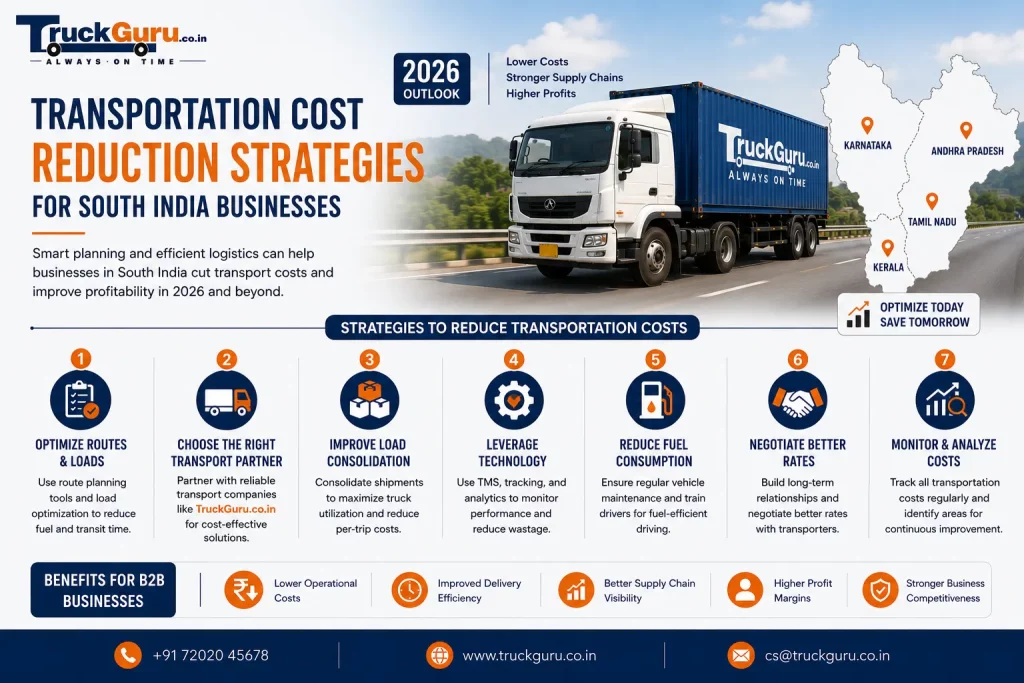
Transportation Cost Reduction Strategies for South India Businesses
Transportation costs eat into margins quietly — a few extra rupees per kilometre here, a half-empty truck there, a last-minute booking surcharge somewhere else — and by the time it shows up clearly in the books, the pattern has usually been running for months. For a B2B business shipping regularly across South India — Chennai to Bengaluru, Hyderabad to Coimbatore, and the routes in between — getting ahead of this is less about finding one big saving and more about fixing the handful of small, repeated mistakes that compound every month.
Cost Reduction Strategies: Quick Summary
Cost Reduction Strategies: Looking to reduce transport expenses for your business in 2026? Discover cost-saving logistics strategies and book smarter with.
Why Transport Costs Keep Rising
A few forces are pushing costs up at the same time, and most businesses are only tracking one or two of them. Diesel prices fluctuate enough that a budget set on last quarter’s fuel cost can be meaningfully off by the time a shipment actually moves. The October 2026 bulk diesel hike is a live example: see what the bulk diesel price rise means for truck freight rates. Driver and warehouse labour costs have been rising steadily, and for businesses shipping daily, that line item compounds faster than most P&L reviews catch.
Toll structures vary by route and truck size, and picking a route without checking this can add real cost for no benefit at all. On top of all of this, customers increasingly expect fast delivery without paying more for it — which means the businesses that manage transport costs well are the ones who stay competitive, and the ones that do not eventually either lose margin or lose customers.
1. Stop Booking at the Last Minute
Last-minute bookings are consistently more expensive than planned ones, for a simple reason: urgency removes your ability to compare options or wait for better availability. Look at your own shipping history to see when volume peaks, and book ahead of that rather than scrambling at month-end. If you ship to the same destinations regularly, that repeat pattern itself is useful information — a transporter who sees consistent volume from you has more reason to prioritise your booking than a one-off customer calling in a panic.
2. Stop Sending Half-Empty Trucks
This is the single most common source of avoidable cost in regional freight. If you have three partial loads heading to nearby cities, that is three separate base charges and three separate distance rates, even though a single full truck could carry all of it. Consolidating shipments and packing more carefully to use available space turns three part-loads into one full one — and the savings on the duplicated base charges alone are usually substantial.
Take a concrete version of this: three partial loads heading to Vijayawada, Visakhapatnam, and Kochi, each booked separately, means paying for three trips. Combined into fuller loads on shared routes, that becomes two bookings instead of three — a direct saving with no change to what is actually being shipped. Better packing has a second, less obvious benefit too: less shifting in transit means fewer damage claims, which is its own quiet cost saving.
3. Use a Platform With a Transparent, Fixed Rate — Not a Negotiated One
Digital booking platforms change one specific thing that matters a lot in practice: the price you see is the price that gets confirmed, rather than a verbal quote from a broker that may shift once the truck is already loaded. On TruckGuru specifically, the rate shown for a route and truck size comes from a published rate card — distance and vehicle category determine it, not how busy that day happens to be or who you managed to reach on the phone.
That is a different kind of benefit than “live demand-based pricing” — it is the absence of price uncertainty, which, for budgeting purposes, is usually more valuable than a price that might occasionally be lower but is never predictable in advance.
What digital booking changes in real time is visibility: GPS tracking through the trip, and digital documentation — LR and GST invoice — generated without anyone having to chase paperwork. None of this requires calling several transporters and comparing verbal quotes against each other.
4. Build Real Relationships With a Few Transporters Rather Than Booking Randomly
With traditional broker-based transporters, consistent volume genuinely can lead to negotiated discounts and priority access — this is standard practice in that part of the market, and worth pursuing if that is how you are currently booking. On a fixed-rate platform like TruckGuru, the published per-km rate for a given truck category does not change based on relationship, since it is not negotiated to begin with — but the practical benefit of regular business still exists in a different form: a platform that knows your shipping pattern can flag truck availability on your usual corridors and routes more proactively than a one-off booking would surface.
What Digital Platforms Actually Change
The traditional method — calling multiple transporters, getting verbal quotes, chasing trucks for status updates — costs real time even when it does not cost extra money directly. A digital platform puts truck size options, confirmed rates, and booking status in one place, which removes the phone-call overhead without requiring you to negotiate or compare quotes from multiple separate companies.
How TruckGuru Helps South India Businesses Manage Transport Costs
TruckGuru serves B2B logistics across South India as part of its broader pan-India network. A few specifics worth knowing:
- A published rate, not a moving target: the rate shown for your route and truck size at booking is the rate on the invoice after delivery — no surprise additions once the truck is loaded.
- Coverage across the region: pickup and delivery across Tamil Nadu, Telangana, Andhra Pradesh, Karnataka, and Kerala, covering factory shipments and distributor deliveries alike.
- Booking history that informs better scheduling: over multiple bookings on the same corridor, your own shipping data shows which routes and days run more consistently, which is useful for planning even without anything described as “predictive.”
- Digital documentation: GPS tracking, digital LR, and GST invoice generated automatically — no manual paperwork chase.
What This Actually Adds Up To
Consolidating loads properly and avoiding last-minute bookings can meaningfully reduce per-shipment cost — the exact percentage depends heavily on how partial your current loads typically are, so treat any single figure as illustrative rather than guaranteed. Beyond the direct cost line, working with transporters who provide consistent tracking and documentation tends to improve delivery predictability, which customers notice even when they cannot see the logistics behind it.
Less paperwork chasing also means your team spends less time on administrative follow-up and more on work that actually grows the business. And because a fixed-rate platform does not require renegotiating terms as volume grows, scaling shipment frequency does not have to mean a proportional increase in coordination overhead.
The Bottom Line
Reducing transportation costs in South India comes down to three habits: book ahead of when you actually need the truck, consolidate shipments wherever the routes overlap, and use a platform where the price is known before the truck leaves rather than discovered on the invoice. Fuel and labour costs are not going to fall on their own, and competitive pressure on delivery speed is not going away either — but neither of those facts changes what is actually within a shipper’s control.
Check a confirmed rate for your South India route on the freight calculator.
Frequently Asked Questions
How can I reduce transportation costs in my business?
Three habits make the most difference: book trucks ahead of last-minute deadlines, consolidate partial loads into full ones wherever routes overlap, and use a platform with a transparent, fixed rate so you know the cost before the truck leaves rather than after delivery.
What is the biggest expense in transportation?
Fuel typically accounts for a large share of total transport cost, commonly cited at around 30-40% in Indian trucking, with labour costs for drivers and staff close behind. Managing both is central to controlling overall transportation cost.
How does load consolidation reduce freight costs?
Combining multiple partial shipments into one full truckload means paying one base charge and one distance rate instead of several. The exact saving depends on how partial the original loads were, but the underlying mechanism — fewer separate bookings for the same total cargo — is consistent.
Should I use a logistics platform or negotiate directly with transporters?
It depends on the transporter type. With traditional broker-based transporters, direct negotiation and repeat business can genuinely lower verbal quotes over time. With a fixed-rate platform like TruckGuru, the rate is published rather than negotiated, so the benefit shifts from “lower price through negotiation” to “known price with no surprises” — a different kind of value, not a worse one.
Which platform covers South India for B2B freight booking?
TruckGuru covers Tamil Nadu, Telangana, Andhra Pradesh, Karnataka, and Kerala as part of its pan-India network, with a published rate card, GPS tracking, and digital documentation for FTL bookings.
Call 72020 45678 or book online at truckguru.co.in for a confirmed rate on your next South India shipment.
Related Reading
- Reduce Manufacturing Freight Costs: India Intercity Guide
- Reduce B2B Freight Costs in India: 25 Proven Strategies
- Ship-To GSTIN Mandate August 2026 — What Shippers Must Do
For current rules and official notifications, see the Ministry of Road Transport & Highways.