

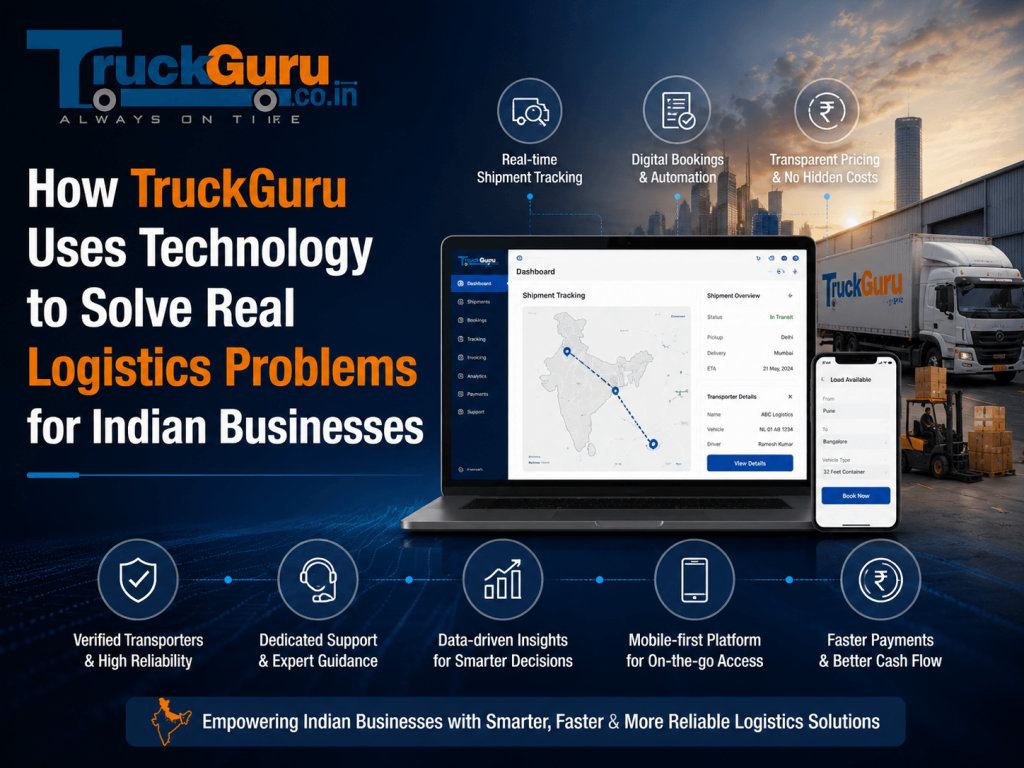
How TruckGuru Uses Technology to Solve Real Logistics Problems for Indian Businesses
Technology in Logistics: Quick Summary
Technology in Logistics: See how TruckGuru uses online truck booking, GPS tracking, and data tools to fix the real logistics problems Indian businesses face.
Running a business that moves goods intercity is not straightforward. Most companies that rely on freight transport have dealt with the same set of problems for years – calls that go unanswered, trucks that show up late, costs that shift between the quote and the final bill, and no real way to know where a shipment is mid-route.
These are not minor inconveniences. Poor logistics planning leads to production delays, missed customer commitments, and freight costs that quietly eat into margins. For SMEs and manufacturers running lean operations, this is the kind of friction that stalls growth.
TruckGuru built its platform specifically to fix these operational problems. Not with buzzwords, but with tools that address each pain point directly — from the moment a business checks a rate to the moment goods are delivered.
What Most Logistics Operations Get Wrong
Before looking at solutions, it helps to name the actual problems clearly. Businesses dealing with intercity freight transport consistently run into the same six or seven issues:
- Finding a truck requires calling multiple providers one by one, with no guarantee that any of them has availability on the required date.
- Shipment visibility is close to zero once the truck leaves the loading dock. Businesses have to call the driver or the transporter and hope for an honest update.
- Manual paperwork — loading slips, LRs, invoices — slows down dispatch and creates errors that surface later in billing or GST reconciliation.
- Quoted rates and final billed amounts often do not match. Fuel surcharges, toll adjustments, and “handling fees” appear on the invoice that were never in the original quote.
- There is no structured data on freight spend, route performance, or carrier reliability, which means every booking decision is made on instinct.
- Communication between dispatch, transporter, and the receiving team is fragmented — usually running across phone calls, WhatsApp messages, and email threads simultaneously.
Each of these problems has a direct cost, either in money, time, or both. Technology addresses them when it is applied to the right part of the process.
For a broader view of how transportation services work within a managed freight platform, that page covers the end-to-end service structure.
Online Truck Booking: Cutting Out the Guesswork
The booking process is where most businesses waste the most time. Calling multiple transporters, getting different quotes, following up to confirm availability, and then waiting to see if the truck actually arrives — the entire process can take hours for a single shipment.
TruckGuru’s online truck booking platform changes this from a phone-based negotiation into a structured, transparent transaction. A business enters the pickup city, the delivery city, and the cargo load. The platform shows available trucks, displays the trip rate, and confirms the booking in one flow.
What this means practically:
- Truck availability is visible before the booking, not discovered by calling around.
- Pricing is shown upfront. The rate displayed at the time of booking is the rate on the invoice.
- The booking is confirmed digitally, with a record that both parties can reference.
- The platform is accessible at any time, which removes the dependency on office hours or transporter availability windows.
For businesses that run frequent intercity shipments — even 10 to 15 per month — this kind of structured booking process saves several hours of coordination work every week.
GPS Tracking: Knowing Where Your Goods Are
One of the most common complaints in Indian freight is the lack of mid-route visibility. Once a truck leaves, the shipper is dependent on the driver’s phone availability for any updates. If the driver is driving, sleeping, or simply not picking up, there is no information until the truck arrives.
TruckGuru addresses this with GPS-based shipment tracking built into the platform. Shippers can check the current location of their cargo in real time, without calling anyone.
The practical benefits go beyond just knowing where the truck is:
- Estimated arrival times become more reliable when they are based on actual GPS position and route progress rather than a driver’s verbal estimate.
- Route deviations trigger alerts, so if a truck takes an unexpected detour, the shipper knows before it becomes a problem.
- The receiving team at the destination can prepare for arrival with accurate timing, which reduces idle time at the loading dock.
- Documentation of the actual route driven is available for review after delivery, which matters for any billing disputes or insurance claims.
For businesses shipping high-value cargo — electronics, pharmaceuticals, precision components — real-time visibility is not a convenience feature. It is a basic operational requirement.
Data-Driven Decision Making in Freight Operations
Most businesses that ship regularly have no structured view of their freight spending. They know the approximate cost per shipment, but not which corridors are running above market rate, which carriers are consistently late, or what the total monthly freight bill looks like broken down by route and vehicle type.
TruckGuru’s platform aggregates shipment data in a way that gives businesses this visibility. Over time, patterns become clear: which routes are efficient, where costs are climbing, and when to book ahead to secure better rates.
On the platform side, data analytics drive the rate engine. Pricing adjusts to actual market conditions rather than fixed tariff sheets, which keeps rates competitive without requiring businesses to negotiate every booking. Route planning recommendations are generated from historical and live data, not just maps. Early identification of route or delivery issues helps teams respond before small delays become larger problems.
For a business running dozens of shipments monthly, this kind of data layer changes freight from a cost centre into a managed function with visibility and accountability.
End-to-End Digital Process: From Booking to Delivery
One of the structural weaknesses in traditional freight management is that each step — booking, dispatch, transit, delivery, documentation — runs in a different system or through a different communication channel. Nothing is connected, which means information gets lost between steps.
TruckGuru’s platform connects the entire process. Registration and booking happen through the same interface, whether on mobile or desktop. Once a booking is confirmed, tracking is live. Documentation is generated digitally at each stage rather than collected manually after the fact. Notifications keep the shipper informed at key milestones — truck assigned, goods loaded, in transit, delivered.
This matters most for businesses that manage multiple shipments simultaneously. When each booking, its current status, and its documentation are all accessible from one place, the coordination load on the dispatch team drops significantly. Less time spent chasing updates means more time spent on the actual work.
For businesses wanting to manage bookings on the move, the TruckGuru mobile app provides the same functionality as the web platform from any smartphone.
Choosing the Right Truck for the Load
Technology solves the booking and tracking problems, but the underlying cost efficiency starts with the vehicle choice. A manufacturer shipping 3.5 tons of goods in a 32ft container built for 16 tons is paying for 12.5 tons of space. That is a cost problem that no tracking system fixes.
Getting the vehicle right is the first step in any cost-efficient freight operation. TruckGuru’s fleet covers six vehicle classes, from the Tata Ace at 750 kg load capacity to the 32ft container at 18 ton, which means there is a match available for almost any commercial cargo volume.
Truck Type | Load Capacity | Best For |
Tata Ace | 750 kg | Small batch, fragile goods, sample shipments |
Bada Dost (1.5T) | 1.5 ton | Regular SME dispatches, packaged goods |
14ft Eicher (3.5T) | 3.5 ton | Mid-volume FMCG, auto parts, textiles |
20ft truck (6.5T) | 6.5 ton | Bulk consumer goods, machinery, construction materials |
32ft container (7-8T) | 7-8 ton | Sealed cargo, multi-drop loads |
32ft container (16T) | 16 ton | Full pallet loads, large volume manufacturers |
32ft container (18T) | 18 ton | Maximum volume intercity FTL |
The truck size guide on TruckGuru helps shippers match cargo to the right vehicle before booking, which is the single most effective way to reduce per-shipment freight cost.
How Different Businesses Use This in Practice
The operational improvements from a technology-enabled freight platform look different depending on the type of business using it.
E-commerce and retail businesses typically run high-frequency, time-sensitive shipments where on-time delivery directly affects customer satisfaction. GPS tracking and accurate ETAs allow their customer service teams to give reliable delivery windows rather than vague estimates.
Manufacturers and industrial units care most about cost consistency and route reliability. Access to rate benchmarks and structured booking removes the variability that makes freight budgeting difficult when using informal broker arrangements.
Distributors and trading companies often run multiple corridors simultaneously. A platform that consolidates all active shipments into one view — with current status, expected delivery time, and documentation — replaces the patchwork of phone calls and WhatsApp groups that most distribution teams currently rely on.
Startups and growing businesses benefit from access to a managed freight infrastructure without needing to build transporter relationships from scratch. Booking through a platform gives them consistent pricing and documentation from their first shipment.
For businesses wanting to understand how the full logistics service structure works, including documentation and carrier management, that page covers the end-to-end model.
What to Check Before Your Next Shipment
Before booking a truck — through any channel — three things determine whether the shipment will run on cost and on time:
- Correct vehicle selection. Use the truck size guide or the freight calculator to confirm the right truck for the load before comparing rates.
- Rate verification. Check the live rate on TruckGuru for the specific route and truck type. Use that as a benchmark against any quote received through other channels.
- Documentation readiness. E-Way Bill, loading details, and consignee address should be confirmed before dispatch, not assembled after the truck is already loaded.
Getting these three right before booking eliminates most of the common causes of delivery delays, billing disputes, and compliance issues.
Frequently Asked Questions
Q1: Does TruckGuru offer within-city truck bookings?
No. TruckGuru covers intercity FTL (Full Truck Load) shipments only. The platform is built for goods moving between cities, not for local or within-city deliveries. For intercity transport across India’s major corridors, the platform has truck availability and live rate data.
Q2: How accurate is the GPS tracking on TruckGuru shipments?
TruckGuru’s tracking provides real-time location updates based on the truck’s GPS position throughout the journey. This includes live location, estimated arrival time, and route alerts. Tracking is accessible from the same platform interface used for booking.
Q3: Is the price shown on the platform the final price?
Yes. TruckGuru shows the full trip cost range at the time of booking, based on route distance and truck type. There are no fuel surcharges or other variable fees added after dispatch. The rate shown before confirmation is the rate on the invoice.
Q4: What is the smallest truck available for intercity booking?
The Tata Ace, with a load capacity of 750 kg, is the smallest vehicle available on TruckGuru for intercity FTL bookings. For loads between 750 kg and 1.5 ton, the Bada Dost is the next option. Both are available for intercity routes, not local deliveries.
Q5: How does TruckGuru handle documentation for GST compliance?
Digital bookings through TruckGuru generate proper freight invoices and Lorry Receipt documentation from the point of booking confirmation. This removes the common documentation gaps that arise from informal broker arrangements and simplifies month-end freight expense reconciliation.
Q6: Can I book a truck through the mobile app?
Yes. The TruckGuru mobile app provides the same booking, tracking, and documentation features as the web platform. It is available for both Android and iOS and is designed for operations teams that manage shipments while on the move.
Q7: How do I check the freight rate for my specific route?
Enter the pickup city, delivery city, and required truck type into the TruckGuru freight calculator. The platform displays a live rate range for that route and vehicle class. This takes under two minutes and gives a verified benchmark before any booking commitment.
Q8: Does TruckGuru cover all major intercity corridors in India?
TruckGuru covers pan-India intercity freight with strong availability on high-frequency corridors, including Delhi-Mumbai, Ahmedabad-Mumbai, Chennai-Hyderabad, Delhi-Bangalore, and Mumbai-Bangalore. For less common routes, the freight calculator will show availability and current rates.
Related Reading
- Ship-To GSTIN Mandate August 2026 — What Shippers Must Do
- Common Questions FTL Shippers Ask Before Booking a Truck
- How to Increase Truck Mileage to Save Fuel Cost
For current rules and official notifications, see the Ministry of Road Transport & Highways.