

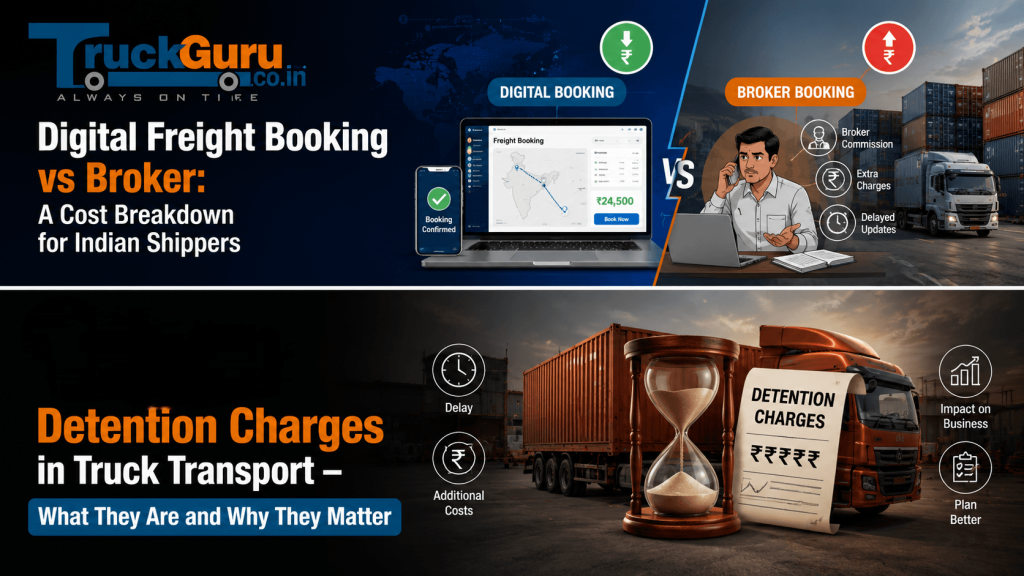
Digital Freight Booking vs Broker: A Cost Breakdown for Indian Shippers
Digital Freight Booking vs Broker: Quick Summary
Digital freight booking vs broker: compare costs, speed, and reliability for FTL shipments in India. Real numbers, no sales pitch.
Most businesses that ship goods between cities have used the same broker for years. Not because the broker is the best option, but because no one sat down and did the math. When you add up the markup, the phone time, the missed trucks, and the rate surprises on delivery day, the picture changes.
This article breaks down the actual cost difference between booking a truck through a traditional freight broker and using a digital freight platform. No sales pitch. Just numbers and a few things your operations team should know.
How Freight Brokers Work — and Where the Margin Goes
A freight broker connects your business to a truck owner or fleet. They earn a margin on every booking, typically 8 to 15 per cent of the trip cost on standard FTL routes. For longer corridors, some brokers charge a flat commission on top of variable fuel adjustments, which they pass through at their discretion.
The problem is not that brokers exist — they fill a real gap, especially for cargo types that need negotiation or in markets with poor truck availability. The problem is that their pricing is opaque. You call for a rate, they call a transporter, add their cut, and quote you back a number. You have no way to know what the base rate was. For a Delhi-to-Mumbai shipment in a 32ft container, a broker chain with two intermediaries can add 20 to 25 per cent to the trip fare.
For a business running 30 to 40 shipments a month, that gap adds up to lakhs per quarter.
What Digital Freight Booking Actually Costs
On a digital freight platform, you enter your origin, destination, and cargo weight. The platform matches you to available trucks and shows the rate upfront. What you see is what you pay.
Here is what a trip of about 500 km costs on TruckGuru by truck type, toll included. Rates are not fixed, so treat these as a guide:
| Truck | Load capacity | Indicative trip fare (about 500 km) |
| Tata Ace / Dost / Pickup | 750 kg – 1,100 kg | Rs.13,000 – Rs.14,500 |
| 14FT Eicher | 3.5 ton | Rs.15,500 – Rs.17,500 |
| 17FT Eicher | 5 ton | Rs.17,000 – Rs.18,500 |
| 19FT Eicher | 7 ton | Rs.18,500 – Rs.20,500 |
| 20FT Container | 6.5 ton | Rs.20,500 – Rs.22,500 |
| 32FT Container | 7-8 ton | Rs.27,500 – Rs.29,000 |
| 32FT Container | 16 ton | Rs.39,000 – Rs.42,500 |
| 32FT Container | 18 ton | Rs.42,500 – Rs.45,500 |
Indicative fares, checked October 2026. Freight rates move with route, vehicle type, cargo, date and availability. Confirm the current rate at booking.
Add a broker margin of 8 to 15 per cent to these fares and a 14FT trip of about 500 km goes up by roughly Rs.1,200 to Rs.2,600. With two brokers in the chain, the markup is higher.
Use the TruckGuru freight calculator to check live rates for your specific route before comparing any quote you have received.
Hidden Costs That Brokers Rarely Mention
Rate markup is the visible cost. The hidden costs are harder to calculate, but real.
Time cost. Getting three quotes from brokers for a single shipment takes 30 to 90 minutes of phone time, back-and-forth WhatsApp messages, and then a follow-up to confirm the truck actually shows up. For a dispatch team running multiple shipments a day, this compounds fast. A digital platform cuts that to under 10 minutes from inquiry to booking confirmation.
Cancellation risk. Brokers commit a truck verbally. If the rate changes or a higher-paying load comes in, the truck gets pulled with short notice. When that happens, one day before dispatch, your options are limited and expensive. Platform bookings carry confirmation records and create accountability that verbal broker commitments do not.
Rate inconsistency. The same broker can quote different prices on the same route on different days, depending on how busy they are or how desperate they think your timeline is. Digital platforms show a consistent rate based on live truck availability and route distance.
No paper trail. Broker transactions often run on informal receipts or WhatsApp confirmations. For businesses managing GST reconciliation and freight expense audit, this creates compliance headaches. Digital freight bookings generate proper documentation from the start.
When a Broker Still Makes Sense
To be fair about it: brokers are not always the wrong choice.
If you are shipping cargo that needs custom handling, oversized loads that fall outside standard FTL categories, or if you are on a route where digital platforms have limited truck availability, a broker with strong local relationships can be genuinely useful.
The same applies if your cargo requires negotiation around loading schedules that fall outside normal windows, or if you need a specific vehicle type that is not commonly listed on platforms.
However, for standard FTL shipments on high-frequency corridors like Delhi-Mumbai, Ahmedabad-Mumbai, or Chennai-Hyderabad, a digital platform will almost always deliver a better combination of price, transparency, and reliability.
For cargo types and corridor selection guidance, the TruckGuru truck type guide explains what each vehicle class handles and where it makes sense.
A Real-World Comparison: Delhi to Jaipur, 32ft Container (16T)
Delhi to Jaipur is roughly 280 km via NH-48. It is one of North India’s most active freight corridors, with regular truck availability in both directions.
Broker route:
- Call placed to the broker, rate given at Rs. 36,000 to Rs. 40,000
- Truck confirmation comes 4-6 hours later
- Actual billing on delivery: Rs. 39,500, including “fuel surcharge” added at dispatch
Platform route (TruckGuru):
- Route entered, 32ft container (16T) selected
- Indicative trip fare shown: Rs.21,800 – Rs.23,800 for about 280 km, toll included (checked October 2026). Rates are not fixed; confirm the live rate at booking.
- Booking confirmed in minutes, documentation generated immediately
Check the live rate for Delhi to Jaipur on the same day you get the broker quote. The gap between the two is the broker margin, and on a corridor you run twice a week it adds up every month.
To check your own corridor, visit the online truck booking page and enter your route details directly.
The Documentation and Compliance Angle
One area where digital freight booking has a clear edge is paperwork. SMEs and mid-market manufacturers managing GST-compliant freight expense accounts need proper tax invoices, LR (Lorry Receipt) documentation, and traceable payment records.
Broker transactions often lag on this, especially when the broker is a sole operator rather than a registered firm. Late or missing freight invoices create reconciliation problems at the month’s end.
A digital platform generates documentation from the point of booking. For businesses that have moved to a digital accounts payable process, this removes a friction point entirely.
For an understanding of how transportation services work end-to-end on a platform, including documentation and tracking, that page covers the process in detail.
Is Switching from Broker to Platform a Big Change?
Not really. The core freight operation stays the same — you still book a truck, load your goods, and track delivery. The difference is the booking channel and the pricing model.
Most businesses that switch to digital booking keep a broker relationship for edge cases or unusual cargo requirements. They move high-frequency standard shipments to the platform and use the broker only where the platform does not have coverage.
The transition takes one or two runs to get comfortable with the interface and documentation flow. After that, most logistics teams find it easier to manage than the phone-based broker model.
If your team is evaluating options, the TruckGuru mobile app is the fastest way to get a live rate comparison against any broker quote you have in hand.
Truck Size and Route Matching: Getting the Basics Right First
Before comparing broker vs platform pricing, the bigger cost lever is often the truck choice itself. An SME that consistently ships 4 tons in a 32ft container (built for 16 tons) is absorbing high deadweight cost on every run.
Getting the truck size right before any booking — broker or platform – is the first cost optimisation step. The truck size guide on TruckGuru walks through the load capacity and best-use case for every vehicle class, from the Tata Ace (750 kg – 1,100 kg) to the 32ft container at 18 ton.
Once the right truck is matched to the load, the cost comparison between booking channels becomes cleaner and more meaningful.
Frequently Asked Questions
Q1: How much does a freight broker typically add to the base truck rate in India?
Most brokers in the Indian FTL market add 8 to 15 per cent as their commission on top of the carrier rate. In markets where two brokers are in the chain, the combined markup can reach 20 to 25 per cent. On a Rs. 50,000 trip, that is Rs. 4,000 to Rs. 12,500 in intermediary cost alone.
Q2: Does a digital freight platform guarantee the truck will show up?
Platform bookings carry confirmation records, which create accountability that verbal broker commitments do not. On high-frequency corridors with strong truck availability, platform no-shows are rare. For time-critical shipments, booking 48 to 72 hours ahead of dispatch significantly reduces cancellation risk on any channel.
Q3: What is the minimum load for booking a full truck through TruckGuru?
TruckGuru offers FTL bookings starting from the Tata Ace (750 kg – 1,100 kg). There is no minimum cargo value requirement. The platform is designed for B2B freight, so it works best for manufacturers, distributors, and traders moving goods between cities, not for local or within-city deliveries.
Q4: Can I get a proper GST invoice through a digital freight platform?
Yes. Digital freight bookings generate proper documentation, including tax invoices and Lorry Receipts from the point of confirmation. This is one of the clearest operational advantages over informal broker arrangements, especially for businesses managing monthly GST reconciliation.
Q5: How are freight rates shown on a digital platform calculated?
Rates are based on route distance, truck type, and live truck availability. TruckGuru shows final trip cost ranges rather than per-km formulas, so you see what the run will cost before you commit. There are no hidden fuel surcharges added after dispatch. Rates are not fixed, so the fare can move between two bookings on the same lane.
Q6: Is digital freight booking suitable for first-time shippers with no transport relationship?
Yes, and this is one area where platforms have a specific advantage. A first-time shipper has no broker relationship to lean on and is at risk of overpaying significantly on informal markets. A platform with published rate ranges and a booking confirmation process removes the information gap that brokers typically exploit with new customers.
Q7: What truck types are available for FTL booking through TruckGuru?
TruckGuru books Tata Ace (750 kg – 1,100 kg), Bada Dost (up to 1.5 ton), 14ft Eicher (3.5 ton), 17ft and 19ft Eicher (5 and 7 ton), 20ft container (6.5 ton) and 32ft containers (7-8, 16 and 18 ton). All bookings are full truck loads for routes above 100 km. The platform does not cover local deliveries or vehicle transport.
Q8: How do I compare a broker quote against a platform rate?
Enter your route on the TruckGuru freight calculator, select the truck type that matches your load, and note the displayed rate range. Compare that directly to the broker quote you have received. If the broker quote is more than 10 per cent above the platform range, the difference is the margin, not a market rate variation.
Related Reading
- Reduce Manufacturing Freight Costs: India Intercity Guide
- Reduce B2B Freight Costs in India: 25 Proven Strategies
- Ship-To GSTIN Mandate August 2026 — What Shippers Must Do
For current rules and official notifications, see the Ministry of Road Transport & Highways.