

Truck Transport Rates in India: Per-Km Cost by State and Route
Truck Transport Charges: Quick Summary
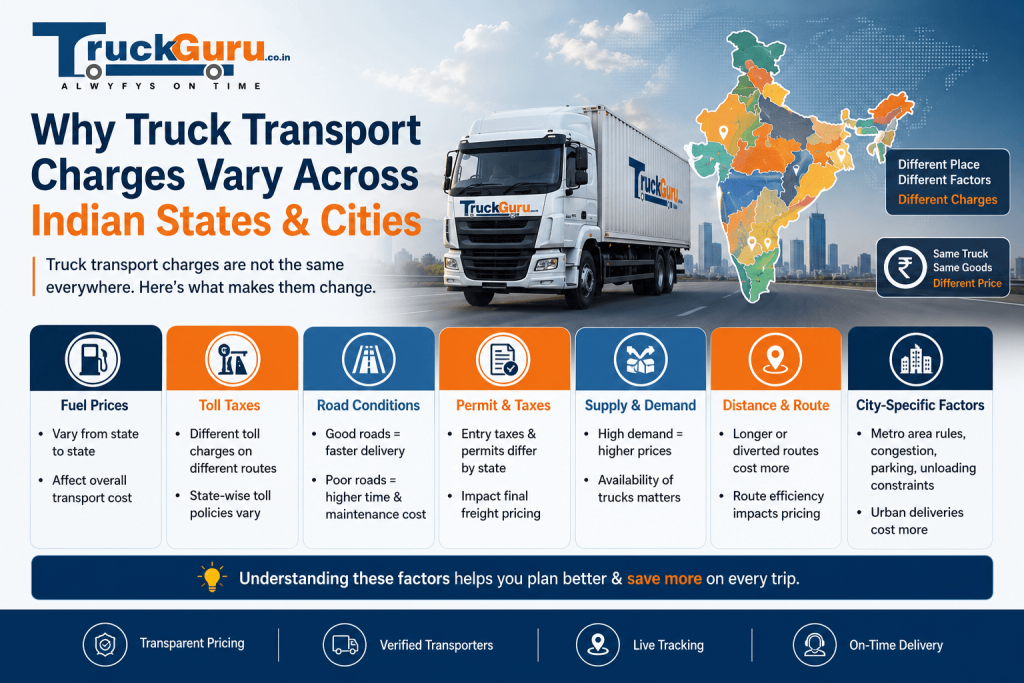
Truck Transport Charges: Fuel costs, toll rates, state taxes, truck size, and route distance all shape what you pay per km. Here is what drives each part of.
Trucks carry more than 60% of India’s freight by volume, making road transport the primary channel for B2B goods movement across the country. Yet truck transport rates per km in India are not a single number — they run from about Rs.26 per km for a Tata Ace to Rs.91 per km for an 18-ton 32ft container on TruckGuru’s October 2026 rate card, and they are not fixed. Understanding what drives that variation helps shippers budget accurately and choose routes that make commercial sense.
A recent NCAER report put India’s logistics cost at 7.97% of GDP in FY 2026-27 – a significant improvement from the 13-14% estimate that was widely cited for years. Lower logistics costs as a proportion of GDP signal that truck freight rates and transportation charges are coming down relative to economic output. But at the route level, the variation in transport charges per km between states remains substantial, and shippers booking without checking current rates often face invoice surprises. Use the freight calculator for live truck rates on your specific route before booking.
Truck Freight Rate Ranges in India by Vehicle Type
These are TruckGuru’s rate card ranges, toll included. Rates are not fixed: they move with route, cargo, date and truck availability, and short routes can price above the per-km range.
- Tata Ace / Dost / Pickup (750 kg – 1,100 kg): Rs.26-29 per km
- Closed body Ace / Dost / Pickup (up to 1.5 ton): Rs.26-29 per km
- 14FT Eicher (3.5 ton): Rs.31-35 per km
- 17FT Eicher (5 ton): Rs.34-37 per km
- 19FT Eicher (7 ton): Rs.37-41 per km
- 20FT Container (6.5 ton): Rs.41-45 per km
- 32FT Container (7-8 ton): Rs.55-58 per km
- 32FT Container (16 ton): Rs.78-85 per km
- 32FT Container (18 ton): Rs.85-91 per km
Indicative rates, checked October 2026. Freight rates move with route, vehicle type, cargo, date and availability. Confirm the current rate at booking.
The wide range within each category reflects route, distance, diesel price at booking, and return load availability. To see how these rates translate into a full trip cost, check the truck size guide and the freight calculator.
A real example: a 32FT 16-ton container from Delhi to Chennai (about 2,200 km) is indicatively Rs.1,71,600 – Rs.1,87,000 for the trip, toll included, against Rs.1,17,000 – Rs.1,27,500 from Delhi to Kolkata (about 1,500 km), checked October 2026. Distance does most of the work. Return-load availability on each lane moves the final rate, which is why rates are not fixed.
6 Factors That Drive Transport Charges Per Km Across India
1. Fuel Price Differences by State
Diesel is a state subject in India, meaning each state levies its own VAT on top of the central excise. Diesel in Delhi costs approximately Rs. 87.62 per litre, while in Thiruvananthapuram it is Rs. 96.13 — nearly Rs. 9 more per litre. A truck covering 1,500 km consumes roughly 200-250 litres of diesel. That Rs. 9 per litre difference adds Rs. 1,800-2,250 to the fuel cost on a long corridor running through high-tax states. These fuel price differences across states flow directly into truck transportation cost and ultimately into the per-km rate a shipper pays.
2. Toll and Permit Charges
State toll collection data illustrates the variation: Uttar Pradesh collected Rs. 7,060 crore and Maharashtra Rs. 5,115 crore in toll revenues in recent years. A truck crossing multiple states on a Delhi-to-Chennai run passes through at least four toll corridors. Interstate trucking cost differences in India are substantially determined by which states a route crosses and how many toll plazas sit on that specific highway. The FASTag system has removed cash queuing at booths, which saves time, but the toll charges themselves remain route-specific.
3. Terrain and Road Conditions
Moving freight through the hills of Himachal Pradesh or Uttarakhand costs 20-25% more than equivalent distances across the plains of Punjab or Haryana. Mountain gradients increase fuel consumption significantly — trucks climbing at 15-20 km/h versus highway cruising at 55-65 km/h. Bad road surfaces with potholes force lower speeds and add wear on tyres and suspension. States with well-maintained highways, like Gujarat on NH-48, help trucks maintain speed and fuel efficiency. This is why truck freight rates on the Ahmedabad-Mumbai corridor are structurally lower per km than on comparable distances in hill states.
4. Traffic and Congestion
Mumbai, Delhi, and Bangalore impose time-of-day entry restrictions on heavy vehicles, meaning trucks either wait outside city limits burning fuel or take longer alternative routes. A truck that averages 5 km per litre on an open highway drops to 2-3 km per litre in stop-start urban traffic. This is why transport charges per km are structurally higher for metro delivery points compared to industrial zones with direct highway access. Sending goods from Mumbai to Pune (150 km) often costs more per km than Ahmedabad to Rajkot (215 km) for exactly this reason — NH-48 Pune entry delays versus smooth highway between Gujarat cities.
5. Driver Wages and Operational Costs
Driver wages vary by region and route type. Drivers on Delhi-Chennai or Delhi-Mumbai corridors command Rs. 25,000-35,000 per month due to the skill requirement, time away from base, and road conditions. Regional drivers on shorter corridors in smaller states earn Rs. 15,000-20,000. Driver costs are factored into the per-km truck transport rates by operators, which is why long-distance interstate routes have different base rates than medium-distance regional runs.
6. Return Load Availability
One of the less visible factors in truck fare calculation is whether trucks return loaded or empty. On corridors with strong bidirectional freight — like Ahmedabad-Mumbai or Delhi-Bangalore — operators can charge less on each leg because the truck earns revenue in both directions. On routes with weak return cargo, like many Northeast India or interior corridors, the operator effectively needs to recover the full round-trip cost from the outbound consignment. This demand-supply factor can add 15-25% to per-km transport charges on one-directional freight corridors.
State-Wise Transport Cost Differences
Why Gujarat Routes Cost Less
Gujarat has one of India’s better-maintained highway networks, particularly on NH-48 linking Ahmedabad to Mumbai and the Vadodara-Surat-Mumbai corridor. Smooth road surfaces allow trucks to maintain speed and fuel efficiency. Gujarat’s diesel prices are also historically moderate. Combined, these factors keep truck freight rates on Gujarat-origin and Gujarat-destination routes structurally lower per km than comparable distances through states with worse road quality.
Why Tamil Nadu and Maharashtra Cost More
Tamil Nadu and Maharashtra have high concentrations of toll plazas on national highways. Diesel prices in Tamil Nadu are among the higher state averages. Both states have significant truck entry restrictions around Chennai and Mumbai that add waiting time and fuel cost. Routes through Maharashtra also include the Western Ghats section (Mumbai-Pune, Mumbai-Goa, Mumbai-Bangalore) where gradient adds significant fuel cost.
Northeast India
The Guwahati-Kolkata corridor on NH-27 represents a structurally different cost category. Poor road conditions in parts of Meghalaya, Assam’s flood-prone stretches, and limited return cargo from Northeast India back to mainland push truck transport rates per km on this corridor above national averages. The freight that does move — tea, agri-products, construction materials — is high-value or bulk, making FTL booking the practical model even for smaller consignments.
Government Policies Reducing Transport Charges
GST and E-Way Bills
Before GST, trucks could wait hours at state border checkposts for paperwork clearance. The e-way bill system under GST removed most of these stops. Trucks that previously spent 30-40% of their time at checkposts now move faster, reducing driver time, fuel cost, and delivery timelines. This is a significant structural reduction in truck transportation cost that the 7.97% GDP logistics cost figure partially reflects.
FASTag
FASTag removed cash collection queues at toll booths. A truck that previously stopped for 10-15 minutes at each toll plaza now passes through in seconds. On a Delhi-Chennai run with 15+ toll plazas, this saves 2-4 hours of idling time and the associated fuel cost.
Bharatmala Pariyojana
By December 2024, 19,201 km of projects have been built under Bharatmala, creating dedicated freight corridors between major industrial clusters. Better roads mean faster speeds, lower fuel consumption, and lower truck transport rates over time. The programme’s target is reducing logistics costs from the old 14-18% of GDP estimate to 8% by 2030.
How to Calculate Your Actual Truck Freight Rate
The full truck transportation cost for any shipment consists of:
- Distance of the route actually driven
- Truck type and load capacity
- Cargo type and loading point
- Pickup date and truck availability on the lane
- Toll, which TruckGuru includes in the trip fare
Rather than estimating from industry averages, use TruckGuru’s freight calculator for a confirmed truck fare on your specific pickup and delivery cities. The transportation cost calculator shows the full per-trip rate — not just the per-km component — based on current diesel prices, the actual distance for your route, and truck type. The rate shown before booking is the rate on your invoice.
For a full comparison of FTL vs LTL freight models and when each makes economic sense, see: FTL vs LTL freight in India. For background on how the logistics market is structured, see: What is a logistics company?
FAQs — Truck Freight Rates in India
What is the truck transport rate per km in India?
On TruckGuru’s October 2026 rate card, a Tata Ace runs Rs.26-29 per km, a 14FT Eicher Rs.31-35, a 20FT container Rs.41-45 and a 32FT container Rs.55-91 depending on tonnage, toll included. Rates are not fixed; they move with route, cargo, date and availability. Use the freight calculator for the live rate on your corridor.freight calculator for the actual rate on your specific corridor.
Why do truck freight rates differ between states?
Diesel prices vary by Rs. 8-10 per litre across states. Toll collection and permit fees differ significantly — Uttar Pradesh and Maharashtra are among the highest. Road quality affects fuel efficiency and, therefore, cost. Return load availability on a corridor affects outbound rates. All these factors combine to produce the state-wise transport charge differences shippers experience.
Why are transport charges higher for metro cities?
Metro cities impose truck entry restrictions that force waiting time and fuel burn. Traffic congestion reduces fuel efficiency from 5 km/litre on highways to 2-3 km/litre in stop-start conditions. Parking and loading zone costs in metros are substantially higher than at industrial zones with direct highway access.
How are truck transport charges calculated?
The trip fare depends on distance, truck type, cargo, date and truck availability on the lane. On TruckGuru, toll is included in the trip fare. Rates are not fixed, so check the live rate for your route on the transportation cost calculator rather than estimating from averages.
How do I get the current truck fare for my route?
Check the freight calculator for a live rate on your pickup city, destination, and truck type. Current diesel prices, actual route distance, and truck type are all factored in. The rate shown is the confirmed truck fare — not an estimate subject to revision at delivery.
Has GST reduced transport costs in India?
Yes, measurably. The NCAER 2023-24 report puts India’s logistics cost at 7.97% of GDP — down from the widely cited 13-14% estimate. GST removed most checkpost stops through the e-way bill system, FASTag cut toll waiting time, and Bharatmala improved freight corridor quality. The structural reduction is real, though state-wise differences in fuel prices and toll density persist.
For confirmed truck transport rates on any corridor in India, use the freight calculator. Or book a truck online with a rate locked before dispatch, or call 72020 45678.
Related Reading
- How to Estimate Goods Transport Rates: A Beginner’s Guide
- How Are Truck Transportation Charges Calculated in India?
- 6 Truck Booking Platforms Compared for FTL Freight in India: FR8, WheelsEye, Trukky, BlackBuck, Vahak & TruckGuru
For current rules and official notifications, see the Ministry of Road Transport & Highways.