

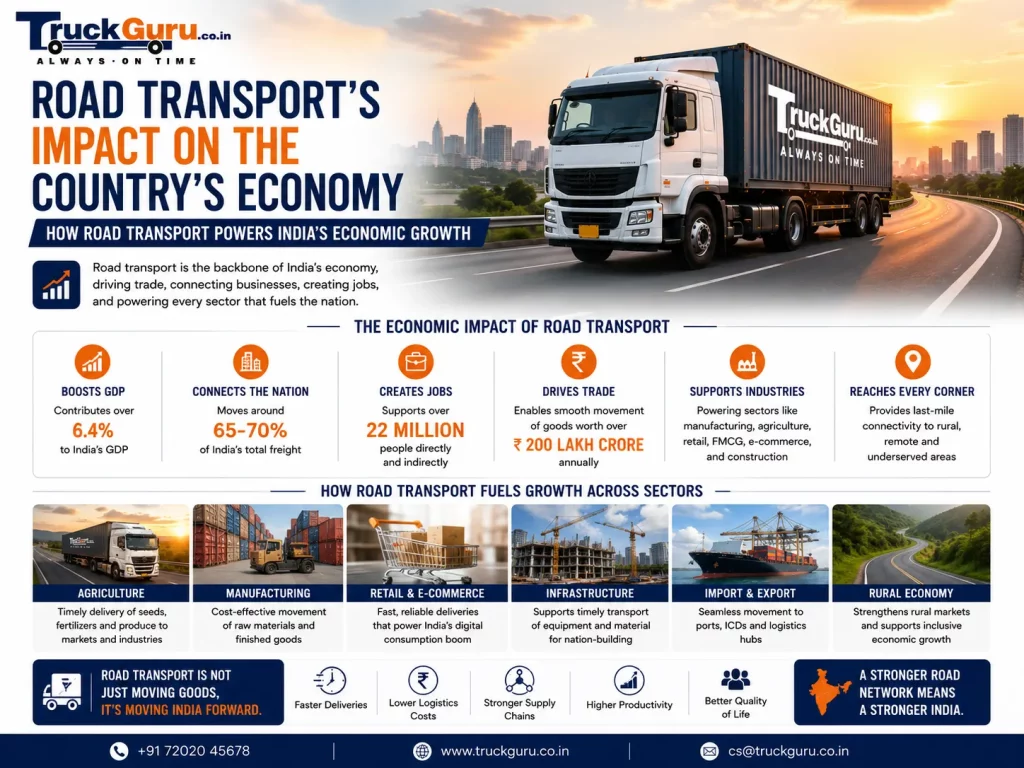
How Road Transport Powers India’s Economic Growth
Road transport is the layer of infrastructure most people only notice when it fails — a blocked highway, a delayed delivery, a price spike traced back to a transport bottleneck. The rest of the time, it operates quietly underneath nearly every other part of the economy: moving raw materials into factories, finished goods out to markets, and people to the jobs and schools that depend on actually being reachable.
Transport Powers India's Economic: Quick Summary
Transport Powers India's Economic: Discover how road transport drives India’s economic growth by boosting GDP, agriculture, industry & education. Explore key.
How Transport Infrastructure Supports Economic Growth
A well-developed road network lowers the operational cost of moving raw materials to manufacturers and finished products to end customers, which is one of the more direct ways transport infrastructure shows up in a country’s growth figures. It also has effects that are easy to overlook: workers reaching jobs safely and on time, better access to education and healthcare in areas that used to be effectively cut off, and villages connected to cities in a way that lets farmers and small businesses reach markets beyond their immediate area.
None of these effects works in isolation — a road network that cuts transport time also tends to attract the kind of business investment that depends on being able to move goods predictably.
The Impact of Transportation on Agriculture in India
Farming remains a substantial part of India’s economy even as the country urbanises and industrialises elsewhere. Transport infrastructure affects this sector in fairly specific ways: farming equipment and materials arrive on time, perishable goods spoil less because they reach markets faster, and farmers gain access to larger markets rather than being limited to whatever local buyers are willing to pay. Better roads do not guarantee a farmer a better price, but they remove one of the structural constraints that prevent finding one.
Transportation and Industrial Growth
Factories and service businesses depend on road transport for the same reason agriculture does — raw materials need to arrive, and finished goods need to leave, on a schedule the business can actually plan around. For categories like food, medicine, and fresh produce specifically, road transport tends to be the practical choice because it is faster to arrange and more flexible than rail or air for the distances most domestic shipments actually cover.
Road transport offers a few structural advantages that other modes do not: it reaches pickup and delivery points directly rather than requiring transfer at a fixed terminal, it requires far less upfront capital investment than rail or air infrastructure, and it remains the only practical option for a large share of rural and underserved regions that rail lines and airports simply never reached.
The Effect of Transport on Education Access in Rural Areas
Road connectivity has a less obvious but genuinely significant effect on education. In villages without reliable roads, children — particularly girls and those from lower-income families — are more likely to be kept home rather than sent on a long or unsafe commute. Better rural road connectivity tends to show up as higher enrollment, lower dropout rates, and schools able to attract qualified teachers who would otherwise be unwilling to make the commute themselves. Road transport, in this context, is not just a way to move goods — it is part of what determines who gets meaningful access to an education in the first place.
Why Road Transport Has Specific Advantages Over Other Modes
- Direct delivery without a fixed-terminal transfer: useful for e-commerce and perishable goods specifically, since both benefit from minimising handling steps between origin and destination.
- Reach into areas without rail or air access: most remote regions in India are accessible by road and nothing else.
- Scheduling flexibility: road transport is not bound to a fixed train or flight timetable, which matters when a shipment needs to move outside standard scheduled windows.
- A better fit for shorter distances: for intra-city or inter-town movement specifically, road transport is generally faster and more economical than arranging rail or air for the same short hop.
How Transport Boosts GDP and Productivity
Spending on road infrastructure tends to return more than its direct cost, because the gains show up indirectly — less time lost in transit, lower operating costs for businesses that depend on moving goods, and more areas genuinely reachable for trade. Better roads do not just move goods faster; they expand how many customers, suppliers, and job opportunities are actually within reach for a given business or household.
Where TruckGuru Fits Into This Picture
Within this much larger transport and infrastructure story, TruckGuru’s actual role is narrower and worth stating plainly: it books confirmed-rate FTL truck transport between Indian cities, not a comprehensive logistics or warehousing service. The rate for a route and truck size comes from a published rate card rather than a customised negotiation — consistent for every customer, not adjusted business to business.
Within that specific scope, TruckGuru covers intercity routes across major Indian cities with GPS tracking through the trip, digital LR and GST invoice generation after delivery, and a fleet running from a Tata Ace through a 32ft container depending on shipment size. This is intercity transport specifically — not local or last-mile delivery, which falls outside what TruckGuru offers, even though it is a genuine advantage of road transport as a mode more broadly.
Check a confirmed rate for your route on the freight calculator.
Closing Thoughts
Road transport’s contribution to economic growth runs through several different channels at once — agriculture, industry, education access, and GDP all depend on it in ways that are easy to take for granted until the infrastructure fails to keep up. For a business that depends specifically on moving freight between cities, the practical version of this larger story is simpler: a transport partner with a confirmed rate, real tracking, and digital documentation removes the uncertainty that used to sit between booking a shipment and actually knowing it would arrive as planned.
Frequently Asked Questions
How does road transport contribute to India’s economic growth?
It lowers the cost of moving raw materials and finished goods, connects rural areas to markets and education, and supports industrial growth by giving businesses a predictable way to move freight. Road transport investment tends to return more than its direct cost through these indirect effects.
Why is road transport better than rail or air for short distances?
It delivers directly between origin and destination without a fixed-terminal transfer, and it does not require the upfront capital investment that rail or air infrastructure does. For intra-city or inter-town distances specifically, this generally makes it faster and more economical.
Does TruckGuru offer local or last-mile delivery?
No. TruckGuru books intercity FTL transport between cities — routes above 100 km. Local or last-mile delivery within a city is a genuine advantage of road transport as a mode, but it is not part of what TruckGuru specifically offers.
Is TruckGuru a full logistics and warehousing provider?
No. TruckGuru books FTL truck transport with a confirmed rate, GPS tracking, and digital documentation. It does not manage warehousing or a business’s broader supply chain.
Call 72020 45678 or book online at truckguru.co.in for a confirmed rate on your next shipment.
Related Reading
- Reduce Manufacturing Freight Costs: India Intercity Guide
- Reduce B2B Freight Costs in India: 25 Proven Strategies
- Ship-To GSTIN Mandate August 2026 — What Shippers Must Do
For current rules and official notifications, see the Ministry of Road Transport & Highways.