

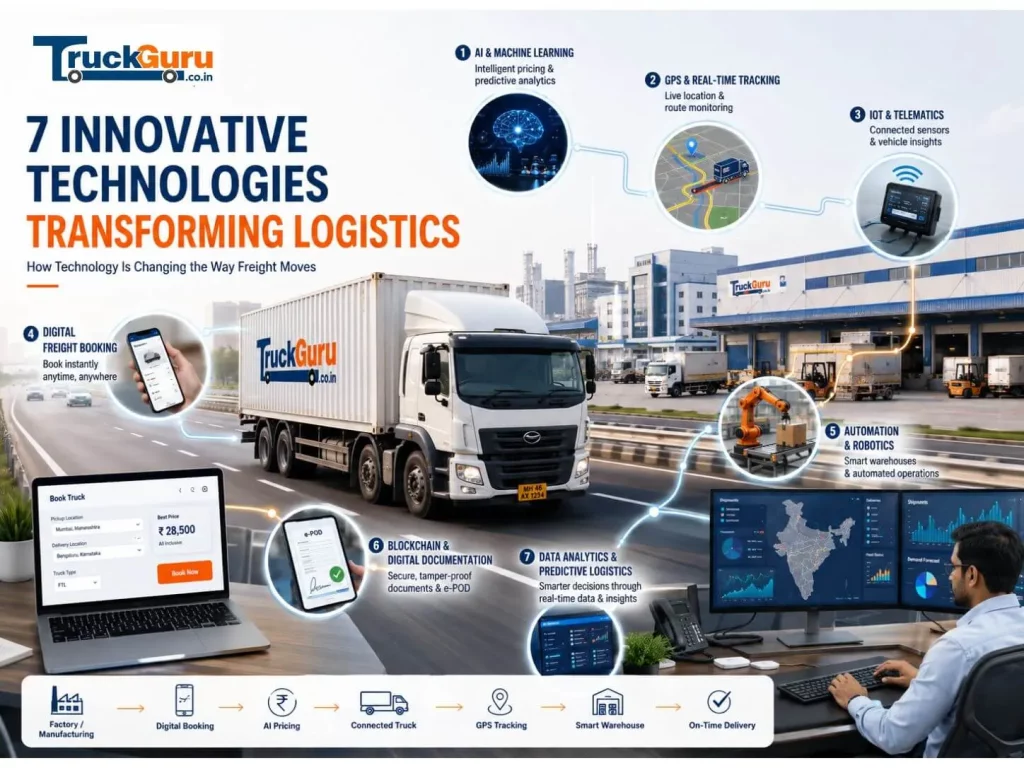
7 Innovative Technologies That Are Transforming The Logistics Industry
For most of that movement, booking depended on phone calls to brokers and verbal rate quotes. Lorry Receipts were handwritten and tracking meant calling the driver.
Logistics Technology: Quick Summary
Logistics technology in India: how TMS, GPS tracking, digital freight booking, e-way bill integration, AI and IoT are changing FTL transport for shippers.
Technology has changed specific parts of that process — not uniformly, but enough to matter. B2B businesses now have access to freight services that would have required significant scale a decade ago.
1. Transportation Management Systems (TMS)
A Transportation Management System is software that manages the planning, execution, and tracking of freight movements. For a logistics operator, a TMS handles route planning, load assignment, driver scheduling, freight billing, and carrier performance data. For a shipper, a TMS provides a centralised view of freight spend, delivery performance, and documentation across all carriers and routes.
In India, TMS adoption has accelerated significantly in the past five years among larger FMCG, pharma, and manufacturing companies. A company running 200 truck movements a month across 15 corridors cannot manage carrier selection, rate comparison, documentation, and tracking manually without significant administrative overhead. A TMS centralises these functions, reduces manual data entry errors, and provides the reporting that finance and operations teams need for cost visibility.
Cloud-based TMS platforms have made this technology accessible to mid-size businesses that cannot justify large upfront software investments. Pay-per-use SaaS models mean a distributor shipping 30 trucks a month can access route optimisation and freight analytics that previously only large manufacturers could afford.
2. GPS Tracking and Real-Time Shipment Visibility
What has changed is integration. GPS data is now fed into booking platforms, making live truck location accessible to the shipper without separate hardware or a call to the driver.
For B2B shippers, the operational benefit is specific. A warehouse team in Bangalore receiving a consignment from Mumbai does not need to call the driver at 11 PM to estimate arrival time. They check the tracking link, see the truck is 4 hours out, and schedule dock availability accordingly. A pharma company receiving temperature-sensitive cargo can see if a truck is delayed and adjust receiving preparation. An auto component plant coordinating production around incoming parts can adjust schedules based on actual vehicle position.
The accuracy of GPS tracking has improved substantially as cellular network coverage has expanded across India’s National Highway corridors. NH-48 (Delhi-Mumbai), NH-44 (Delhi-Bangalore and Chennai), and NH-16 (Kolkata-Chennai) all have good coverage. Remote state highway sections and ghat routes still have gaps, but coverage on the primary intercity corridors used for most B2B freight is reliable.
3. Digital Freight Booking Platforms
The shift from broker-based freight sourcing to digital booking platforms is the most significant technology change affecting B2B shippers directly. The difference is not just convenience — it changes the information available at the point of decision and the certainty of the rate confirmed.
A broker gives a verbal quote based on what they know about current market conditions and their own margin requirements. That quote may change at invoice. A digital freight platform calculates the rate based on route distance, truck type, and truck availability on the booking date. The rate at booking confirmation is the rate on the invoice.
Every booking on TruckGuru generates a digital LR at dispatch and a GST invoice after delivery. E-way bill support is included for consignments above Rs. 50,000 crossing state borders.
4. E-Way Bill Integration
The GST e-way bill system, introduced in 2018, requires an electronic permit for goods worth more than Rs. 50,000 being transported across state borders. The e-way bill must be generated on the GST portal before the goods are loaded and must accompany the consignment throughout transit.
API integration between a company’s ERP and the GST e-way bill portal automates this. The e-way bill is generated when the shipment is booked, without manual re-entry.
Freight booking platforms with e-way bill support reduce this friction further. They prompt shippers to generate the document as part of the booking flow, not as a separate compliance step.
5. Mobile Applications for Freight Booking and Tracking
For shippers, a freight booking app allows bookings, tracking updates, and document access from a phone. This is useful for operations managers who are not always at a desk.
In India’s B2B freight context, driver apps have had a significant impact on documentation accuracy. When a driver completes a delivery and the receiver confirms on the app, that confirmation is timestamped and stored. The digital proof of delivery removes the ambiguity that arises when a handwritten delivery receipt is lost or disputed weeks later.
For shippers, app-based tracking means the freight status is accessible without logging into a desktop system. An operations manager can check the status of five active shipments in 30 seconds from a phone while on-site at a factory or warehouse. This is particularly useful for businesses running high-frequency short-corridor freight where multiple trucks may be active simultaneously.
6. Artificial Intelligence in Route Optimisation
Route optimisation uses historical traffic data, road condition inputs, and delivery windows to recommend the most efficient route. It balances distance, fuel consumption, toll costs, and transit time for each movement.
For a fleet operator managing 50 trucks daily, AI-assisted route planning reduces fuel spend and improves on-time delivery. No human dispatcher needs to manually calculate optimal routes for each movement.
Demand forecasting AI helps logistics companies anticipate freight volume changes. It predicts when Q4 demand spikes will require additional capacity, or when a product launch will create a surge on a specific corridor.
7. IoT and Smart Freight Monitoring
IoT in freight uses connected sensors that transmit data about cargo and vehicle condition during transit.
A temperature logger in a pharma consignment records and transmits data throughout a 20-hour transit. It provides documented evidence that cold chain requirements were maintained — or flags a breach in real time before goods are compromised.
Vehicle telematics monitor engine condition, fuel consumption, tyre pressure, and driver behaviour. Fleet operators use them to reduce breakdown risk on long corridors and manage fuel costs.
How TruckGuru Uses This Logistics Technology
TruckGuru is an FTL intercity truck booking platform for B2B shippers, operating from Vadodara, Gujarat across 110+ cities in India. The platform incorporates several of the technologies discussed in this article:
- Freight calculator: Confirmed per-km rate shown before booking — the same figure that appears on your invoice after delivery.
- GPS tracking: Accessible through the TruckGuru mobile app on Android and iOS from dispatch through delivery.
- Digital LR: Generated at dispatch and stored on the platform as proof of handover.
- GST invoice: Generated automatically after delivery confirmation with full tax breakup for input tax credit.
- E-way bill support: Integrated into the booking flow for consignments above Rs. 50,000 crossing state borders.
The platform covers Tata Ace (750 kg) through 32ft container (7/8T, 16T, or 18T) across 110+ cities.
To check freight rates on a specific corridor, use the freight calculator or call 72020 45678.
Logistics Technology: Where Indian Shippers Should Start
Logistics technology does not need to arrive all at once. For most mid-sized shippers moving full truck loads, the order that works is simple: digital booking first, tracking second, and planning tools third.
Digital booking replaces phone calls to brokers with a confirmed quote, a confirmed vehicle and a clear record of every load. Tracking then gives dispatch and sales the same view of where the truck is. Once those two pieces are stable, logistics technology such as a TMS or route planning software has clean data to work with.
- Start with the logistics technology that removes the most phone calls and follow-ups.
- Choose tools that fit your e-way bill and invoicing process.
- Review results after a quarter of real loads before adding the next layer.
Budget matters too. Logistics technology that needs a long setup, custom integration or new hardware makes sense only when your volumes justify it. For many shippers, the practical step is to standardise how loads are booked, documented and tracked, and then judge any new logistics technology by how many manual steps it removes each week. If a tool does not reduce calls, spreadsheets or delays, it is not the right logistics technology for your business yet.
TruckGuru handles the first step for intercity FTL: book the truck online at a confirmed rate, with tolls included.
Key Takeaways
- India moves 70% of its freight by road, and technology is changing how that freight is booked, tracked, and documented
- TMS platforms have made freight analytics accessible to mid-size distributors and manufacturers via cloud SaaS models
- GPS tracking integration into booking platforms gives shippers live visibility without separate hardware
- Digital freight booking platforms deliver confirmed rates and automated documentation that broker-based booking cannot
- E-way bill API integration reduces compliance risk for businesses with high shipment frequency
- AI route optimisation reduces fuel costs and improves on-time delivery for high-volume fleet operators
- IoT freight monitoring is becoming a compliance requirement for pharma cold chain, not just an optional enhancement
- Adopt logistics technology in stages, and measure each piece of logistics technology against real loads.
FAQ
What is a Transportation Management System and who needs one?
Businesses running 30 to 50 truck movements a month across multiple corridors typically find a TMS pays for itself. It reduces administrative overhead, improves carrier visibility, and delivers freight cost analytics.
How does GPS tracking work for intercity freight in India?
GPS devices fitted to trucks transmit location data to servers via cellular networks. That data is accessible through a platform interface or mobile app. Coverage on India’s primary National Highway corridors is generally reliable. GPS tracking accuracy is typically within a few hundred metres, with location updates every 30 to 60 seconds on most systems.
What is an e-way bill and when is it required?
An e-way bill is a mandatory electronic permit required under GST for goods worth more than Rs. 50,000 being transported across state borders. It must be generated on the GST e-way bill portal before the goods are loaded. Trucks found without a valid e-way bill at state checkposts face penalties. Businesses with high shipment frequency can automate e-way bill generation through API integration with the GST portal.
How does AI help in logistics route optimisation?
AI route optimisation systems analyse multiple variables simultaneously: distance, traffic patterns, toll costs, and delivery windows. They recommend the optimal route for each specific movement.
What is IoT monitoring in freight and when does it matter?
It is most relevant for pharma cold chain, high-value electronics, and perishable food. Real-time monitoring allows intervention before damage occurs, not after.
For intercity FTL freight across India, check rates on the TruckGuru freight calculator or call 72020 45678.
Which logistics technology should a small shipper adopt first?
Start with online truck booking. It is the logistics technology with the quickest payoff for FTL shippers because it cuts broker calls and gives you a confirmed rate. Add tracking and planning logistics technology once your booking data is consistent. That order keeps each logistics technology investment tied to real loads.
Related Reading
- How to Estimate Goods Transport Rates: A Beginner’s Guide
- How Are Truck Transportation Charges Calculated in India?
- 6 Truck Booking Platforms Compared for FTL Freight in India: FR8, WheelsEye, Trukky, BlackBuck, Vahak & TruckGuru
For current rules and official notifications, see the Ministry of Road Transport & Highways.