

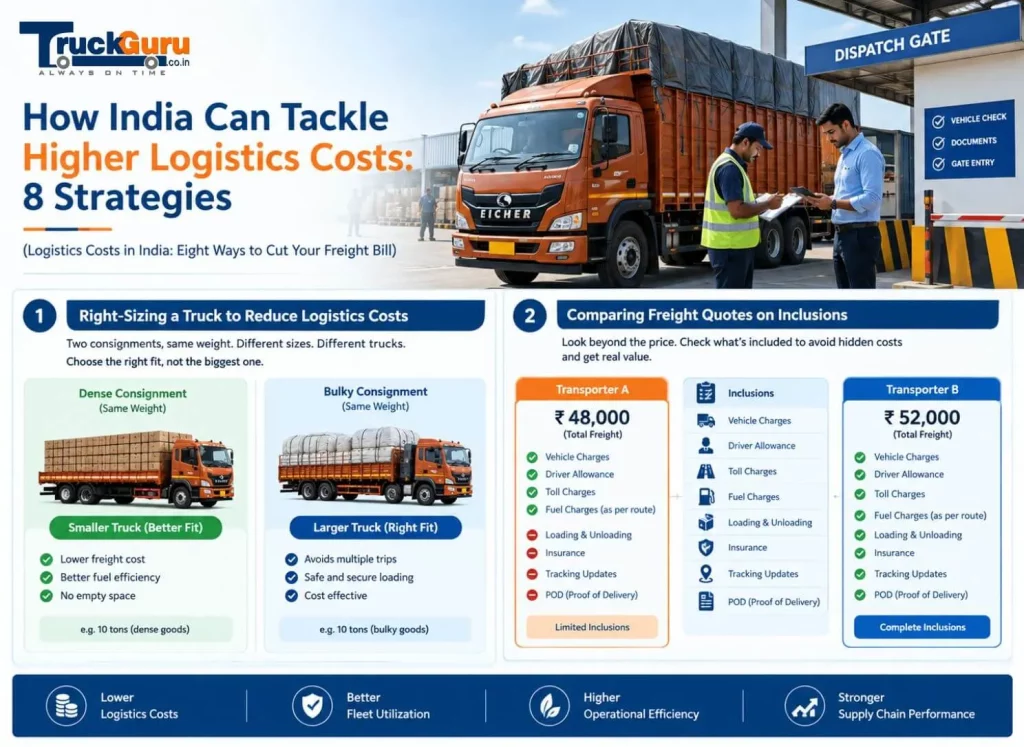
Logistics Costs in India: Eight Ways to Cut Your Freight Bill
Most articles on logistics costs in India explain what the country should do about infrastructure and policy. Useful for a policy conference, useless on a Tuesday when you are booking a truck.
Logistics Costs in India: Quick Summary
Logistics costs in India are mostly decided by choices you control. Eight practical ways to cut your freight bill without squeezing your transporter.
These are eight things a shipper actually controls. None require negotiating harder, and none work by squeezing your transporter, which tends to cost more than it saves.
1. Right-size the vehicle
The largest single lever, and the one most often got wrong.
Every truck has two limits: registered load capacity and deck space. Your cargo hits one first. Dense goods such as tiles, castings, chemicals in drums and bagged material reach the weight ceiling with the body part empty. Bulky goods such as textiles, packaging and moulded plastics fill the deck at a fraction of the tonnage.
Calculate both numbers for the packed consignment, weight in kilograms and volume in cubic feet, and book against whichever you reach first. Booking on tonnage alone is how a business pays for a 19ft vehicle that leaves half full, or pays twice because a 14ft could not take the load.
2. Consolidate into fewer, fuller trucks
Two half-full vehicles on the same corridor in the same week cost considerably more than one full one. The saving is not proportional, because a large part of a freight rate is the vehicle placement rather than the distance.
This usually means holding a consignment two or three days to combine it with the next. Whether that trade works depends on your buffer stock at the receiving end, which is a decision worth making deliberately rather than by default.
3. Compare quotes on inclusions, not the headline rate
The most common reason a freight bill exceeds the quote, and the easiest to fix.
- Is toll inside the rate or billed at actuals?
- Is loading and unloading labour included, and at which end?
- What is the detention-free period, and the rate after it?
- Is the vehicle specification stated: body length and registered load capacity?
A cheaper headline rate with three exclusions is not cheaper. Two quotes only become comparable once you know what each covers.
4. Cut detention by loading faster
Detention charges start after a free period, and they are pure loss because nothing moves while they accrue.
Have the consignment packed and staged before the vehicle arrives. Have labour arranged rather than called for. Know your loading window and hold to it. Beyond avoiding the charge itself, operators price shippers who load quickly more keenly over time, because a truck that turns around fast is worth more to them.
5. Choose corridors where return loads exist
Empty running is the highest cost in operator economics, and it is priced into what you pay. A route where the transporter can find freight for the return leg carries a lower rate than one where the vehicle comes back empty.
You cannot always choose your destination, but you can ask. On routes where return loads are scarce, ask directly whether consolidating your shipments to fewer, larger movements would improve the rate. It frequently does, because it changes the operator arithmetic.
6. Book with notice
A booking placed three days out costs less than the same booking placed that morning, particularly when capacity is tight. Quarter-end weeks and festival periods are predictable, and spot rates in those windows reflect scarcity rather than distance.
Plan dispatches around the last week of March, June, September and December if you can move them at all. If you cannot, book earlier for those weeks specifically.
7. Make freight GST recoverable
For a GST-registered business, freight GST is generally recoverable as input tax credit subject to the applicable conditions and your own eligibility. That only works if the movement is properly invoiced.
Cash freight produces no invoice and therefore no recovery. If you are booking informally to save on the headline rate, check what the unrecovered tax costs you before deciding you saved anything. Confirm your position with your accountant, since treatment depends on the contracting and invoicing structure.
8. Reduce damage through packaging and paperwork
Damage is a freight cost that never appears on a freight invoice, and for most shippers it is larger than the rate difference they spend time negotiating.
Two things do most of the work. Packaging that survives the actual road conditions on your route, not ideal conditions. And documentation discipline: the consignment note completed correctly at loading, with package count, declared value and condition of goods checked at the gate, and any damage recorded on the proof of delivery at receipt rather than reported two days later. Damage you cannot document is damage you absorb.
What is Actually Driving Logistics Costs in India
Worth being clear about where the cost sits, because it is not mainly in the truck rate.
Indian road freight rates per kilometre are not high by international standards. What is expensive is everything around the movement: inventory held because transit is uncertain, damage in handling, delays at gates and checkpoints, and capital tied up while goods sit. Structural reforms including GST, the e-way bill system, FASTag and improved highways have reduced part of that.
For official sector data rather than the figures that circulate on logistics blogs, the Ministry of Road Transport and Highways publishes the source material.
The practical consequence for a shipper: pushing your transporter for a lower rate addresses the smallest part of your cost. The eight items above address the rest.
Where TruckGuru Fits
TruckGuru provides full truckload intercity transportation across 110+ cities in India, with upfront freight pricing and the vehicle type, route and rate stated before loading. Toll is included in the quoted fare rather than added at delivery, which removes one of the exclusions that makes quotes hard to compare. Dispatched bookings carry live GPS tracking, and digital documentation includes the LR and delivery records, with GST invoicing applied where relevant. Check a corridor rate on the freight calculator or book a truck online.
For sizing the vehicle against your cargo, see truck sizes in India. For getting better service as a smaller shipper, see MSME logistics.
Key Takeaways
- Right-sizing the vehicle against both weight and cubic feet is the largest single lever on freight cost.
- Fewer, fuller trucks beat more half-empty ones, because placement is a large part of the rate.
- Compare quotes on toll, labour, detention and vehicle specification, not the headline number.
- Detention is pure loss. Fast loading avoids the charge and earns better pricing over time.
- Corridors with return loads price lower. Ask about it.
- Damage and unrecovered GST are freight costs that never appear on a freight invoice.
Frequently Asked Questions
How can I reduce logistics costs in India?
Right-size the vehicle against weight and volume, consolidate into fuller trucks, compare quotes on inclusions rather than headline rate, load quickly to avoid detention, book with notice, keep freight GST recoverable through proper invoicing, and reduce damage through packaging and documentation.
Why are logistics costs in India considered high?
Not mainly because truck rates are high. Rates per kilometre are competitive. The cost sits in inventory held against uncertain transit, damage in handling, delays, and capital tied up while goods sit. Structural changes including GST, e-way bills and FASTag have reduced part of it.
Does negotiating a lower freight rate save much?
Less than most shippers expect. The rate is the visible cost but rarely the largest one. Right-sizing, detention and damage usually move your total more than a rate negotiation does, and squeezing an operator often costs you priority when capacity tightens.
What is detention in freight?
Charges that apply when a vehicle waits at loading or delivery beyond an agreed free period. Agree the free period and the rate after it before booking rather than during a wait.
Is it cheaper to send two small trucks or one large one?
Usually one larger vehicle, because a significant part of a freight rate covers placing the vehicle rather than the distance travelled. The trade-off is holding the consignment to consolidate, which depends on your buffer stock at the receiving end.
Can I claim GST paid on freight?
A GST-registered business can generally recover freight GST as input tax credit subject to the applicable conditions and its own eligibility, provided the movement is properly invoiced. Confirm your position with your accountant, since treatment depends on the contracting and invoicing structure.
The Short Version
Your freight bill is mostly decided before you ask for a rate. Measure the consignment properly, load fast, book early, and make sure the paperwork lets you claim what you are entitled to. That moves more money than any negotiation will.
Related Reading
- How to Estimate Goods Transport Rates: A Beginner’s Guide
- How Are Truck Transportation Charges Calculated in India?
- 6 Truck Booking Platforms Compared for FTL Freight in India: FR8, WheelsEye, Trukky, BlackBuck, Vahak & TruckGuru
For current rules and official notifications, see the Ministry of Road Transport & Highways.