

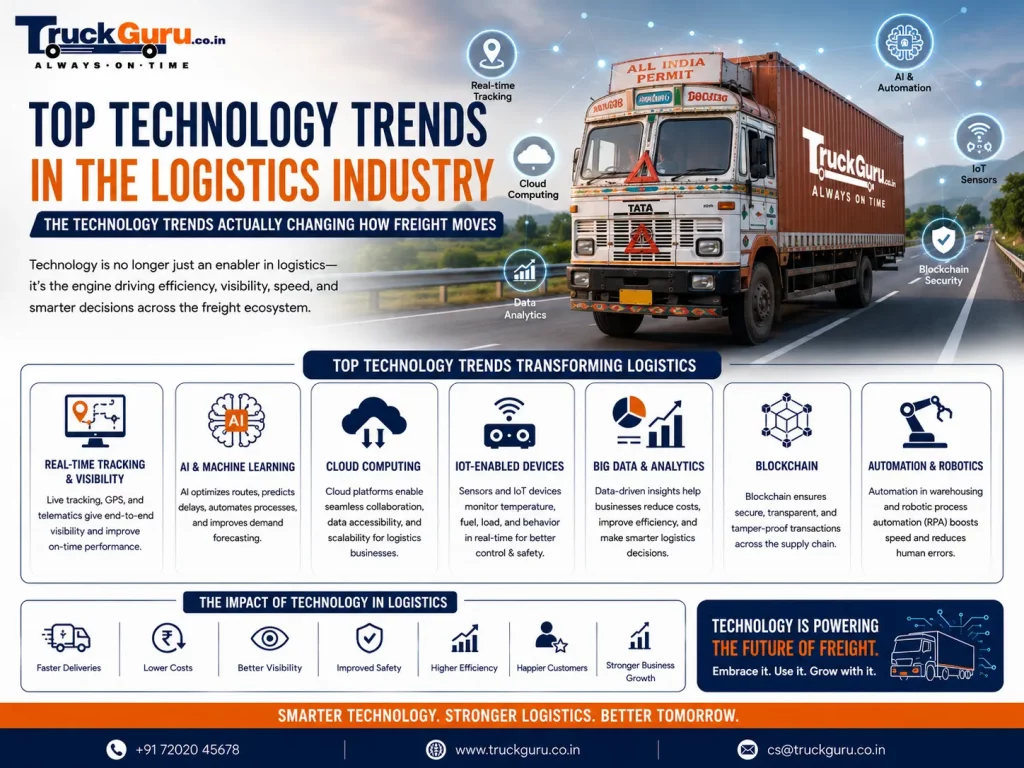
The Technology Trends Actually Changing How Freight Moves
Most “top technology trends in logistics” content is written from a US or European vantage point, where some of what follows is genuinely close to commercial deployment. India’s trucking environment is different enough — in regulation, infrastructure, and what is actually on the road today — that it is worth separating what is realistically relevant here from what remains a future story elsewhere. A trend being real and well-funded globally does not automatically mean it changes anything about booking a truck in India this year.
Technology Trends in Logistics Industry: Quick Summary
Technology Trends In Logistics Industry: Stay ahead with the latest logistics tech trends! Discover how AI, IoT, automation, and digital platforms are.
A lot of what these trends ultimately affect shows up in logistics services booked day to day, even when the underlying technology itself is still years out.
Electric and Autonomous Vehicles
Autonomous trucking is a genuinely active area of development, though concentrated almost entirely in the US and Europe right now. Daimler Truck, through its partnership with Torc Robotics, has been running driver-out tests on closed tracks and is targeting commercial deployment around 2027. Aurora Innovation and Kodiak AI are also actively running driverless freight routes in the US as of this year. None of this has a current presence on Indian roads, and there is no clear regulatory framework yet for how it would work here — worth tracking as an industry direction, not something relevant to a booking made in India today.
On the electric side, battery research continues to push range and safety forward — Volkswagen, for instance, has backed solid-state battery development through an investment in QuantumScape, aimed at improving energy density and extending range. As with autonomy, electric trucking in India specifically is still early-stage; standard diesel vehicles remain the overwhelming majority on Indian roads today.
Currently available categories are covered in the truck type guide.
The Internet of Things (IoT)
IoT sensors embedded in modern trucks track tyre pressure, load stability, and location in ways that feed directly into fleet management decisions — this is a genuine, already-deployed trend among truck manufacturers and larger fleet operators, not a speculative one. Truck platooning — linking vehicles digitally to travel closer together for fuel savings — has had a more mixed history; one of the technology’s most prominent early developers ceased operations in 2021, and at least one major truck manufacturer has since said its own platooning trials did not show strong enough fuel savings to justify continued investment, redirecting that effort toward full autonomy instead.
The lesson is less about any one company and more about how unevenly different logistics technologies actually pan out once tested at scale.
Vehicle and driver details are confirmed through the transporter network before any TruckGuru shipment dispatches.
Big Data and Artificial Intelligence
Large logistics operators increasingly use historical and real-time data to forecast shipping volumes and catch data-quality issues before they affect a shipment — AI plays a growing role here in cleaning and structuring that data rather than replacing the underlying forecasting work entirely. For a business booking freight rather than running a large fleet, the more immediate version of this trend is simpler: a rate calculated instantly from real route and weight data, rather than a quote that takes a phone call and a wait to produce.
See this in practice on the freight calculator.

Blockchain Technology
Blockchain is being tested by some logistics companies globally as a way to create a tamper-resistant record of a shipment’s journey, with all parties able to verify the same transaction history rather than relying on a single company’s internal records. It is a genuinely interesting approach to a real problem — transparency and dispute reduction — though it remains an emerging trend rather than a standard tool across the industry. Worth being direct here: TruckGuru’s current tracking and documentation runs on GPS tracking and digitally-generated LR and invoice records, not blockchain infrastructure.
Book and document a shipment through online truck booking today, using the tools actually available now.
Predictive Analytics and Machine Learning
Analysing historical shipping patterns, weather data, and demand signals together lets larger logistics operations anticipate disruptions — a demand surge, a weather event, a regional bottleneck — before they fully materialise, rather than reacting once a shipment is already delayed. This is a genuinely useful capability at scale, and one that continues to mature as more historical data accumulates across the industry. For a smaller business, the practical version of the same idea is simpler: knowing your own shipping patterns well enough to book ahead of predictable peak periods, rather than needing a dedicated forecasting system to tell you the same thing.
Track an individual shipment in real time through the TruckGuru mobile app, regardless of which larger industry trend eventually shapes the technology behind it.
Where TruckGuru Fits Today
Set against the broader trends above, TruckGuru’s actual current capability is the practical, already-deployed end of this list: a published rate card, GPS tracking on booked shipments, and digital LR and GST invoice generation. No autonomous trucks, no blockchain infrastructure, no platooning — the tools that are genuinely available to book with today rather than a future roadmap.
Check available truck sizes or explore transportation services for your route.
Closing Thoughts
Some of what gets called a “logistics technology trend” is already practical and worth understanding now — IoT-based fleet monitoring and data-driven forecasting chief among them. Some of it, like autonomous trucking and blockchain-based tracking, is genuinely promising but not yet relevant to a booking made in India today. Knowing which category a given trend falls into is more useful than treating all of them as equally close to changing how freight actually moves here.
Frequently Asked Questions
What are the top technology trends in the logistics industry?
Autonomous and electric vehicles, IoT-based fleet and cargo monitoring, AI-assisted data analysis, blockchain for supply chain transparency, and predictive analytics for demand forecasting. Most of these are more advanced in the US and Europe than in India currently.
Are autonomous trucks used in India?
No. Autonomous trucking remains concentrated in the US and Europe, with companies like Daimler Truck (via Torc Robotics), Aurora Innovation, and Kodiak AI leading current development. There is no commercial deployment or clear regulatory framework for autonomous trucks on Indian roads at this time.
Does TruckGuru use blockchain or AI for tracking?
No. TruckGuru’s current tracking and documentation tools are GPS-based tracking and digitally-generated LR and GST invoices. Blockchain and AI-driven forecasting are genuine industry trends, but not part of TruckGuru’s current tooling.
Is truck platooning a proven technology?
Results have been mixed. One of the most prominent early platooning companies, Peloton Technology, ceased operations in 2021, and at least one major truck manufacturer redirected its own platooning research toward full autonomy after inconclusive fuel-savings results.
Call 72020 45678 or book online at truckguru.co.in for a confirmed rate on your next shipment.

Related Reading
- Ship-To GSTIN Mandate August 2026 — What Shippers Must Do
- Common Questions FTL Shippers Ask Before Booking a Truck
- How to Increase Truck Mileage to Save Fuel Cost
For current rules and official notifications, see the Ministry of Road Transport & Highways.