

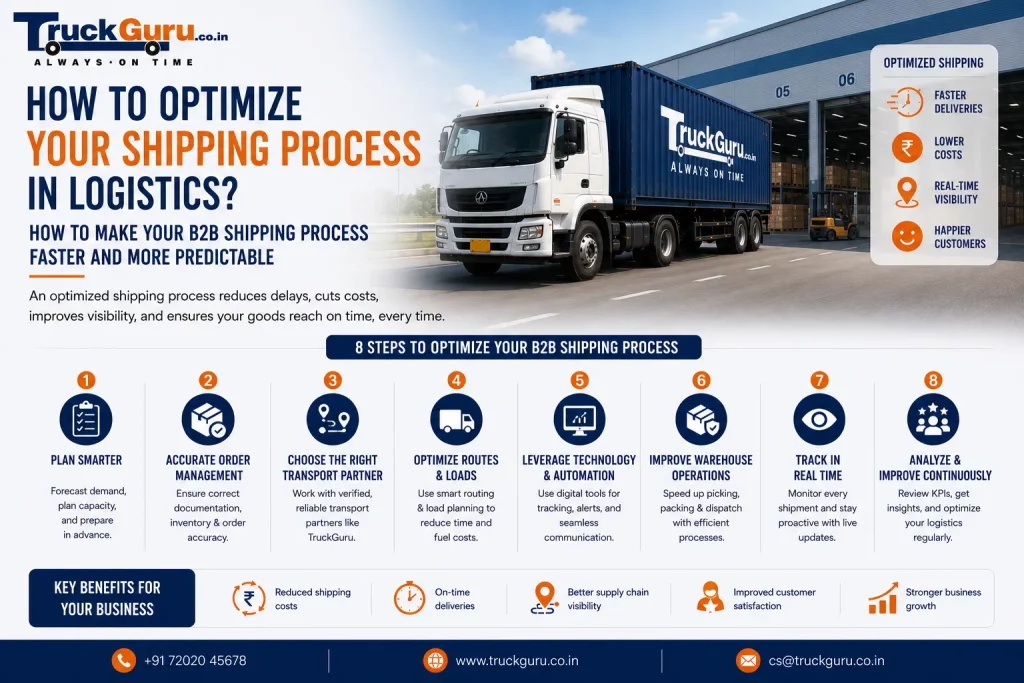
How to Make Your B2B Shipping Process Faster and More Predictable
India’s logistics costs run close to 14% of GDP, against a global norm closer to 8-9% — a gap that is partly structural and partly the result of avoidable inefficiency in how individual businesses actually plan and execute their own shipping. The structural part is slow to change. The avoidable part is not, and it is where most of the realistic improvement actually lives for a business shipping FTL freight regularly.
Your B2B Shipping Process: Quick Summary
Your B2B Shipping Process: Unlock the secrets of shipping process in logistics with our step-by-step guide. Learn how proper tracking ensure timely.
The tactics below are specifically about full truckload point-to-point shipping — one truck, one route, one consignee — not the multi-stop last-mile delivery problem that a lot of generic “shipping optimisation” content is actually written for. A few of the usual tips (letting a customer pick their own delivery window, running a dispatch system across dozens of drivers and stops) simply do not apply to a single FTL booking, so they are left out here in favour of what does.
Common Shipping Challenges for B2B Businesses
A few pressures show up consistently for businesses shipping regularly. Buyers want reliable transit windows without paying a premium for certainty. Fuel price fluctuation makes monthly freight budgets harder to plan around than a fixed number would be. Finding and retaining experienced drivers has gotten harder across the industry, which shows up as delays when a regular route loses its usual driver. And city traffic at both ends of a route continues to push transit times in the wrong direction, particularly around major industrial hubs during peak hours.
1. Consolidate Shipments Instead of Booking Reactively
The single biggest lever for FTL shipping specifically is avoiding half-empty trucks. If you have several partial loads heading to nearby destinations, combining them into one full booking instead of several partial ones cuts the duplicated base charges that come with each separate trip. This requires looking slightly ahead at your shipping calendar rather than booking reactively as each order comes in — a small planning habit with a real cost payoff.
2. Plan Routes and Pickup Timing Around Real Conditions
Route choice affects both fuel cost and transit time more than most shippers account for upfront. Where it is genuinely available, having an alternate route in mind for a corridor prone to congestion or seasonal road issues prevents a single blocked route from becoming the reason a delivery misses its window. If your business has any flexibility in where goods are staged before pickup, positioning closer to the actual pickup point reduces the distance a truck has to travel before the billable trip even starts.
3. Keep Route and Consignee Details Consistent
For corridors you ship regularly, keeping consistent details on file — exact delivery address, dock access hours, any site-specific instructions — prevents the same clarifying question coming up on every single booking. This sounds minor until you are booking the same corridor weekly and re-explaining the same access details each time; a small amount of upfront documentation removes a recurring point of friction.
4. Track the Actual Shipment, Not Just a Promise of Tracking
Live GPS tracking that you can actually check, rather than a tracking feature that exists mostly in the marketing copy, changes how you can plan on the receiving end. Knowing a truck’s real position lets a warehouse team schedule unloading staff accurately and lets you give a customer or buyer a delivery estimate grounded in where the truck actually is, not when it was originally scheduled to arrive.
5. Match the Right Truck and Confirm the Driver Before Dispatch
Booking the correct truck size for the actual cargo weight avoids paying for capacity you do not use, and confirming driver name, phone number, and vehicle registration before the truck leaves lets you verify the right vehicle is actually showing up rather than finding out something is wrong only at the loading dock.
Match your load to the right size on the truck size guide.
6. Move Documentation Digital
Digital signatures and photo proof of delivery, rather than paper records that can be lost or delayed in transit, give you a retrievable record if a dispute comes up weeks later. Keeping Lorry Receipts, GST invoices, and e-way bills in one searchable digital location rather than scattered paper files saves real time at month-end reconciliation, even if it does not feel urgent on any single booking day.
7. Track Your Actual Cost Per Shipment
Fuel, tolls, and per-trip rates are worth tracking at the shipment level rather than only reviewing as a lump monthly total — patterns in which routes or truck sizes run more expensively relative to their cargo only show up once you are looking at individual trips rather than an aggregate number. On a fixed-rate platform, the rate confirmed at booking is the rate on the invoice, which removes one common source of cost surprise from this tracking exercise entirely.
Check a confirmed rate before booking on the freight calculator.
8. Use a Platform That Connects Booking, Tracking, and Documentation
The time savings in modern shipping mostly come from not having to switch between five disconnected tools and a phone — booking, GPS tracking, and digital documentation living in one place removes the coordination overhead that used to sit between each of those steps.
Where TruckGuru Fits Into This
TruckGuru books FTL truck transport for businesses across India — it is a confirmed-rate booking platform, not a broader 3PL or full logistics services provider managing warehousing or supply chain operations. Within that specific scope, it offers a published rate card, live GPS tracking, digital LR and GST invoice generation, and driver and vehicle details confirmed before dispatch. Support is available to help resolve booking issues, though response times vary, and there is no guarantee of instant resolution at any hour.
Book directly or check a rate at TruckGuru.co.in.
Closing Thoughts
Most of the realistic improvement in B2B shipping comes from a handful of specific habits — consolidating loads, planning routes ahead of time, keeping documentation digital and consistent, and tracking cost at the shipment level rather than the monthly total. None of this requires a major operational overhaul, and the businesses that build these habits tend to see the benefit compound over a few months rather than all at once.
Frequently Asked Questions
How can I optimise my shipping process in logistics?
For FTL freight specifically: consolidate partial loads into full bookings where routes overlap, plan pickup timing and routes ahead of last-minute scrambling, move documentation digital, and track cost at the individual shipment level rather than only as a monthly total.
What is the biggest cost-saving opportunity in B2B shipping?
Avoiding half-empty trucks. Combining multiple partial loads into a single booking eliminates duplicate base charges that would otherwise apply to separate trips for the same total cargo.
Does GPS tracking actually reduce delivery delays?
It reduces the impact of delays more than it prevents them outright — knowing a truck’s real position lets you adjust unloading schedules and customer communication in real time rather than discovering a delay only when the truck fails to arrive on schedule.
Is TruckGuru a full logistics services provider?
No. TruckGuru books FTL truck transport with a confirmed rate, GPS tracking, and digital documentation. It does not manage warehousing, inventory, or a business’s broader supply chain — those fall under 3PL or 4PL providers, a different category of service.
Call 72020 45678 or book online at truckguru.co.in for a confirmed rate on your next shipment.
Related Reading
- Reduce Manufacturing Freight Costs: India Intercity Guide
- Reduce B2B Freight Costs in India: 25 Proven Strategies
- Ship-To GSTIN Mandate August 2026 — What Shippers Must Do
For current rules and official notifications, see the Ministry of Road Transport & Highways.