

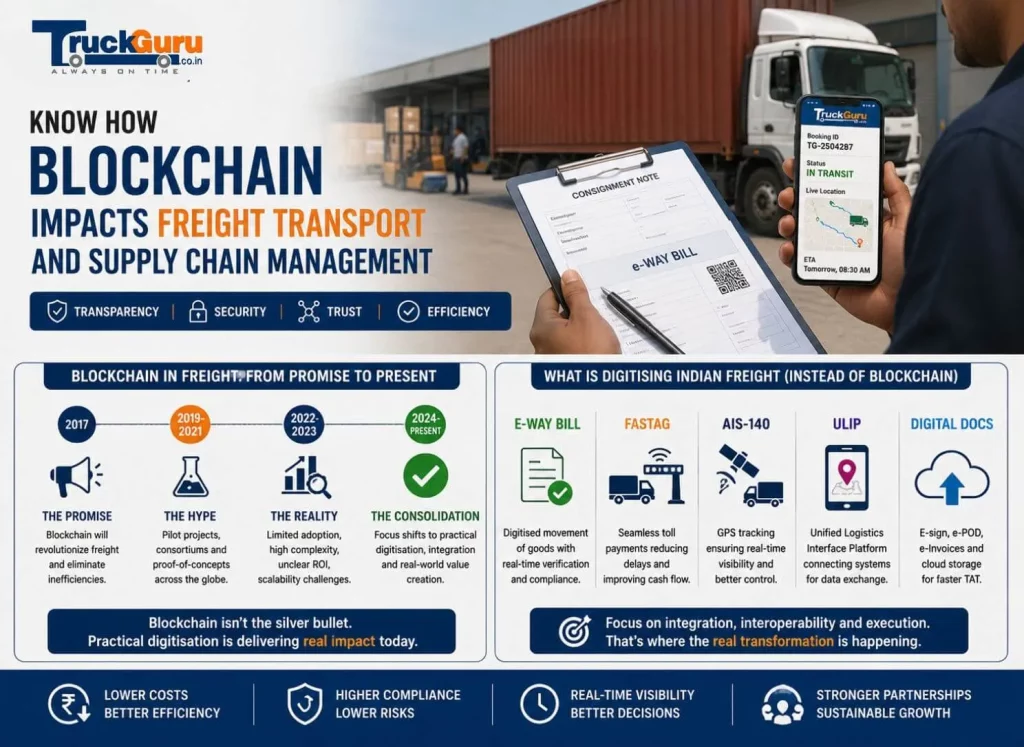
Blockchain in Freight: What Was Promised, and What Actually Happened
Around 2018, blockchain in freight was going to fix everything. Shared ledgers would end paperwork disputes. Smart contracts would release payment automatically on delivery. Every party in a supply chain would see the same immutable record, and fraud would become impractical.
It is worth looking at what came of that, because the answer is more useful to a shipper than another round of the original pitch.
What blockchain in freight actually meant
A blockchain is a shared ledger. Multiple parties hold the same record, entries cannot be quietly edited after the fact, and no single participant controls it. Applied to freight, the idea was that a shipper, transporter, warehouse, customs broker and bank would all write to one record of a consignment rather than each keeping their own version and arguing when the versions disagreed.
The related idea was the smart contract: code that executes when conditions are met. Goods scanned as delivered, payment released, no invoice chase.
Both ideas addressed real problems. Freight genuinely does run on parties keeping separate records that disagree, and payment genuinely does get delayed behind paperwork.
What happened to blockchain in freight
The flagship project was TradeLens, built by Maersk and IBM for container shipping. It signed up carriers, ports and customs authorities and was the proof that the model worked at scale. It was discontinued, with the wind-down announced in late 2022 and the platform closed in early 2023.
The stated reason is the interesting part. The platform did not fail technically. It failed to reach the level of industry participation needed to make it commercially viable. Which is the whole problem in one sentence.
VERIFY: Confirm the TradeLens dates before publishing. The announcement and closure are well documented, but the exact months are worth a check, and I do not have search access to verify them.
Why it did not work, and the reason matters
Three problems, none of them about the technology.
- Garbage in, permanently. A shared ledger guarantees that a record cannot be altered later. It guarantees nothing about whether the record was correct when entered. If a loading clerk types the wrong package count, the blockchain preserves that error immutably. Most freight disputes start at data entry, and no ledger design fixes data entry.
- Network effects nobody wanted to fund. A shared ledger is worthless with two participants and valuable with two hundred. Getting to two hundred requires competitors to agree on a standard and pay to join something that benefits everyone including their rivals. In practice each large player preferred its own platform.
- The problem was cheaper to solve another way. Almost every benefit claimed for blockchain in freight, shared visibility, documented terms, traceable payment, is achievable with a conventional database and a party everyone already trusts. That is a much smaller bill.
Where it still has a genuine role
Narrower than the 2018 pitch, but not zero. The cases that survived tend to share one feature: parties who do not trust each other and cannot agree on who should hold the database.
- Provenance for high-value or regulated goods, where proving chain of custody carries real commercial weight.
- Cross-border trade documentation involving multiple jurisdictions and no natural neutral operator.
- Settlement between parties with no existing commercial relationship.
For a manufacturer in Ankleshwar moving drums to Bhiwandi, none of these apply. The consignment involves you, a transporter and a receiver. You do not need a distributed ledger to agree on what was loaded. You need a consignment note filled in correctly.
What is actually digitising Indian freight
While the blockchain conversation ran, Indian freight was digitised substantially by other means, mostly regulatory. These are the systems that changed daily operations.
- E-way bill: introduced under GST, this put consignment movement above a threshold value onto a national electronic system. It did more for freight documentation in India than any private platform, because participation was not optional. Current thresholds and state rules are on the e-way bill portal.
- FASTag: electronic toll collection across national highways. Toll transactions became digital records rather than cash at a barrier, which cut queue time at plazas and made toll cost auditable per trip.
- AIS-140 and vehicle tracking: India mandated vehicle location tracking devices for specified commercial vehicle categories. This is the Indian equivalent of the tracking conversation, and it is worth noting the original article discussed ELDs, which are a United States hours-of-service mandate and do not apply here.
- National Logistics Policy and ULIP: the policy framework and the Unified Logistics Interface Platform were built to connect government logistics data systems so operators can access them through a single interface. This is closer to the original shared-ledger ambition than any blockchain project reached, and it works because a neutral operator already existed.
VERIFY: Confirm current ULIP and National Logistics Policy status and naming before publishing. Government programme details change and I cannot verify the current position.
For sector data and current road transport rules, the Ministry of Road Transport and Highways publishes the official figures.
What this means for your freight
If you ship goods for a living, the practical takeaway is that the things that protect you are unglamorous and available now.
- A consignment note filled in correctly at loading, with the right package count, consignee and declared value.
- A booking with the rate and inclusions stated in writing before the vehicle is assigned.
- Payment through traceable channels, producing a GST invoice and a record.
- Damage recorded on the proof of delivery at receipt, not reported two days later.
None of that requires new technology. Most freight losses in India happen because one of those four was skipped, not because the ledger was centralised.
Does TruckGuru use blockchain?
No. TruckGuru runs on conventional infrastructure, and there is no blockchain in it.
What the platform does instead is the ordinary version of the same goal: a documented booking with vehicle type, route and rate stated before loading, toll included in the quoted fare rather than added later, staged payment across confirmation, loading and delivery, and no cash accepted, so every movement produces a GST invoice and a record. That solves the disputes shippers actually have.
If verification of an operator is what you are really after, the guide to choosing a transport service provider covers the checks that work today. For booking, see online truck booking.
Key takeaways
- Blockchain in freight promised shared records and automatic settlement. The flagship project, TradeLens, was discontinued after failing to reach viable industry participation.
- The failure was commercial and organisational, not technical. Competitors would not fund a shared standard.
- An immutable ledger does not fix incorrect data entry, which is where most freight disputes begin.
- Remaining genuine use cases involve parties who cannot agree on a neutral database operator. Domestic road freight is not one of them.
- Indian freight was digitised mainly by regulation: e-way bill, FASTag and AIS-140 tracking.
- Correct paperwork at loading protects you more than any ledger design.
Frequently asked questions
Is blockchain used in logistics today?
In limited applications. Large shared-ledger platforms for container shipping did not achieve the industry participation they needed, and the most prominent one was discontinued. Narrower uses around provenance and cross-border documentation continue.
What happened to TradeLens?
It was discontinued. Maersk and IBM announced the wind-down after the platform did not reach the level of industry participation required for commercial viability. It was the largest blockchain project in freight.
Does blockchain prevent freight fraud?
It prevents records being altered after entry. It does nothing about incorrect or dishonest data entered in the first place, which is where most disputes originate. Verification at loading remains the practical control.
What is a smart contract in freight?
Code that executes automatically when conditions are met, such as releasing payment on confirmed delivery. The concept works, but it requires all parties on a shared system and agreement on what counts as proof of delivery, which is the part that proved difficult.
Do Indian trucks use ELDs?
No. Electronic logging devices are a United States hours-of-service requirement. India mandates vehicle location tracking devices under AIS-140 for specified commercial vehicle categories, which is a different requirement serving a different purpose.
What actually digitised Indian freight?
Mainly regulation. The e-way bill put consignment movements onto a national electronic system, FASTag digitised toll collection, and AIS-140 brought vehicle tracking into specified categories. Participation was mandatory, which is why adoption happened.
Should a small shipper care about blockchain?
Not for domestic road freight. Your protection comes from a correctly completed consignment note, a written booking with inclusions stated, traceable payment and damage recorded at delivery. All four are available now and cost nothing to insist on.
The unglamorous version works
The 2018 pitch was that freight needed a new kind of database. What most Indian shippers actually need is for the existing paperwork to be filled in properly and for the commercial terms to be written down before the truck arrives. That has been available the whole time.