

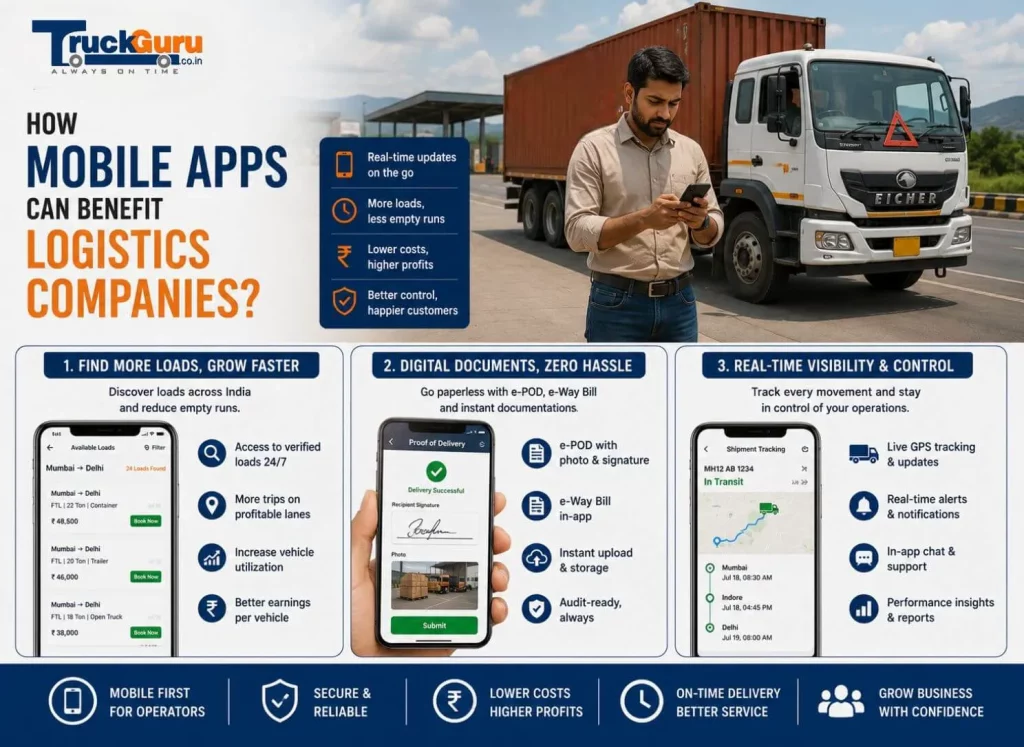
How Mobile Apps Benefit Logistics Companies
A two-truck operator in Ludhiana sends a load to Delhi on Tuesday. The vehicle unloads Wednesday morning and sits until Thursday afternoon while the owner calls three brokers looking for something to bring back. It gets a partial return at a poor rate.
Mobile Apps for Logistics: Quick Summary
Mobile apps for logistics, assessed honestly: what they fix for a transport operator, what they do not, and where the return actually comes from.
That is where a transport business actually loses money, and it is the test any conversation about mobile apps for logistics has to pass. Not whether the software is modern. Whether it puts a load on that empty truck.
What mobile apps for logistics genuinely fix
- Load discovery. This is the big one for small and mid-sized operators. Before apps, finding a return load meant knowing brokers in the destination city. Now the load boards are on a phone, and an owner in Ludhiana can see what is moving out of Delhi without knowing anyone there. Empty running is the highest cost in owner-operator economics, and cutting a day off the wait changes the month.
- Dispatch without phone tag. Assigning a trip, sending pickup details and confirming acceptance in one place removes the string of calls that used to carry that information, and the misheard addresses that came with it.
- Documentation capture at the point it happens. A proof of delivery photographed at the receiving gate, with the date and place attached, is worth more than a paper copy that reaches the office a week later. Damage disputes turn on when the damage was recorded.
- Payment records. Digital trip records and invoices mean a GST paper trail, which matters for input tax credit and for any operator who wants to work with organised shippers rather than only on cash.
- Compliance paperwork in one place. Permit and fitness expiry dates, insurance renewals and driver licence validity are the things that get forgotten until a checkpoint. A calendar in an app is a small feature with a large downside avoided.
What mobile apps for logistics do not fix
This part gets skipped in most articles on the subject, and it is where operators waste money.
- An app does not create freight. If there is no volume on your corridor this week, better software shows you the same emptiness faster.
- It does not fix driver availability. Driver shortage is the binding constraint for a lot of Indian operators, and no dispatch screen solves it.
- It does not correct bad data. A wrong package count entered on a phone is as wrong as one entered on paper, and it travels further.
- It does not replace the consignment note. The LR remains the contract of carriage regardless of what the app records.
- It does not make an unprofitable route profitable. If your rate does not cover fuel, driver, EMI and maintenance on that run, the app just documents the loss more precisely.
Where tracking sits in Indian operations
Vehicle location tracking is the feature most operators ask about first. In India, this is partly regulatory rather than optional, since AIS-140 mandates vehicle location tracking devices for specified commercial vehicle categories.
Worth being clear about what tracking does for you. It answers “where is the vehicle” without a phone call, which saves time and reduces the friction with shippers who keep asking. It does not shorten transit. A truck stuck behind a closed weighbridge is equally stuck whether or not you can see it on a map.
The commercial value is mostly in what it lets you promise. An operator who can answer a location question in ten seconds wins repeat business from shippers who have been burned by operators who cannot.
The digitisation that happened around you
Indian freight got substantially digitised over the last several years, mostly through regulation rather than through anyone choosing software. Any assessment of mobile apps for logistics has to account for that, because these systems are already in your workflow.
- E-way bill: consignment movements above a threshold value moved onto a national electronic system under GST. Current thresholds and state rules are on the e-way bill portal.
- FASTag: toll went electronic across national highways, which cut plaza queue time and made per-trip toll cost auditable instead of a cash number the driver reported.
- AIS-140: vehicle location tracking device requirements for specified commercial categories.
The practical point for an operator: a lot of what an app now needs to do is sit alongside systems you are already required to use, rather than replace them.
Choosing software for a small fleet
An honest assessment for anyone running under about ten vehicles: custom development is rarely the right answer. The economics do not work, and the maintenance falls on you.
- Start with the problem that costs you most. For most small operators, that is empty running, which points to load discovery rather than a full management suite.
- Check it works on the phones your drivers actually have, on the networks they actually get on your routes. Software that needs steady data fails on the stretches where it matters.
- Prefer something your drivers will use without training. Adoption is the failure point, not features.
- Do not pay for warehousing or inventory modules if you do not run a warehouse.
- Count the return before you commit. If a subscription costs less than one avoided empty day a month, it pays. If it does not, it is a hobby.
Working with a booking platform
For operators, a booking platform is a load discovery channel. TruckGuru runs full truck load intercity freight across 110-plus cities in India, connecting shippers with independent transport vendors, and operates a separate Android app for drivers alongside the customer app. Bookings carry the vehicle type, route and rate stated before loading; toll is included in the quoted fare, and payment is staged across confirmation, loading and delivery. No cash, which means every trip produces a record. If you want to see how the shipper side works before deciding whether to supply capacity, look at online truck booking and the transporter page.
VERIFY: Feature claims held back. I have not asserted live tracking, instant automated pricing, in-app load matching or GPS visibility for either app, because none of these is confirmed to me. This section is thinner than it should be as a result. Supply the confirmed feature list, and this becomes the strongest part of the page.
Key takeaways
- Judge mobile apps for logistics on whether they reduce empty running. That is where operator money is lost.
- Load discovery is the feature with the clearest return for small and mid-sized fleets.
- Apps do not create freight, fix driver shortage, or correct bad data entry.
- Tracking answers location questions and wins repeat business. It does not shorten transit.
- E-way bill, FASTag and AIS-140 already digitised much of Indian freight through regulation.
- Under roughly ten vehicles, buy rather than build, and skip modules for operations you do not run.
Frequently asked questions
Do small transport operators need mobile apps for logistics?
Not a custom one. What most small operators need is access to load discovery so trucks do not sit empty at the destination. That is available through booking platforms without building anything.
How do truck operators find return loads?
Traditionally, through brokers in the destination city, which required contacts there. Booking platforms and load boards now show available freight on a corridor without that relationship, which is the main change apps have brought to operator economics.
What does a driver app do?
Typically, it carries trip assignment, pickup and delivery details, and capture of delivery confirmation at the receiving end. The value is having documentation recorded where and when it happens rather than reconstructed later.
Is vehicle tracking mandatory in India?
Vehicle location tracking device requirements apply to specified commercial vehicle categories under AIS-140. Check the current requirement for your vehicle class and state, since the rules are amended and vary.
Do apps replace the consignment note?
No. The consignment note or LR remains the contract of carriage, issued at loading. An app record is not a substitute, and damage or loss claims rest on the LR and the proof of delivery.
Should I build custom software for my fleet?
Below roughly ten vehicles, rarely. Development cost and ongoing maintenance outweigh the benefit, and the problems small operators face are mostly solved by existing platforms.
Is there an iPhone version of the TruckGuru apps?
No. The customer and driver apps are Android. Bookings can also be placed through the website on any device.
The test that matters
Before paying for anything, work out what an empty day costs you on your main corridor. Then ask whether the software shortens it. If it does, the arithmetic is simple. If the answer is that it improves visibility and efficiency, ask again until you get a number.
Related Reading
- How to Estimate Goods Transport Rates: A Beginner’s Guide
- How Are Truck Transportation Charges Calculated in India?
- 6 Truck Booking Platforms Compared for FTL Freight in India: FR8, WheelsEye, Trukky, BlackBuck, Vahak & TruckGuru
For current rules and official notifications, see the Ministry of Road Transport & Highways.