

Online Truck Booking in India: How It Works and What Actually Changes
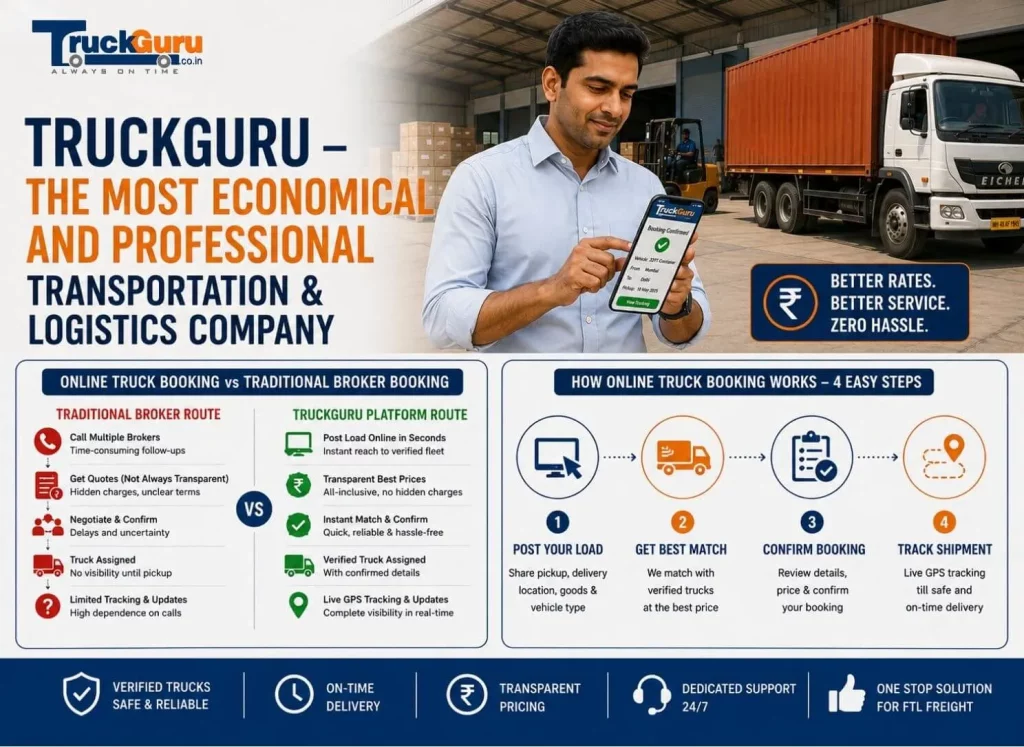
Booking freight in India used to mean three phone calls. One to a broker you had used before, one to a second broker to see whether the first rate was fair, and one back to the first to negotiate. You learned the real price after the fact, from the bill.
Online Truck Booking: Quick Summary
Online truck booking in India explained: how it differs from calling a broker, what it fixes, what it does not, and the checks that still matter before loading.
Online truck booking changes part of that, and leaves other parts exactly where they were. Both halves are worth understanding before you switch, because platforms are frequently sold as fixing more than they do.
What online truck booking actually is
An online truck booking platform lets you enter your route, consignment weight and vehicle requirement, and receive a rate and a confirmed booking without negotiating it verbally. The vehicle itself is usually supplied by an independent transport vendor. The platform sits between you and that vendor, handles the booking record and the payment, and holds the commercial terms.
That last point is where most descriptions get dishonest. Platforms often claim they eliminate brokers. In reality, a platform is an intermediary too. The meaningful difference is not that the middle layer disappeared; it is that the middle layer now runs on a documented booking with stated terms rather than on a verbal agreement you cannot refer back to.
What online truck booking genuinely fixes
- The rate is stated before you commit. You see the price against a specific vehicle and route, in writing, before the truck is assigned. That alone removes the most common dispute in Indian road freight, which is a final bill that does not match the number agreed on the phone.
- Inclusions are explicit. Toll included in the fare rather than added at delivery is a written term, not a promise you have to remember. Ask the same question of any quote you compare against.
- There is a record. Booking details, vehicle type, route and payment all sit in one place. When a dispute happens six weeks later, you are not reconstructing it from call logs.
- Payment is traceable. Bank transfer, UPI and card leave a trail and produce a GST invoice, which means input tax credit for you and no ambiguity about what was paid. Cash freight does neither.
- Comparison becomes possible. When rates are quoted on the same basis, with the same inclusions, you can actually compare them. Verbal quotes rarely are.
What online truck booking does not change
This is the part sales pages skip, and knowing it will save you a bad assumption.
- A truck still has to be physically placed at your pickup point. Platforms shorten the search; they do not create capacity on a corridor where none exists. On thin routes or at peak season, placement takes what it takes.
- The consignment note still matters. Booking online does not replace the LR issued at loading. Check the consignee, package count, declared value and condition of goods at the gate, as you always would.
- Insurance is still a separate question. A booking record is not transit cover. Ask what your consignment is insured for and who holds the policy.
- Loading and unloading labour is usually still yours to arrange. Confirm it rather than assuming it comes with the vehicle.
- Cargo density still decides the vehicle. Entering a tonnage figure does not size the truck if your goods are bulky. Weight and volume both need to go in.
Online truck booking compared with calling a broker
Neither is automatically better. It depends on what your freight looks like.
- A broker relationship works well when you run the same corridor constantly with the same person; they know your loading bay and your timings, and they will find you a vehicle at 9 pm because you have given them steady volume for years. That relationship has real value and a platform does not replicate it.
- A platform works better when your routes vary, you are moving into corridors where you have no contacts, you need the rate documented for internal approval, or you want a paper trail for accounting and tax. It also removes the awkwardness of price discovery in an unfamiliar market.
Plenty of shippers run both: the broker for the daily route, the platform for everything else and for peak overflow.
How to book a truck online without getting caught out
- Get both numbers first. Weight in kilograms and stacked volume in cubic feet, for the packed consignment including crating. Dense cargo hits the weight limit early, bulky cargo fills the deck first, and entering only one of the two is how the wrong vehicle gets assigned.
- Check the vehicle spec on the quote. Body length in feet and registered load capacity in tonnes. For container class, confirm axle configuration, since a 32ft container ranges from 15 to 18 tonnes depending on it.
- Confirm what is included. Toll, loading labour, detention-free period and the rate after it. A cheaper headline rate with charges added later is not cheaper.
- Check the approach road. A 32ft container that cannot reach your gate is a placement failure regardless of how smooth the booking was. Older industrial pockets and market areas frequently cannot take one.
- Verify the paperwork at loading. Consignment note details are checked at the gate, and any damage is recorded on the proof of delivery at the receiving end rather than reported afterwards.
Where TruckGuru fits
TruckGuru runs full truck load intercity freight across 110-plus cities in India, connecting shippers with independent transport vendors on a documented booking. Toll is included in the quoted fare. Payment is staged: a Booking Amount at confirmation, 90 percent once the truck reaches your pickup location, and the balance at delivery before unloading. NEFT, IMPS, UPI and major debit and credit cards are accepted, and cash is not, so every movement carries a GST invoice. Booking runs through the website or the Android or iOS app. You can place a booking through online truck booking or check origin availability on a city page such as Bangalore.
It is full truck load only. Part load, parcel, local delivery, air, sea and household shifting are outside what TruckGuru does, and a platform booking does not change that.
If you are still assessing operators rather than ready to book, the guide to choosing a transport service provider covers the verification checks worth running on anyone, platform or broker.
Key takeaways
- Online truck booking documents the commercial terms before loading. That is its real advantage, not speed.
- Platforms are intermediaries too. The honest claim is a documented middle layer, not the removal of one.
- It does not create capacity. On thin corridors and at peak season, placement still takes time.
- The consignment note, insurance and loading labour remain separate questions after you book.
- Enter weight and volume both, or the platform will size the vehicle against half the picture.
- Cash-free payment means a GST invoice and input tax credit, which is a real cost difference over informal freight.
Frequently asked questions
How do I book a truck online in India?
Enter your pickup and delivery locations, the consignment weight and approximate dimensions, and the cargo type. You receive a rate against a specific vehicle, confirm the booking, and the vehicle is placed at your pickup point. Check the consignment note details at loading.
Is online truck booking cheaper than using a broker?
Not automatically. What it changes is that the rate and its inclusions are stated before you commit, so you can compare like with like. The saving usually comes from avoiding charges added after the fact rather than from a lower headline rate.
What is the difference between a truck booking platform and a broker?
Both sit between shipper and vehicle owner. A platform runs on a documented booking with stated terms and traceable payment. A broker relationship runs on a verbal agreement and personal familiarity, which has genuine value on routes you run constantly.
Do I still need a consignment note if I book online?
Yes. The consignment note or LR is the contract of carriage, issued at loading. A booking record is not a substitute, and any damage or loss claim rests on the LR and the proof of delivery.
Can I book a part load online with TruckGuru?
No. TruckGuru bookings are full truck load, meaning you take the whole vehicle. For consignments that do not fill a truck, a shared-load operator will be more economical.
What information do I need before booking?
Pickup and delivery locations, consignment weight, stacked dimensions, cargo type, and any constraint on the approach road at either end. Those five inputs settle the vehicle in most cases.
Is my consignment insured when I book online?
Not by default. Transit insurance covering the declared value is a separate arrangement. Ask what cover applies, for what value, and who holds the policy, and get the answer before loading.
Before your next booking
Have weight, volume and both locations ready, then compare on inclusions rather than headline rate. If you want the vehicle sizing settled first, the guide to truck sizes in India covers load capacity by class. For sector-level road transport data, the Ministry of Road Transport and Highways publishes the official figures.
Related Reading
- How to Estimate Goods Transport Rates: A Beginner’s Guide
- How Are Truck Transportation Charges Calculated in India?
- 6 Truck Booking Platforms Compared for FTL Freight in India: FR8, WheelsEye, Trukky, BlackBuck, Vahak & TruckGuru
For current rules and official notifications, see the Ministry of Road Transport & Highways.