

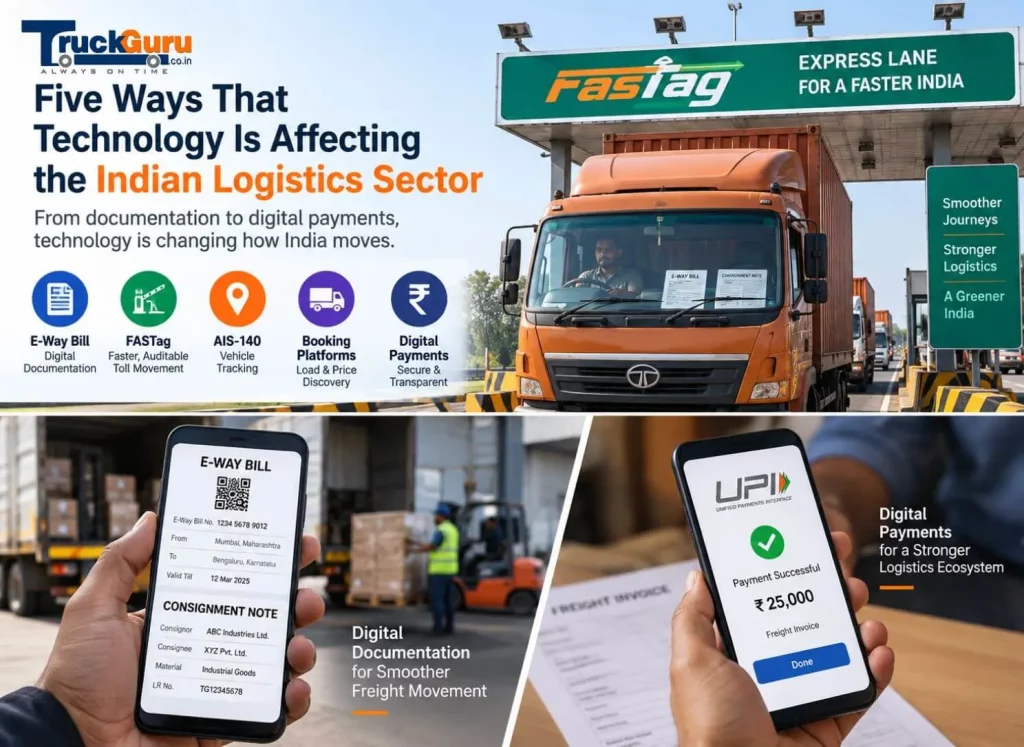
Five Ways Technology Changed Indian Logistics
Most articles on technology in Indian logistics list what might happen. This one lists what already did, and the pattern is worth noticing before the list: four of the five arrived because somebody was required to adopt them, not because operators chose to.
Technology in Indian Logistics: Quick Summary
Technology in Indian logistics changed five things that matter to shippers: documentation, toll, tracking, load discovery and payment. Here is what each did.
These are the five pieces of technology in Indian logistics that changed daily freight operations, in the order a consignment encounters them.
1. E-Way Bill: Documentation Went Electronic
Under GST, consignment movements above a specified value moved onto a national electronic system. It is the single largest change to Indian freight documentation, and it happened because participation was not optional. Current thresholds and applicable rules sit on the e-way bill portal.
What it changed practically: a consignment now carries an electronic record that exists independently of whatever paperwork travels in the cab. Checkpoint disputes about whether documentation exists became disputes about whether it is correct, which is a considerably better problem.
2. FASTag: Toll Became an Auditable Cost
An RFID tag read by a gantry, deducting from a linked account, mandatory on national highways.
The queue reduction got the coverage. The commercial change was that toll stopped being a cash figure a driver reported afterwards and became a transaction tied to a plaza and a timestamp. That is why toll can now be quoted inside a freight rate rather than billed at actuals, and it removed a whole category of bill-versus-quote argument.
3. AIS-140: Tracking Arrived by Mandate
Vehicle location tracking device requirements under AIS-140 apply to specified commercial vehicle categories. That put telematics onto vehicle classes that would not have bought it commercially. Applicability varies by category and state, and sits with the Ministry of Road Transport and Highways and your state transport department.
For a shipper this is the reason you can now expect a location answer without a chain of phone calls. Worth keeping in proportion: it improves communication, not transit time. A vehicle held at a weighbridge is held whether or not you can see it.
4. Booking Platforms: Load and Price Discovery
The only one of the five that arrived commercially rather than by regulation, and the one that changed operator economics most.
Before, finding a return load out of an unfamiliar city meant knowing brokers there. Empty running is the largest cost in owner-operator economics, and cutting a day off the wait at the destination changes the month. On the shipper side, the change is price discovery: rates quoted against a specific vehicle and route, in writing, comparable against each other.
One honest qualification. Platforms are frequently sold as removing brokers. They are intermediaries themselves. The real difference is that the middle layer now runs on a documented booking rather than a verbal agreement nobody can refer back to.
5. Digital Payment: Freight Left the Cash Economy
UPI, IMPS and card payment made it practical to settle freight without cash. That matters more than it sounds for a business shipper.
Cash freight produces no invoice, no input tax credit documentation and no record if a consignment is lost or damaged. Digital settlement produces all three. For any business that needs its freight spend to appear correctly in its accounts, this is the change that made organised transport viable to work with at all.
What This Pattern in Technology in Indian Logistics Tells You
Four of the five were mandated. The one that was not, booking platforms, succeeded because a single party captured the benefit and could fund it alone.
That is a useful filter for anything you read next about technology in Indian logistics. Ask who pays and who benefits. If a technology requires competitors to cooperate on a shared standard, discount it heavily, because that is exactly where the last decade of freight technology predictions failed.
The failed predictions are covered in blockchain in freight. The sensor layer is in applications of IoT in transportation and logistics, and what a shipper should ask a transporter for is in mobile technology in logistics.
Where TruckGuru Fits
TruckGuru provides full truckload intercity transportation across 110+ cities in India, with upfront freight pricing and the vehicle type, route and rate stated before loading. Toll is included in the quoted fare rather than added at delivery. Dispatched bookings carry live GPS tracking, and digital documentation includes the LR and delivery records, with GST invoicing and e-way bill support applied where relevant. Payment is staged across confirmation, loading and delivery. You can book a truck online or use the mobile app to manage bookings and track active shipments.
It is full truck load intercity only. Part load, parcel and courier movements, local delivery and household shifting are outside what TruckGuru does, and no amount of technology changes that.
Key Takeaways
- Four of the five changes that mattered arrived through regulation, not commercial adoption.
- E-way bill put freight documentation onto a national electronic system.
- FASTag turned toll into an auditable per-trip cost, which is why it can be quoted inside a rate.
- AIS-140 brought tracking to vehicle classes that would not have bought it. It improves communication, not transit time.
- Booking platforms cut empty running for operators and made rate comparison possible for shippers.
- Digital payment produces the invoice, tax documentation and record that cash freight does not.
Frequently Asked Questions
How has technology in Indian logistics changed freight operations?
Five changes did most of the work: the e-way bill for documentation, FASTag for toll, AIS-140 for vehicle tracking, booking platforms for load and price discovery, and digital payment for settlement. Four of the five were mandated rather than chosen.
What is the e-way bill?
An electronic document required under GST for consignment movements above a specified value. It records the movement on a national system independently of the paperwork travelling with the vehicle. Thresholds and applicable rules should be checked on the official portal.
Does FASTag actually help freight businesses?
Yes, though less through queue time than through cost auditability. Toll became a transaction tied to a plaza and a timestamp rather than a cash figure reported afterwards, which is what allows toll to be quoted inside a freight rate.
Is GPS tracking mandatory on Indian trucks?
Vehicle location tracking device requirements under AIS-140 apply to specified commercial vehicle categories. Whether a particular goods vehicle is covered depends on its category and state implementation, so confirm with your RTO.
Do booking platforms remove brokers?
No. A platform is an intermediary too. What changes is that the arrangement runs on a documented booking with stated terms and traceable payment, rather than a verbal agreement you cannot refer back to later.
Why does paying for freight digitally matter?
It produces a GST invoice, the documentation your finance team needs for any eligible input tax credit claim, and a payment record if a consignment is lost or damaged. Cash freight produces none of those.
What technology in Indian logistics has not changed freight?
Blockchain shared ledgers, cargo-level sensing outside pharma and high-value goods, predictive maintenance at small fleet scale, and autonomous vehicles. Each required either coordinated industry adoption or a scale most Indian operators do not have.
The Short Version
Technology in Indian logistics moved when somebody had to comply or when one party could fund it alone. Documentation, toll, tracking, load discovery and payment all changed on that basis. Judge the next prediction the same way.
Related Reading
- How to Estimate Goods Transport Rates: A Beginner’s Guide
- How Are Truck Transportation Charges Calculated in India?
- 6 Truck Booking Platforms Compared for FTL Freight in India: FR8, WheelsEye, Trukky, BlackBuck, Vahak & TruckGuru
For current rules and official notifications, see the Ministry of Road Transport & Highways.