

MSME Logistics: How Smaller Shippers Get Better Service From Transporters
A components maker in Rajkot ships four or five full loads a month. A competitor down the road ships forty. When capacity tightens at quarter end, the transporter places vehicles with the competitor first.
MSME Logistics: Quick Summary
MSME logistics runs on low volume and little leverage. How smaller Indian shippers get priority from transporters without paying above the market rate.
That is the structural position of MSME logistics in India, and no amount of relationship advice changes the arithmetic. What can change is everything else, because volume is not the only thing that decides who gets a truck.
Why Transporters Prioritise Some Shippers Over Others
Worth understanding the operator side, because it is not only about who ships more.
A transporter earns on vehicle utilisation. Anything that keeps a truck moving is worth money to them, and anything that makes a truck wait costs them money, whether or not they can bill you for it. So the shipper they favour is not simply the largest. It is the one whose loads are predictable and whose gate does not hold a vehicle for six hours.
That is the opening for a smaller shipper. You cannot outbid a larger competitor on volume. You can be considerably easier to serve than they are.
What Actually Earns Your Priority in MSME Logistics
Fast, predictable loading
The single most effective thing a small shipper can do. If a vehicle arrives at your gate and is loaded and away in ninety minutes while the larger shipper down the road takes five hours, the transporter notices within two trips.
Have the consignment packed and staged before the vehicle arrives. Have labour arranged rather than called for. Know your loading window and hold to it.
Accurate weights and dimensions
Booking a 14ft truck for a consignment that turns out to need a 19ft wastes a vehicle placement and a day, and the transporter absorbs part of that. Repeat it, and you become a shipper whose bookings carry risk.
Weigh and measure the packed consignment, including crating. Give both weight and cubic feet, because dense cargo hits the weight limit early and bulky cargo fills the deck first.
Paying on the agreed terms
Freight runs on thin working capital, especially for the small operators who make up much of the Indian market. A shipper who pays as agreed is worth more to a transporter than one who negotiated a better rate and pays late.
This is genuine leverage for an MSME because it is the one dimension in which you can outperform a much larger customer. Large buyers are frequently the slowest payers in freight.
Giving notice
A booking placed three days out is worth more than the same booking placed the same morning, because it lets the operator plan placement and find a return load. In corridors that tighten at quarter-end, notice is often the difference between getting a vehicle and waiting.
Treating drivers reasonably
Somewhere to wait, access to water and a toilet, and a gate process that does not leave someone sitting in a cab for hours in the heat. This costs almost nothing, and drivers remember it. Driver availability is a real constraint in Indian freight, and operators route people toward the places that do not make their day harder.
What to agree in writing before you need it
- The rate, with inclusions stated. Toll inside the fare or billed at actuals, loading and unloading labour, and anything else outside the number.
- Detention terms. The free period at each end and the rate after it. Agree this when nothing is going wrong, because agreeing it during a six-hour wait is a different conversation.
- Payment terms and method. Staged payment tied to confirmation, loading and delivery is standard and protects both sides.
- Who you contact when a vehicle is delayed. A named person beats a general line.
- What cover applies, what limits and exclusions, and who is responsible for the policy. A booking record is not transit cover.
Where a small shipper genuinely has leverage
Three places in MSME logistics where a small shipper holds real cards, and none of them involve volume.
- A predictable four loads a month on the same corridor is easier for an operator to plan around than twenty that arrive unannounced. Steady beats large for a small fleet.
- Return-load value. If your destination is somewhere the operator struggles to find return freight, you are worth more than your volume suggests. Ask about this directly. It sometimes moves the rate.
- A second option in reserve. Running a small share of volume through an alternative transporter in normal conditions gives you placement when your usual operator is committed, and it makes rate conversations less one-sided.
For MSME registration, schemes and support, the Ministry of Micro, Small and Medium Enterprises is the official source. Payment-related protections for registered enterprises are worth checking there against your own position rather than assuming they apply.
VERIFY: Confirm before publishing whether to reference MSMED Act payment provisions explicitly. They govern payments to MSME suppliers, so whether they help an MSME shipper depends on which side of the transaction the enterprise sits. Kept general for that reason.
Where TruckGuru Fits
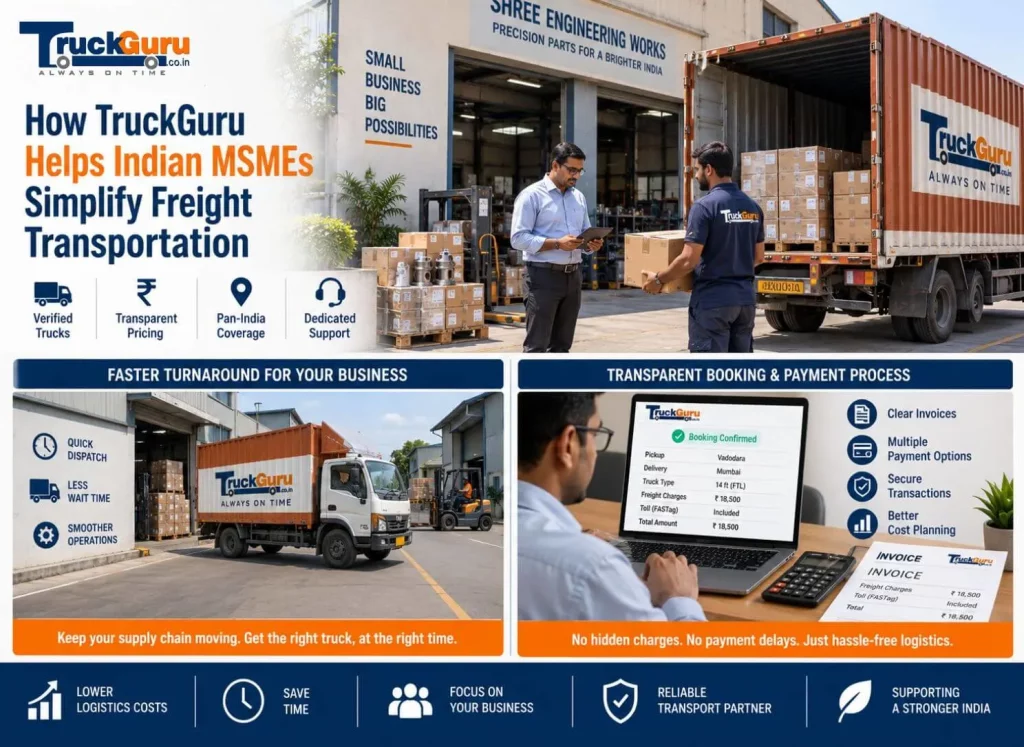
A booking platform removes part of the leverage problem, because the rate is quoted against a specific vehicle and route rather than negotiated from a weak position. TruckGuru provides full truckload intercity transportation across 110+ cities in India, with upfront freight pricing and the vehicle type, route and rate stated before loading. Toll is included in the quoted fare. Dispatched bookings carry live GPS tracking, and digital documentation includes the LR and delivery records, with GST invoicing and e-way bill support applied where relevant. Payment is staged across confirmation, loading and delivery. You can book a truck online or check a corridor rate on the freight calculator.
For verifying a transporter before you commit, see choosing a transport service provider. For building a second option before you need one, see supply chain disruption planning.
Key Takeaways
- MSME logistics competes for capacity against shippers with far more volume. Volume is not the only thing operators weigh.
- Fast, predictable loading is the most effective thing a small shipper can do. Operators notice within two trips.
- Accurate weight and cubic feet prevent wasted placements and keep you a low-risk booking.
- Paying on agreed terms is genuine leverage, because large buyers are often the slowest payers in freight.
- Agree detention terms and insurance in writing before a problem, not during one.
- Consistency and useful destinations are worth more to a small operator than occasional large volume.
Frequently Asked Questions
How can a small business get better freight rates in India?
Rarely by negotiating harder. More often by being cheaper to serve: fast loading, accurate consignment details, notice on bookings and payment on agreed terms. Operators price risk and turnaround time, not just distance.
Why does MSME logistics get lower priority from transporters?
Because volume gives them planning certainty. But they also prioritise shippers who load quickly and pay on time, since both directly affect vehicle utilisation, which is how a transport business earns.
What is detention in freight?
Charges that apply when a vehicle waits at loading or delivery beyond an agreed free period. Agree the free period and the rate after it before booking, because negotiating it during a wait is a poor position.
How much notice should I give for a booking?
A day is usually enough on short corridors in normal conditions. Give three to four days on long corridors, and more at quarter end and around festivals when placement tightens.
Does paying quickly actually get me better service?
Yes, more than most small shippers expect. Freight operates on thin working capital, particularly for the small fleet owners who make up much of the Indian market, and prompt payment is one area where an MSME can outperform a much larger customer.
Should I use one transporter or several?
Keep a primary and run a small share through a second in normal conditions. It gives you placement when your main option is committed and makes rate conversations less one-sided.
What should be agreed in writing before a booking?
The rate with inclusions stated, detention-free period and rate, payment terms and method, a named contact for delays, and what insurance cover applies with its limits and exclusions.
The Short Version
You cannot out-volume a larger competitor. You can load faster, book earlier, quote your consignment accurately and pay when you said you would. That combination gets a small shipper a truck on the day capacity is tight, which is the only day it matters.
Related Reading
- How to Estimate Goods Transport Rates: A Beginner’s Guide
- How Are Truck Transportation Charges Calculated in India?
- 6 Truck Booking Platforms Compared for FTL Freight in India: FR8, WheelsEye, Trukky, BlackBuck, Vahak & TruckGuru
For current rules and official notifications, see the Ministry of Road Transport & Highways.