

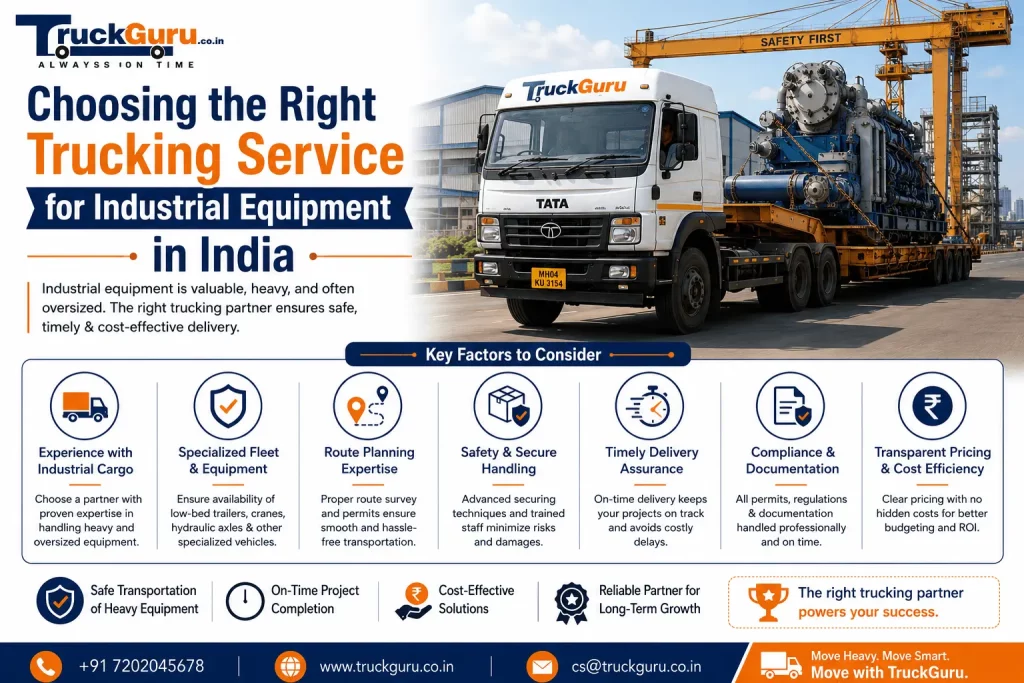
Transporting Factory Machinery Across India: Truck Selection, Permits, and Common Mistakes
Transporting industrial machinery is different from booking a standard FMCG dispatch. A 7-tonne CNC machine going from Coimbatore to Delhi is not the same problem as 50 cartons of packaged goods on the same route. The equipment carries significant value. It is sensitive to vibration and improper securing. It needs the right truck body dimensions. And a wrong decision — a vehicle too small for the load, a poorly secured machine that shifts in transit, a missing e-way bill at a state border — can cause damage that costs more than the freight itself.
Right Trucking Service: Quick Summary
Right Trucking Service: Looking for reliable industrial equipment transport in India? TruckGuru offers expert heavy haul services, route planning, permits &.
This guide is written for plant managers, procurement teams, equipment dealers, and B2B manufacturers who need to move industrial machinery and equipment across Indian states on intercity FTL routes. It covers what makes machinery transport genuinely different, how to match equipment weight to the right truck, what documentation applies, and what to look for in a trucking partner.
Why Industrial Equipment Transport Requires More Attention
Standard freight — packed goods, FMCG cartons, textile rolls — fills a truck body with cargo that is relatively forgiving. Individual items are small. The load is distributed reasonably across the floor. If one box shifts, it does not materially affect the rest.
Industrial machinery changes each of these assumptions. A single piece of equipment may weigh 4-8 tonnes and occupy most of a truck’s available floor space. Its weight concentrates at specific points rather than being distributed across the body. It cannot be stacked. And certain categories — CNC machines, hydraulic presses, sensitive measuring instruments, industrial motors — contain components that are damaged by vibration, impact, or improper angle during transport.
The result is that industrial equipment transport rewards preparation in ways that standard freight does not. The right truck type, proper securing at dispatch, accurate e-way bill documentation, and a route that avoids the worst road conditions are not optional extras — they are the difference between equipment arriving intact and equipment arriving with damaged components that require expensive repair or replacement.
Matching Industrial Machinery to the Right Truck
The first decision in any industrial machinery move is matching the equipment’s weight and dimensions to the correct vehicle. Indian FTL trucks run in five standard categories that cover most manufacturing equipment requirements:
- Tata Ace (up to 750 kg): instrument panels, control units, small motors, precision measuring equipment, spare parts for industrial machinery.
- Bada Dost / Chota Hathi (up to 1.5 tonnes): small compressors, pumps, laboratory equipment, industrial tools, packed machinery components.
- 14 ft Truck (up to 3.5 tonnes): medium-sized CNC machines, packaging machinery, generators up to 3.5T, industrial fans, heat exchangers.
- 20 ft Truck (up to 7 tonnes): larger CNC machining centres, injection moulding machines, industrial boilers, transformer units, compressor systems.
- 32 ft Container (up to 15 tonnes): heavy press machines, large industrial generators, printing machinery, multi-component factory equipment, bulk engineering goods.
The most common mistake in industrial machinery transport is booking a truck that is slightly too small and then overloading it. A 4-tonne machine on a 14ft truck rated at 3.5 tonnes creates a legal overloading problem at any weighbridge on NH-44 or NH-48. The fine, the potential vehicle detention, and the delay are all avoidable by booking the next size up.
Not sure which truck size fits your equipment? The truck size guide provides complete capacity and dimension specifications for all five vehicle types.
How to Secure Industrial Machinery for Road Transport
Vehicle loading is where most industrial machinery damage happens. Unlike palletised FMCG cargo that sits flat and stable, industrial equipment often has an irregular base, a high centre of gravity, and components that must not be stressed laterally.
Before the truck arrives, confirm the following with your dispatch team:
- Tie-down points: the equipment must have identifiable structural points suitable for lashing straps. Tie-down through component arms, motors, or painted surfaces causes damage.
- Base preparation: if the machine does not sit flat on a standard truck floor, wooden blocking or skids need to be prepared before loading. Improvised solutions on the day of dispatch cause delays and security failures.
- Weight distribution: the total load must be distributed within the truck’s axle weight limits, not just within the overall payload. A 5-tonne machine concentrated at one end of a 20ft truck body creates an axle overloading problem even if the total weight is within limits.
- Protection from vibration: sensitive machines and electronic components may need vibration-damping materials between the base and the truck floor. This is particularly relevant for CNC equipment and precision instruments.
- Documentation at loading: photograph the machine condition, loading position, and securing method before the truck moves. This is your baseline if a damage claim becomes necessary.
Documentation for Industrial Machinery Transport
Every intercity industrial machinery move requires a specific set of documents to be prepared before the truck leaves your premises. Missing any of these can stop the shipment at a state border.
E-Way Bill
Mandatory for all consignments above Rs. 50,000 moving across state borders, and for intra-state movements above Rs. 50,000 in most states. For industrial machinery, the declared value almost always triggers this requirement. Key points:
- The e-way bill must be generated before the truck leaves the pickup location
- For interstate moves, generate with sufficient validity — at least 1 day of validity per 200 km is the standard formula, but check the exact rules for your distance
- The transporter ID and vehicle number must be correct on the e-way bill before dispatch
See the complete e-way bill guide for step-by-step generation instructions and validity calculation.
Tax Invoice or Bill of Supply
Required as supporting documentation for the e-way bill. The invoice must accurately state the machinery description, HSN code, declared value, and seller and buyer GST registration numbers.
Lorry Receipt (LR)
Generated at the point of dispatch by the transporter, this is the primary transport document. It records the consignor, consignee, origin, destination, goods description, weight, and truck details. On TruckGuru, the digital LR is generated automatically at booking confirmation.
Choosing the Right Trucking Partner for Industrial Machinery
Not every FTL transporter operates the same way when it comes to industrial equipment. These are the factors that matter: Transparent Pricing
Truck body condition and securing equipment
Industrial machinery requires a clean, flat truck body without floor damage that could create pressure points under a heavy load. Confirm before dispatch that the vehicle has adequate lashing rings or tie-down points for the load weight. A truck body with worn or missing tie-down points is not suitable for heavy machinery.
Driver familiarity with heavy load handling
A truck carrying a 10-tonne industrial machine behaves very differently from one carrying 10 tonnes of packed goods. Braking distances are longer. Cornering requires more care. A driver who handles industrial loads regularly understands these differences; one who does not may not.
Confirmed rate at booking
Industrial machinery moves are not the place for verbal quotes that change at the invoice. The rate agreed at booking should be the rate on the invoice after delivery — not subject to revision based on loading time, extra securing requirements, or other charges that were not in the original quote.
GPS tracking throughout transit
A manufacturing plant dispatching a machine worth Rs. 20 lakh or more on a two-day intercity move needs to know where it is at any point during transit. GPS tracking is not a premium feature for industrial equipment transport — it is a basic operational requirement.
Documentation support
A good trucking partner provides the vehicle number and transporter ID at booking confirmation, before the truck arrives — so your dispatch team can generate the e-way bill without a last-minute scramble. Digital LR generation at dispatch, not after delivery, is also important for high-value cargo tracking.
Practical Examples: Industrial Machinery FTL Transport
Example 1: Packaging machinery, Coimbatore to Delhi (2,100 km via NH-44)
Composite example based on documented patterns on the Coimbatore-Delhi corridor.
A packaging equipment manufacturer in Coimbatore was dispatching a 4.5-tonne packaging machine to a new production facility in Haryana. The buyer needed the machine installed within a 15-day window.
The freight team booked a 20ft truck (7-tonne capacity) with 25% headroom above the equipment weight — the right choice given the machine’s irregular base. The e-way bill was generated the evening before dispatch with the TruckGuru-provided transporter ID and vehicle number. The machine was secured using four-point lashing to the truck’s floor rings with wooden blocking under the base frame. GPS tracking confirmed the truck’s position twice daily through the 2,100 km route crossing Tamil Nadu, Karnataka, Andhra Pradesh, Telangana, Maharashtra, Madhya Pradesh, UP, and Haryana. The machine arrived in Haryana in 30 hours, within the installation window.
Example 2: Industrial pump batch, Jamnagar to Chennai (1,600 km via NH-48)
Composite example based on documented patterns on the Jamnagar-Chennai corridor.
A Jamnagar brass fittings and pump manufacturer was dispatching a batch of 6 industrial centrifugal pumps weighing 8.5 tonnes total to a buyer in Chennai’s Sriperumbudur industrial zone. The batch included both the pump units and control panels.
A 32ft container (15-tonne capacity) was booked with the control panels crated separately and the pump units secured individually to the floor. The 1,600 km route crossed Gujarat, Maharashtra, Karnataka, and Tamil Nadu — four state borders, each requiring a valid e-way bill entry. The freight arrived in Chennai intact with no component damage.
How TruckGuru Handles Industrial Equipment Transport
TruckGuru’s FTL network covers industrial machinery transport across 110+ cities for loads up to 15 tonnes. Every booking includes:
- Confirmed rate before dispatch — the rate on the freight calculator is the rate on your invoice after delivery
- Transporter ID and vehicle number provided at booking confirmation — for e-way bill generation before the truck arrives
- Digital LR generated at dispatch
- GPS tracking from pickup to delivery
- GST-compliant invoice after delivery
For machinery loads above 15 tonnes requiring specialised heavy transport, TruckGuru handles standard FTL transport only. Loads exceeding 15 tonnes require separate heavy arrangements. Check your rate on the freight calculator for your machinery weight and corridor.
Frequently Asked Questions
What truck size is right for transporting industrial machinery in India?
Match the truck to the machinery weight with 15-20% headroom: 14ft truck (up to 3.5 tonnes) for medium CNC machines and packaging equipment; 20ft truck (up to 7 tonnes) for larger machining centres and compressor systems; 32ft container (up to 15 tonnes) for heavy press machines and industrial generators. Never book the minimum-capacity truck for the load weight — always book the next size up to stay within legal limits and provide securing flexibility.
Is an e-way bill required for industrial machinery transport?
Yes. Industrial machinery typically exceeds Rs. 50,000 in declared value, which mandates an e-way bill for interstate moves under GST rules. The e-way bill must be generated before the truck leaves the pickup location, with the correct transporter ID and vehicle number. For moves crossing multiple states, generate sufficient validity based on the total distance.
What documentation is required for intercity industrial machinery transport in India?
You need: (1) GST invoice or bill of supply with accurate HSN code and declared value; (2) e-way bill generated before dispatch with correct transporter and vehicle details; (3) Lorry Receipt (LR) generated by the transporter at pickup. For high-value equipment, maintain a pre-loading condition report with photographs.
How do I secure industrial equipment in a truck for long-distance transport?
Identify structural tie-down points on the machine (not component arms or painted surfaces). Use rated lashing straps with appropriate working load limits. Prepare wooden blocking or skids if the machine does not sit flat on the truck floor. Distribute weight within axle limits, not just total payload. For vibration-sensitive equipment, use anti-vibration padding between the machine base and the truck floor.
What is the cost of transporting industrial machinery from Pune to Hyderabad?
A 20ft truck (7-tonne capacity) for a Pune to Hyderabad move (~570 km) runs approximately Rs. 27,000-29,500. Use the freight calculator for a confirmed rate on your specific date and machinery weight.
Conclusion
Industrial equipment transport in India requires preparation. The right truck size for the load weight, proper securing at the loading end, accurate e-way bill documentation before the truck moves, and a trucking partner who provides confirmed rates and GPS tracking throughout transit — these are the variables that determine whether a machinery move completes on schedule or creates delays and damage claims.
The manufacturer or plant manager who treats an industrial equipment move as a standard freight booking will occasionally be disappointed. The one who treats it as a distinct logistics task — with its own documentation requirements, loading needs, and vehicle selection criteria — rarely is. For confirmed rates on your route and machinery weight: freight calculator.
Call 72020 45678 or book online at truckguru.co.in. Confirmed rate, digital LR, GPS tracking, and GST invoice on every booking.

Related Reading
- Reduce Manufacturing Freight Costs: India Intercity Guide
- Reduce B2B Freight Costs in India: 25 Proven Strategies
- Ship-To GSTIN Mandate August 2026 — What Shippers Must Do
For current rules and official notifications, see the Ministry of Road Transport & Highways.